

Google AI


Modern Australian

Romy Ash’s novel imagines the next pandemic as an eerily beautiful mushroom disease

  • Written by: Jane Rawson, PhD Candidate, Creative Writing, University of Tasmania

Do you remember the very early days of the pandemic, before the freedom rallies, before even the vaccinations, when we were spraying boxes of muesli bars with Glen-20 in case that was how the germs were getting to us?

In those days, there was a feeling these lockdowns could perhaps save us from all the things wrong with the world. Emissions were way down. People were creating spontaneous collective musical experiences on the balconies of apartments. The canals of Venice ran clear. Maybe all it took was a deadly virus to make us change?

In the end, everything actually got worse and has continued to get worse. But that spirit is what animates Romy Ash’s eco-fiction novel, Mantle: the idea that a pathogen might make us wake up to ourselves; make us stop, think and change course.

What if we abandoned the idea of our separateness from nature? What if we embraced our porousness – “our bodies are hosts; we’re always living communally” – and treated ourselves as ecosystems, rather than individuals?
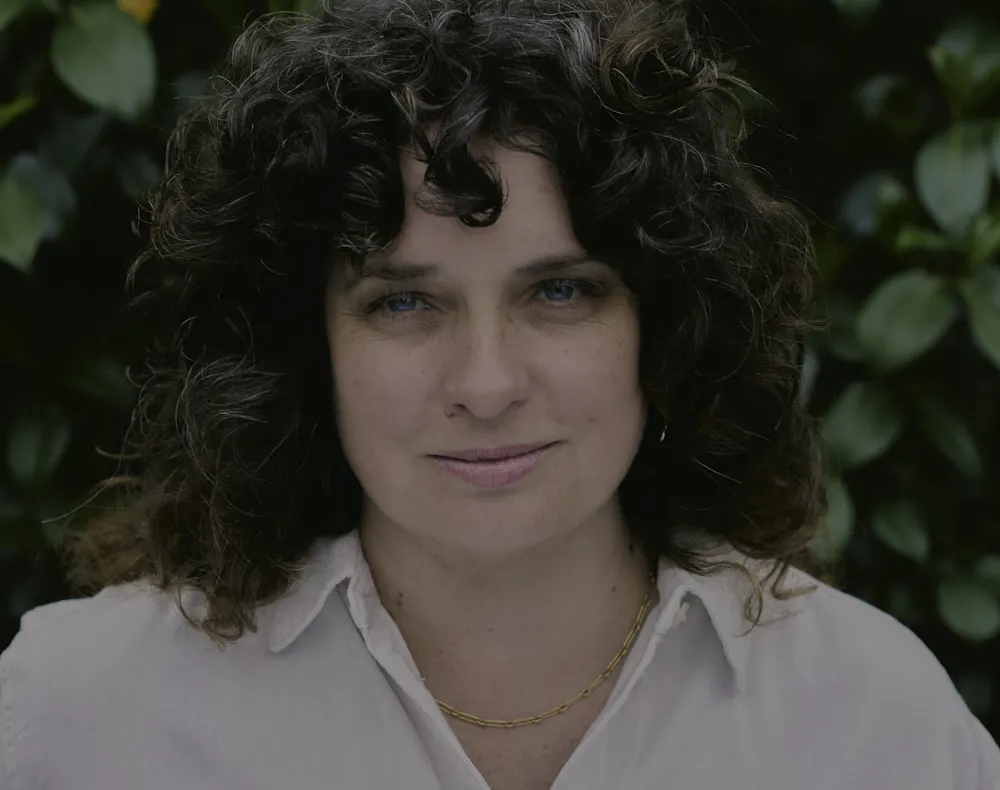
Romy Ash’s novel imagines the next pandemic as an eerily beautiful mushroom disease
Romy Ash’s Mantle explores the idea that a pathogen might make us wake up to ourselves – and change course. Lauren Bamford/Ultimo

Bad – but beautiful

When she published her first novel, Floundering, in 2012, 31-year-old Ash was touted as the next big thing, with photo spreads in Women’s Weekly and a swag of prizes, including shortlistings for the Miles Franklin, Commonwealth Book Prize and Prime Minister’s Literary Awards. This second novel brings depth, humour and wryness, gained in the life she’s lived in between.

Ursula, her main protagonist, is 50, single and childless. She and her mother, Delores, are the last remnants of their family. Ursula works as an academic in Melbourne, but she’s taken a break to spend a little time with her mother, who lives alone in a self-built home where “the windows are actually shower screens”, in the far south of Lutruwita/Tasmania. It overlooks the salmon farms made infamous by Richard Flanagan’s Toxic.

Ursula has come because she needs some quiet time to work on a geology paper, but she discovers her mother is dying and the paper is quickly forgotten. Are the growths in Delores’ lungs cancer?

Delores is independent, fractious, deeply embedded in the intricacies of small-town Tasmanian life. She has a landline phone and a composting toilet. She “bought here because it was the cheapest place to buy land, and this was the cheapest block”.

As death approaches, Delores declines any treatment and focuses instead on making sure Ursula has all the information she needs: the Corolla is serviced at the BMW mechanic with the mossy cars out front, the best lemons come “from the driveway with one goat” and “there is a list of businesses in town that are not be frequented under any circumstances”.

Ash’s understanding and representation of life in the southern reaches of the Huon Valley, particularly for a writer from “the mainland”, is exquisitely accurate: “Small slight, large grievance, long held. This is the fabric of the town.”

book cover - mushroom pattern
Delores leaves Ursula with a house full of hoarded junk and a rash, which turns out to be widespread among the locals – and entirely untreatable. In the throes of grief, Ursula hooks up with Toby, a diver at the salmon farms. She wakes the next morning to find their bodies connected by fine, sticky threads, “pale, translucent, a soft earthy white”, in the places where their skin was touching. It’s a new fungal pandemic. The borders close. News trickles in from the mainland. Whatever it is, it’s bad. But at the same time, it’s also beautiful: as they spend night after night together and wake each morning, ever more stuck, Ursula finds herself dreaming Toby’s dreams, learning new skills, losing her fear of the deep ocean. Then her body starts to fruit. No easy binaries Mantle is set in a near future, just far enough from now that Ursula can “stare out into the night, hoping for the flash of a swift parrot, even in the dark; even knowing they are extinct”. Unlike many contemporary eco-fiction novels, Mantle has no easy villains (not even, really, the salmon farms). It doesn’t let the reader feel self-righteous about their own environmental stance. Ash takes a nuanced, exploratory approach to conservation ethics and to our individual roles in the broader crisis of extinction, wildlife depletion and climate change. She introduces us to an old fisherman, Ernie, who has been breeding and planting endangered giant kelp; Ursula laughingly calls him a greenie. ‘I wouldn’t sit next to a greenie at the pub,’ he continues, ‘but I know giant kelp is a bloody nursery, and I know its disappearance is one reason why we aren’t pulling any lobster out of the sea.’‘I’m a greenie,’ I say. ‘It’s that and the salmon farms.’‘You’re not a greenie; you’re a city slicker.’I laugh. ‘Latte drinker,’ I say. Delores’ best friend Joc tells Ursula: I don’t eat meat. I do no harm. This is my philosophy. Those men who know the ocean is going to hold them, they’ve got a dive bag with a knife in it, they’ve got a spear gun, but they are also appreciating the wonder. Ash rejects the easy binaries that can come with seeing “the environment” theoretically, and investigates the ethics that develop among people who live among, and off, other animals. She recognises the complexities that occur when a place has high unemployment and low education, and where the best jobs can be found at the salmon farms; where being a “greenie” is a privilege attached to class. Next big thing Ursula is middle-aged, grumpy, horny, an expert in her field, scared of the ocean – and not, in any way, a nature lover or an outdoors type. She is far from your typical eco-fiction narrator, and her perspective welcomes in all kinds of readers. The novel is also replete with food, because while Ursula stops thinking about her profession – mudstone geography – almost as soon as the book begins, she never stops thinking about the joys of cooking and eating. Ash is a former food blogger and columnist for The Guardian: Mantle is crying out for an accompanying recipe collection (albeit one that’s mushroom-heavy). This is a novel that explores connection, porousness, the possibilities offered by permeability. “It asks for a numb heart, the patriarchy,” says Joc. Mantle asks, what if we could ask for the opposite; what if we could let ourselves feel? Authors: Jane Rawson, PhD Candidate, Creative Writing, University of Tasmania

Read more https://theconversation.com/romy-ashs-novel-imagines-the-next-pandemic-as-an-eerily-beautiful-mushroom-disease-281017

Understanding a dental implant Melbourne Treatment Plan

A dental implant Melbourne patients may consider is one option for replacing a missing tooth, but suitability depends on oral health, bone support a...

How 3PL Logistics Australia Supports Faster and More Efficient Supply Chains

Why Has 3PL Logistics Become Important for Growing Businesses?  Gone are the days when supply chains were simpler and in minimal quantity. Now, the...

Common Skin Concerns and Treatment Options Available in Melbourne

Skin concerns can develop gradually or become noticeable following changes in age, lifestyle, sun exposure or hormonal factors. Pigmentation, rednes...

Why a Code-Compliant Home Can Still Feel Uncomfortable

When people build or renovate a home, they usually expect that meeting current building requirements will also produce a comfortable place to live. ...

Breach of Contract in Business: What Are Your Options?

Contracts are essential to business relationships. They establish expectations, allocate responsibilities and provide a framework for delivering goods...

How Pest Control Companies Can Rank for the Problems Customers Search First

Introduction SEO for Pest Control needs to start with the customer’s problem. Most people do not search for pest services in a neat or technical wa...

What Are the Benefits of Renovating an Older Home in Sydney?

Sydney has plenty of character homes, from Federation cottages to mid-century brick homes. Renovating rather than rebuilding can preserve what makes t...

Pool and Deck Design: How to Plan the Perfect Outdoor Living Space for Your Sydney Home

For many Australians, the backyard is where life happens. Summer barbecues, weekend swims and long evenings outdoors are all part of the lifestyle, ...

Is Solar Pool Heating Worth It? What Sydney Homeowners Should Know

There's nothing quite like a backyard pool on a hot Sydney day. But once autumn rolls in, many pools sit unused for months because the water is simp...

Planning a Luxury House Move: A Week-by-Week Timeline for Prestige Sydney Homes

Selling or buying a prestige home is a major milestone. Whether it's a waterfront residence in Birchgrove, a grand Federation home in Haberfield or ...

Downsizing or Upgrading Your Caravan? Here's How to Sell It Without the Hassle

Selling a caravan can feel like a major task, especially when you are unsure about its value, paperwork, or how to find a buyer. Whether you are dow...

The Best Overseas Adventure Holidays for Australians Who Love the Outdoors

Australia offers no shortage of incredible outdoor experiences, but sometimes the best way to satisfy your sense of adventure is to head overseas. A...

Cape Town Wine Shuttle: Winelands Tasting & Tours

Embark on an unforgettable journey through the picturesque Cape Winelands, where world-class wines and breathtaking scenery await. Our Cape Town Win...

Metal Fabrication: Choosing Metal Fabrication Melbourne Services for Custom Projects

What Modern Metal Fabrication Involves From individual components to complete structures, metal fabrication brings together processes such as desig...

Why Giant Rats Tail Grass Keeps Coming Back After Spraying

Giant Rats Tail Grass (GRT) is one of the most frustrating pasture weeds for farmers and lifestyle property owners. You spray an infested area, see th...

When Custom Cardboard Boxes Make Sense for Your Business

Custom cardboard boxes can be useful when a standard carton does not fit a product, packing method or presentation requirement particularly well. A ...

Full-Height vs. Pop-Top Caravan: Which Is Better for Family Travel across WA?

A pop-top caravan is an excellent choice for travellers who want the comfort of a caravan without committing to a larger, bulkier setup. With a lowe...

Bottle Label Printing: Key Factors for a Professional Finish

Why the Printing Method Matters When businesses need packaging or printed containers developed for a particular application, the right supplier can m...

















