

'Stupid coronavirus!' In uncertain times, we can help children through mindfulness and play
- Written by: Ben Deery, Lecturer in Early Childhood Education, University of Melbourne
“Stupid coronavirus!” I heard my six-year-old mumble while talking in her sleep.
Earlier that day her swimming and basketball lessons were cancelled, a birthday party postponed, and she had to race with me between several meetings before the university campus shut down. “Stupid coronavirus indeed!”
Hearing this reminded me these are strange and worrying times for young children. While we need to look after ourselves and others, we also need to consider how all this is affecting our kids, and how we can help them through it.
Kids and anxiety
Australian research found child anxiety diagnoses almost doubled from 2008 to 2013. It’s difficult to say whether this is due to a true increase or we’re simply recognising anxiety better in children.
Feeling anxious or worried sometimes is a part of healthy development. But at times, children may feel more anxious or worried than usual.
Climate change, the bushfires, and COVID-19 may have contributed to and continue to fuel increased anxiety. We need research to better understand the effects these crises have had on children’s well-being.
We can support children during these times and also keep an eye out for when they might need more help than we can give. If their anxiety is interfering with typical childhood activities or family life, it could be time to see a GP, paediatrician or psychologist.
But there are many things you can do as a parent or caregiver.
Mindfulness for children?
Mindfulness is the regular and repeated act of directing our attention to the present moment. Mostly, our attention follows whatever is most interesting; mindfulness helps us to focus without judging ourselves when we can’t.
It’s commonly used to reduce stress, improve well-being, and address mental health, which it does reasonably well. In a broader sense, the goal of mindfulness is to help us to sit with our experiences whether they are pleasant, unpleasant, or somewhere in between.
Read more: 6 strategies to juggle work and young kids at home: it's about flexibility and boundaries
Mindfulness practices have become more popular over recent years. Many people practise mindfulness in their day-to-day lives, often using apps (though we need more research to explore the benefits of these). Mindfulness programs are also run in workplaces and other settings.
Large numbers of parents, teachers, and entire schools are also turning to mindfulness.
But what does the evidence say about mindfulness for children?
The evidence is mixed
A recent review of over 60 studies of school-based mindfulness programs involving preschool to secondary students suggested gains in social-emotional and cognitive skills.
The researchers didn’t observe similar gains in academic achievement or student behaviour. They noted the quality of research, much like that in adults, was not strong enough to make the claims many would like to make about the widespread benefits of mindfulness.
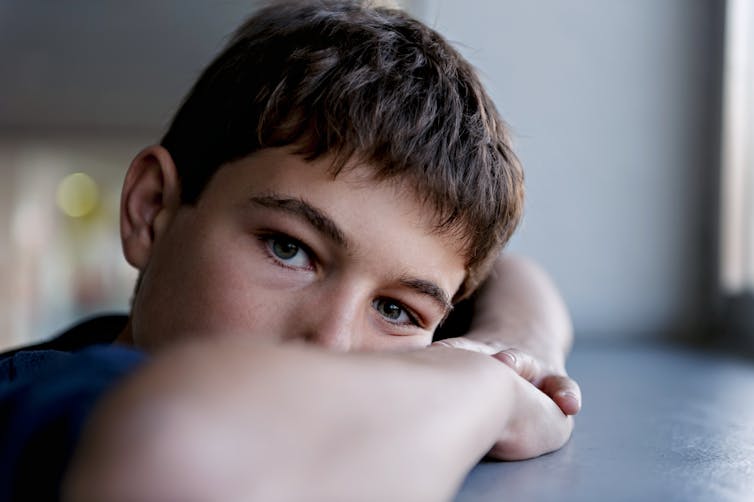 Children are not immune to the stress and anxiety many of us are feeling right now.
Shutterstock
Children are not immune to the stress and anxiety many of us are feeling right now.
Shutterstock
Short-term early childhood mindfulness programs and those delivered using audio-guided tracks have so far provided questionable results at best.
One small but promising study used classroom mindfulness activities (for example, listening to sounds), emotion coping skills (like “where in my body do I feel anger?”), and breathing techniques (such as breathing with a soft toy on the tummy).
At the end of the first year of this program, pre-schoolers displayed better learning skills. After two years, children displayed higher vocabularies and reading scores.
Read more: What is mindfulness? Nobody really knows, and that's a problem
Our own pilot work teaching pre-schoolers about mindfulness found benefits too. While there was little difference immediately after the intervention, three months later, children who learned mindfulness showed significant benefits to their mental well-being compared with those who didn’t.
Adapting mindfulness activities
Obviously, you can’t ask a five-year-old to sit still and focus on their breath for 45 minutes. Techniques commonly used in adults just won’t work with kids.
Mindfulness for children should be interactive, play-based, and focused on sensory and body awareness. It should use emotional vocabulary and sensory language (for example, talking about sounds, taste, textures and smells), be hands-on where possible, and most importantly, it should be fun.
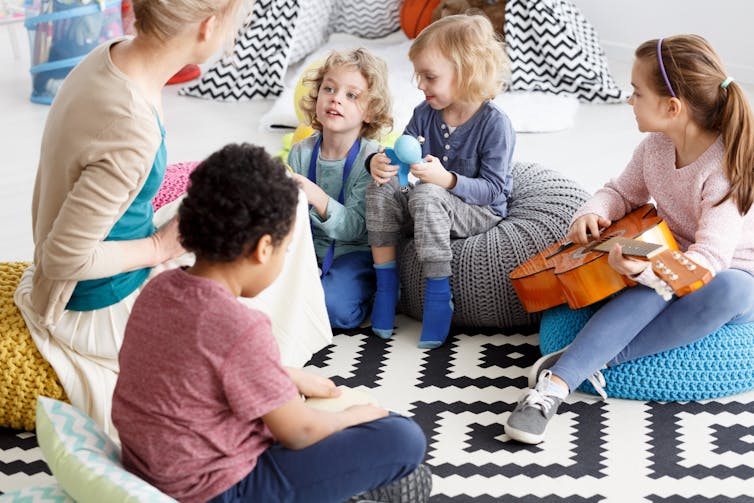 Mindfulness-based activities will look different for children than they do for adults.
Shutterstock
Mindfulness-based activities will look different for children than they do for adults.
Shutterstock
Given the lack of strong empirical evidence for mindfulness on its own for young children just yet, we should integrate aspects of mindfulness-based activities with other components.
Think playful learning about emotions, like colouring in where we notice certain feelings in our bodies, or drawing how music makes us feel. These activities take from other well-known psychological approaches called cognitive behaviour therapy and psycho-education.
3 mindfulness activities for kids
1. Belly breathing with a “buddy”
- find a favourite soft toy (with some weight is good), a plastic bath boat, or similar
- have your child lie down and place the object on their tummy
- get them to pay attention to it by looking and touching
- encourage them to focus on how the object moves up and down as they breathe (you can suggest calm and slow breathing might even put the toy or people in the boat to sleep)
- this activity can be great as part of bath time or getting ready for bed.
2. “Robot” child
- ask your child to pretend they are a robot lying on the ground
- use a remote control (you can make one from cereal box) and pretend to “shut-down” your child/robot’s body
- begin with their feet/legs, move up the body to arms/hands, before getting to the face/brain
- ask “robot” if they can still feel any “electricity” in that body part after it’s been shut down
- as your child gets better with this activity, you can get more detailed with robot body parts (for example, toes, fingers, noses, ears)
- a variation is to get your robot-child to tense and relax (and reset) each body part as you control it with your remote.
3. A mindful walk or “sensory countdown”
- go for a walk outside and try to notice or find: five different sounds, four matching colours, three different textures, two different smells
- add different sounds, sights, shapes, and textures to tick off on a bingo-style checklist
- this activity can be adapted for inside play.
Read more: 8 tips on what to tell your kids about coronavirus
Play School will air a special episode “Mindfully Me” on Monday April 6 at 9am AEST on ABC Kids and the ABC Kids app. The program is accompanied by family and educator notes online.
Authors: Ben Deery, Lecturer in Early Childhood Education, University of Melbourne


















