De-extinction company says it’s made an artificial egg – if true, it could help save living species
- Written by: Nic Rawlence, Associate Professor in Ancient DNA, University of Otago
Today’s announcement by Texas-based de-extinction company Colossal Biosciences about a successful hatching of chicks from an artificial egg would represent a major innovation, if the claims can be verified.
The company says its artificial egg supports the full development of bird embryos outside a biological eggshell, without the requirement for supplemental oxygen. The work is part of its plan to “de-extinct” birds, including the giant moa and dodo.
Colossal’s artificial egg could be groundbreaking science and deliver a useful tool for conservation. But its announcement and slick video include no data or peer-reviewed scientific publications, making it difficult to independently assess the claim.
Artificial egg technology, which involves transferring and growing a developing chick embryo outside a natural eggshell, has been around since the 1980s. Live birds have been hatched from these systems before and grown to adulthood.
The technology is currently used for research purposes such as studying how embryos develop, how tumours grow, and to create genetically modified chickens. It also has applications for drug and vaccine development.
But several stumbling blocks to the widespread use of artificial eggs persist. To improve hatching efficiency, pure oxygen needs to be directly supplied to the developing embryo. This is a double-edged sword because it can also affect chick viability.
Colossal claims to have solved this problem by replacing the hard eggshell and membrane separating the yolk from the shell. Its version is based on the key innovations of an open, latticed half-shell and a transparent, silicone-based membrane that allows oxygen to freely diffuse from the air into the developing embryo.
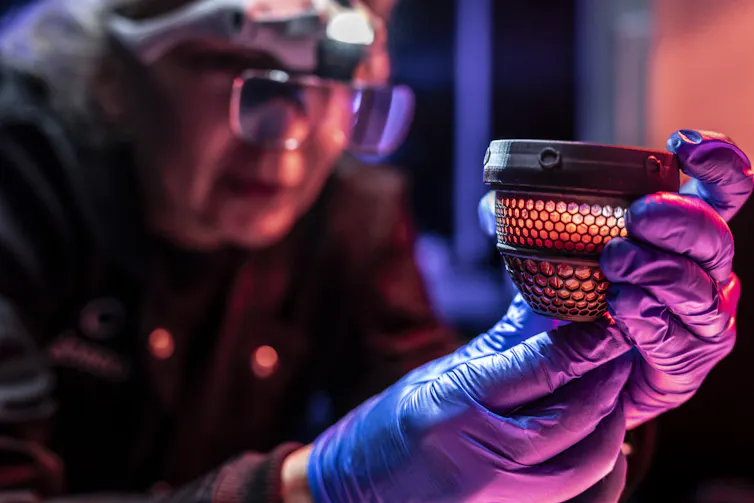
The company’s plan is to transfer a fertilised embryo and yolk from a real egg to their artificial egg, which would then be housed in incubators. Embryo development would be observed directly through the transparent membrane, as in other artificial systems.
A gene-edited emu
Colossal is planning to genetically modify an emu genome to look more like that of a moa (as they did with grey wolves and dire wolves), create an embryo inside an emu egg, and then bring it to term using this new artificial egg.
The technology could also be used in Colossal’s attempts to genetically engineer a Nicobar pigeon to look more like a dodo.
Key to Colossal’s goal is that its artificial egg could be scaled in size.
However, this still requires a fertilised embryo and yolk. Given the large size differences between chicken eggs and emu (up to 12 times bigger) and giant moa (up to 80 times bigger), there is not enough yolk and egg white in any living birds’ eggs to support the development of a giant moa chick.
An egg yolk is a single cell. It will not be as simple as injecting extra yolk into this fragile cell to make it giant.
Bird embryo development is a complex process, unique to each species. A lot happens in an egg and only time will tell whether this new technology reflects natural processes and produces healthy individuals.
But as our work on other extinct species shows, there is also widespread Māori and public opposition in New Zealand to the company’s plans to “de-extinct” the moa for an ecotourism venture.
A potential conservation tool
The company claims its artificial egg technology “has broad applications for the conservation of threatened species”.
Artificial egg technology requires considerable amounts of funding, which Colossal has mobilised from private sources. This is funding that would not have otherwise been available for conservation.
One area where it could make a significant difference is the captive breeding of critically endangered species (such as kākāpō, kakī black stilt and pukunui southern dotteral) for reintroduction into the wild. This is especially true for long-lived and slow-breeding species which tend to produce fewer eggs.
For example, eggs damaged by inexperienced new parents, misadventure or adverse weather events could be rescued into artificial eggs to help developing chicks to survive.
When combined with genome engineering techniques, the use of artificial eggs could help to reintroduce lost genetic diversity or make birds resistant to diseases. The technology may also be able to reverse the impacts of inbreeding on low hatching success in some species.
However, for critically endangered birds with few natural eggs, the development of transgenic birds would be necessary to produce enough chicks.
For example, chickens could provide sperm and egg cells containing genetically modified DNA from a different species. After mating, the fertilised embryo and yolk could be transferred to the artificial egg.
Ethical questions remain about whether such steps should be taken, even if technologically possible.
The use of artificial egg technology in conservation, especially in combination with genome engineering and transgenic birds, would require transparent and increased levels of engagement with Indigenous communities as the kaitiaki (guardians) of endangered species.
It is also vital this technology (and conservation in general) is not privatised. If Colossal’s artificial egg technology is to make a meaningful difference to saving species from extinction, it must be available to conservation organisations in the public sector.
If the technology lives up to the hype, it won’t be a silver bullet or panacea to stopping species declines, but it might just help. In the short term at least, saving species from extinction will still come down to predator control and habitat restoration.
Authors: Nic Rawlence, Associate Professor in Ancient DNA, University of Otago