

Guide to the Classics: Albert Camus' The Plague
- Written by: Matthew Sharpe, Associate Professor in Philosophy, Deakin University
Some weeks ago, I got an email from a student who had returned to Northern Italy over Christmas to see family.
Unable to return to Australia, they were in lockdown. The hospitals were filling up fast, as COVID-19 began to spiral out of control. Sales of Albert Camus’ 1947 novel The Plague (La Peste) were spiking. Everyone was buying it.
Rereading The Plague over these past weeks has been an uncanny experience. Its fictive chronicle of the measures taken in the city of Oran against a death-dealing disease that strikes in 1940 sometimes seemed to blur into the government announcements reshaping our lives.
Oran is a city like anywhere else, Camus’ narrator tells us:
Our citizens work hard, but solely with the object of getting rich. Their chief interest is in commerce, and their chief aim in life is, as they call it, ‘doing business’.
Like people anywhere else, the Oranians are completely unprepared when rats begin emerging from the sewers to die in droves in streets and laneways. Then, men, women and children start to fall ill with high fever, difficulties breathing and fatal buboes.
The people of Oran initially “disbelieved in pestilences”, outside of the pages of history books. So, like many nations in 2020, they are slow to accept the enormity of what is occurring. As our narrator comments drily: “In this respect they were wrong, and their views obviously called for revision.”
The numbers of afflicted rise. First slowly, then exponentially. By the time the plague-bearing spring gives way to a sweltering summer, over 100 deaths daily is the new normal.
Read more: Coronavirus weekly: as the world stays at home, where is the pandemic heading?
Emergency measures are rushed in. The city gates are shut, and martial law declared. Oran’s commercial harbour is closed to sea traffic. Sporting competitions cease. Beach bathing is prohibited.
Soon, food shortages emerge (toilet paper, thankfully, is not mentioned). Some Oranians turn plague-profiteers, preying on the desperation of their fellows. Rationing is brought in for basic necessities, including petrol.
Meanwhile, anyone showing symptoms of the disease is isolated. Houses, then entire suburbs, are locked down. The hospitals become overwhelmed. Schools and public buildings are converted into makeshift plague hospitals.
A convention centre in London has been transformed into a 4,000-bed hospital.Our key protagonists, Dr Rieux and his friends Tarrou, Grand and Rambert, set up teams of voluntary workers to administer serums and ensure the sick are quickly diagnosed and hospitalised, often amongst harrowing scenes.
In these circumstances, fear and suspicion descend “dewlike, from the greyly shining sky” on the population. Everyone realises that anyone – even those they love – could be a carrier.
Come to think of it, so could each person themselves.
The failure of the governors to consistently impose “social distancing” is shown up spectacularly in the novel’s most picturesque scene. The lead actor in a rendition of Gluck’s Orpheus and Eurydice collapses onstage, “his arms and legs splayed out under his antique robe”.
Terrified patrons flee the darkened underworld of the opera house, “wedged together in the bottlenecks, and pouring out into the street in a confused mass, with shrill cries of dismay”.
Arguably the most telling passages in The Plague today are Camus’ beautifully crafted meditative observations of the social and psychological effects of the epidemic on the townspeople.
Epidemics make exiles of people in their own countries, our narrator stresses. Separation, isolation, loneliness, boredom and repetition become the shared fate of all.
In Oran, as in Australia, places of worship go empty. Funerals are banned for fear of contagion. The living can no longer even farewell the many dead.
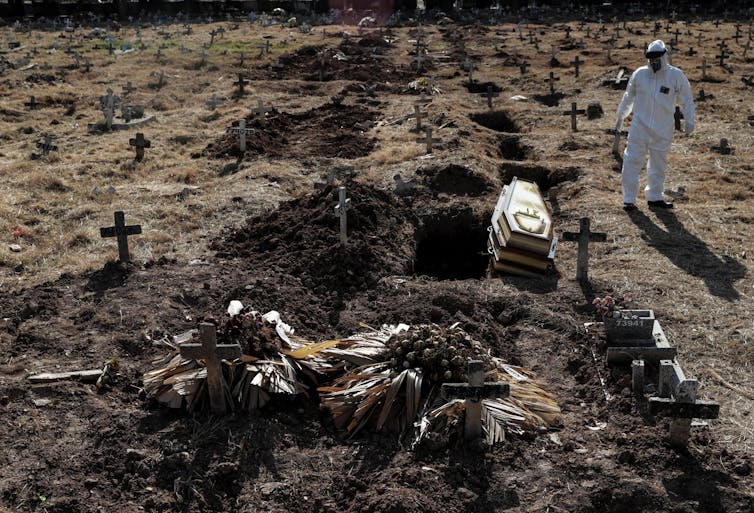 A gravedigger in Rio de Janeiro, Brazil, April 1 2020. Around the world, mass graves are being dug and funerals are being banned.
Antonio Lacerda/EPA
A gravedigger in Rio de Janeiro, Brazil, April 1 2020. Around the world, mass graves are being dug and funerals are being banned.
Antonio Lacerda/EPA
Camus’ narrator pays especial attention to the damages visited by the plague upon separated lovers. Outsiders like the journalist Rambert who, by chance, are marooned inside Oran when the gates shut are “in the general exile […] the most exiled”.
Today’s world knows many such “travellers caught by the plague and forced to stay where they were, […] cut off both from the person(s) with whom they wanted to be and from their homes as well”.
Multiple allegories
Camus’ prescient account of life under conditions of an epidemic works on different levels. The Plague is a transparent allegory of the Nazi occupation of France beginning in spring 1940. The sanitary teams reflect Camus’ experiences in, and admiration for, the resistance against the “brown plague” of fascism.
Camus’ title also evokes the ways the Nazis characterised those they targeted for extermination as a pestilence. The shadow of the then-still-recent Holocaust darkens The Plague’s pages.
When death rates become so great that individual burials are no longer possible – as in scenes we are already seeing – the Oranaise dig collective graves into which:
the naked, somewhat contorted bodies were slid into a pit almost side by side, then covered with a layer of quicklime and another of earth […] so as to leave space for subsequent consignments.
When this measure fails to keep up with the weight of these “consignments”, as with the genocidal actions of the Einzatsgruppen, “the old crematorium east of the town” is repurposed. Closed streetcars filled with the dead are soon rattling along the old coastal tramline:
Thereafter, […] when a strong wind was blowing […] a faint, sickly odour coming from the east remind[ed] them that they were living under a new order and that the plague fires were taking their nightly toll.
Camus’ plague is also a metaphor for the force of what Dr Rieux calls “abstraction” in our lives: all those impersonal rules and processes which can make human beings statistics to be treated by governments with all the inhumanity characterising epidemics.
For this reason, the enigmatic character Tarrou identifies the plague with people’s propensity to rationalise killing others for philosophical, religious or ideological causes. It is with this sense of plague in mind that the final words of the novel warn:
that the plague bacillus never dies or disappears for good; that it can lie dormant for years and years in furniture and linen-chests; that it bides its time in bedrooms, cellars, trunks, and bookshelves; and that perhaps the day would come when, for the bane and the enlightening of men, it would rouse up its rats again and send them forth to die in a happy city.
Ordinary hope
There is nevertheless truth in the description of Camus’ masterwork as a “sermon of hope”. In the end, the plague dissipates as unaccountably as it had begun. Quarantine is lifted. Oran’s gates are reopened. Families and lovers reunite. The chronicle closes amid scenes of festival and jubilation.
Camus’ narrator concludes that confronting the plague has taught him that, for all of the horrors he has witnessed, “there are more things to admire in men than to despise”.
Unlike some philosophers, Camus became increasingly sceptical about glorious ideals of superhumanity, heroism or sainthood. It is the capacity of ordinary people to do extraordinary things that The Plague lauds. “There’s one thing I must tell you,” Dr Rieux at one point specifies:
there’s no question of heroism in all this. It’s a matter of common decency. That’s an idea which may make some people smile, but the only means of fighting a plague is common decency.
It is such ordinary virtue, people each doing what they can to serve and look after each other, that Camus’ novel suggests alone preserves peoples from the worst ravages of epidemics, whether visited upon them by natural causes or tyrannical governments.
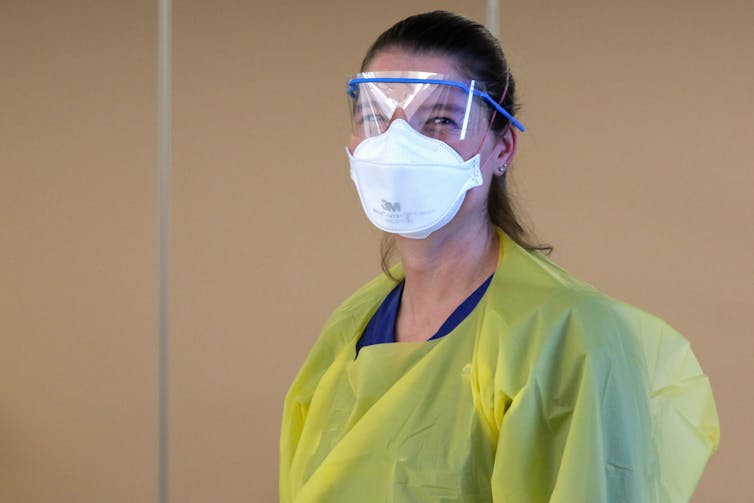 The heroes of Camus’ The Plague are the health workers.
Kelly Barnes/AAP
The heroes of Camus’ The Plague are the health workers.
Kelly Barnes/AAP
It is therefore worth underlining that the unheroic heroes of Camus’ novel are people we call healthcare workers. Men and women, in many cases volunteers, who despite great risks step up, simply because “plague is here and we’ve got to make a stand”.
It is also to these people’s examples, The Plague suggests, that we should look when we consider what kind of world we want to rebuild after the gates of our cities are again thrown open and COVID-19 has become a troubled memory.
Authors: Matthew Sharpe, Associate Professor in Philosophy, Deakin University
Read more https://theconversation.com/guide-to-the-classics-albert-camus-the-plague-134244


















