

Islamic State schooled children as soldiers – how can their 'education' be undone?
- Written by: James S. Morris, PhD Student in International Security and Child Rights, The University of Queensland
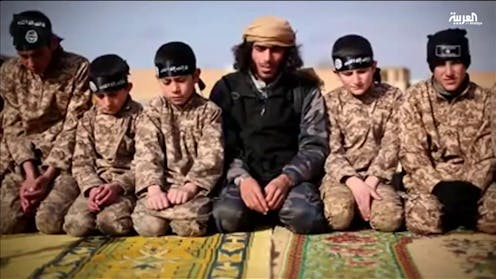
Over the last few years, the Islamic State (IS) terror group has shocked the world with its gruesome public spectacles. Especially abhorrent to our moral sensibilities is its overt use of children as frontline fighters, suicide bombers and propaganda tools.
From macabre hide-and-seek exercises, in which children hunt and kill enemy prisoners in specially constructed mazes, to the mass execution and decapitation of adult soldiers, young people living under IS have been indoctrinated and encouraged to engage in violence.
Meanwhile, IS’s quasi-government instituted an education system explicitly aimed at indoctrinating and weaponising the children living under it.
Mathematics was practised by determining how many more fighters IS has than an opposing force. Chemistry was taught by discussion of methods of gas inhalation. And physical education focused on the correct body positions for firing various weapons.
Their education has been compounded by the retaliatory and sometimes excessive violence of the vast array of forces committed to destroying IS. Through this, children have been exposed to horrific violence on a daily basis – thus generating trauma and, undoubtedly, genuine long-term grievances.
How IS’s use of child soldiers differs
There is a fundamental difference between IS’s use of child soldiers and the practice elsewhere.
IS hasn’t just recruited child soldiers. It systematically militarised the education systems of captured Iraqi and Syrian territory to turn the region’s children into ideological timebombs.
These children, saturated in IS’s particular brand of violent and uncompromising “religious” instruction from about the age of five, were trained in the use of small arms before their teenage years. They constitute a new challenge for the international community.
IS’s state-building efforts appear to have been thwarted for now. But saving the children exposed and potentially indoctrinated in its ideology is key to avoiding further terror attacks in the West, tackling the root causes of regional upheaval, and working toward a future where children play instead of fight, and schools teach instead of drill.
What children have been taught
Military activity, superiority based on IS’s interpretation of Islam, and the need to defeat unbelievers are embedded in its school textbooks.
Various videos, produced both through journalistic investigation and by IS itself, show the more practical side of education under the group’s rule. Children are taught how to fire small arms and use hand grenades.
Although IS extensively forced children into its ranks, many joined voluntarily – with or without their families’ blessing. But, in the long term, it doesn’t matter whether a child is forcibly recruited or not. And this is the matter of gravest concern.
IS’s primary concern is building and maintaining the children’s loyalty. The phrase “cubs of the caliphate” is a microcosm of how it views them. Cubs are unruly, ill-disciplined and dependent on strong (sometimes violent) guidance from their elders.
However, with time, resources and patience they can turn into a generation of fighters and idealists who will foster IS’s ideology even if its current military setbacks prove terminal.
Programs need to take a new approach
Disarmament, demobilisation and rehabilitation programs designed to reintegrate child soldiers into post-conflict society have significantly progressed in recent years. This represents the continued evolution of military-civil partnerships in the quest for a conflict-free world.
But IS’s systematic and meticulous radicalisation of an entire region’s children presents new challenges.
It’s understandable to interpret IS’s rapid retreat as its death knell, and thereby view traditional rehabilitation techniques as an appropriate remedy for yet another region recovering from violence at the hands of a radical armed insurgency. However, this conflict has been highly unusual in its pace, tactics and impacts – both now and potentially in the future.
So, we must revisit the fundamental assumptions of what it means to inspire peace within a society. This starts with the children subjected to the ideological extremism of IS and other armed groups.
If there is to be sustainable peace in the areas liberated from IS control, rehabilitation programs must be viewed as a community-wide process. Even if children did not directly participate in IS activities, the group has moulded their worldview and underpinning life philosophies.
Such philosophies may be especially productive in a region where resentment of perceived foreign – Western – interference and exploitation is long-lasting and multifaceted.
What can be done
The regular processes of identifying child combatants, disarming and reintegrating them into their communities through rehabilitation (such as by ensuring they are physically and mentally capable of rejoining their communities) and reconciliation (developing peace, trust and justice among children and their communities) are all necessary. But they are vastly insufficient in this instance.
Rarely has there been such systematic youth radicalisation and militarisation. So, the international response must be equally far-reaching and methodical.
Rapid reimplementation and revisiting of pre-IS school curricula is of the highest priority. National and local governments should ensure children are shielded from further recruitment by instituting a curriculum drawn from principles of tolerance and inclusion.
It’s essential to develop locally run initiatives to measure the level of radicalisation among a community’s children and to construct child-friendly spaces for young people to socialise, reconnect with their wider community and “unlearn” what they adopted under IS.
Such practices will help to heal the wounds of IS occupation and ensure the potential for cyclical violence is removed. Done right, it will hinder IS’s ability to rise anew.
Authors: James S. Morris, PhD Student in International Security and Child Rights, The University of Queensland


















