

Why coronavirus emerges in clusters, and how New Zealand plans to eliminate outbreaks after lockdown
- Written by: Arindam Basu, Associate Professor, Epidemiology and Environmental Health, University of Canterbury
After four weeks of some of the world’s strictest lockdown conditions, New Zealand now records much higher numbers of people who have recovered from COVID-19 than new infections.
In its April 23 update, the Ministry of Health reported only three new cases – though another two people died, taking the death toll to 16. The total number of cases is 1451, with more than a thousand people having now recovered from the illness.
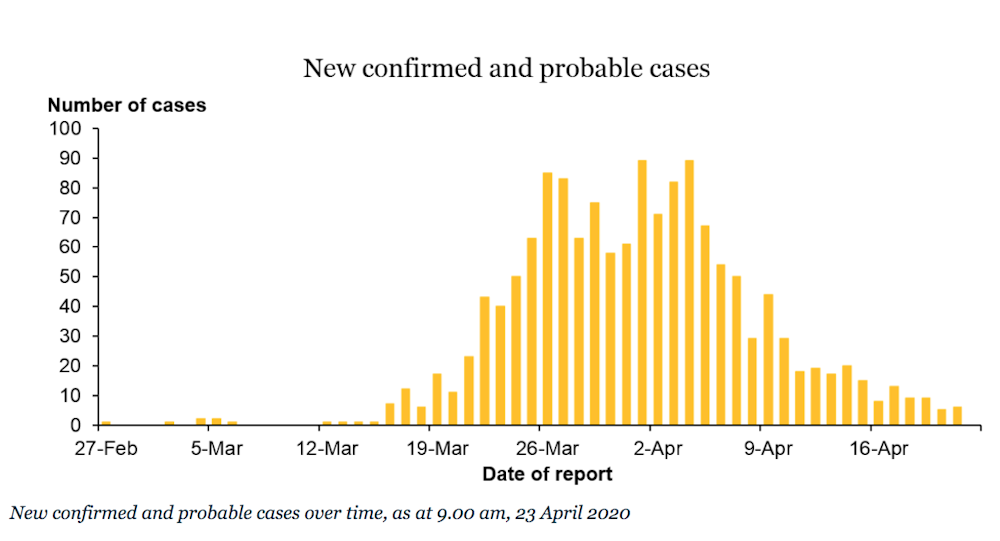 April 23 update, New Zealand's Ministry of Health
As New Zealand prepares to ease lockdown conditions from April 28, it can expect new clusters of infections to emerge, as has been happening in northeast parts of China.
But it plans to continue using a combination of testing and contact tracing to stamp out the spread of COVID-19.
Read more:
Coronavirus weekly: as virus numbers peak, governments are charting the path out of lockdown
How new clusters can emerge – even with closed borders
New Zealand moves on to two weeks of level 3 lockdown from Tuesday, and people who cannot work from home will start returning to their workplaces, if they can maintain social distancing measures.
Border controls will remain in place indefinitely to avoid new introductions of coronavirus.
Prime Minister Jacinda Ardern has said New Zealand will continue to pursue its goal of elimination with a strategy that differs from most other countries.
Success doesn’t mean zero COVID-19 cases. It means zero tolerance, which means that as soon as we know we have a case, we go in straight away, we’re testing around that person, we’re isolating them […] we do our interviews and contact trace to find all the people who have been in contact with them while they may have passed it on, and we ask them to isolate. That’s how we keep stamping out COVID cases.
New Zealand now has 16 significant clusters, with more than 90 people associated with the two largest of them. People in each cluster are from different households, but they are connected through transmission.
April 23 update, New Zealand's Ministry of Health
As New Zealand prepares to ease lockdown conditions from April 28, it can expect new clusters of infections to emerge, as has been happening in northeast parts of China.
But it plans to continue using a combination of testing and contact tracing to stamp out the spread of COVID-19.
Read more:
Coronavirus weekly: as virus numbers peak, governments are charting the path out of lockdown
How new clusters can emerge – even with closed borders
New Zealand moves on to two weeks of level 3 lockdown from Tuesday, and people who cannot work from home will start returning to their workplaces, if they can maintain social distancing measures.
Border controls will remain in place indefinitely to avoid new introductions of coronavirus.
Prime Minister Jacinda Ardern has said New Zealand will continue to pursue its goal of elimination with a strategy that differs from most other countries.
Success doesn’t mean zero COVID-19 cases. It means zero tolerance, which means that as soon as we know we have a case, we go in straight away, we’re testing around that person, we’re isolating them […] we do our interviews and contact trace to find all the people who have been in contact with them while they may have passed it on, and we ask them to isolate. That’s how we keep stamping out COVID cases.
New Zealand now has 16 significant clusters, with more than 90 people associated with the two largest of them. People in each cluster are from different households, but they are connected through transmission.
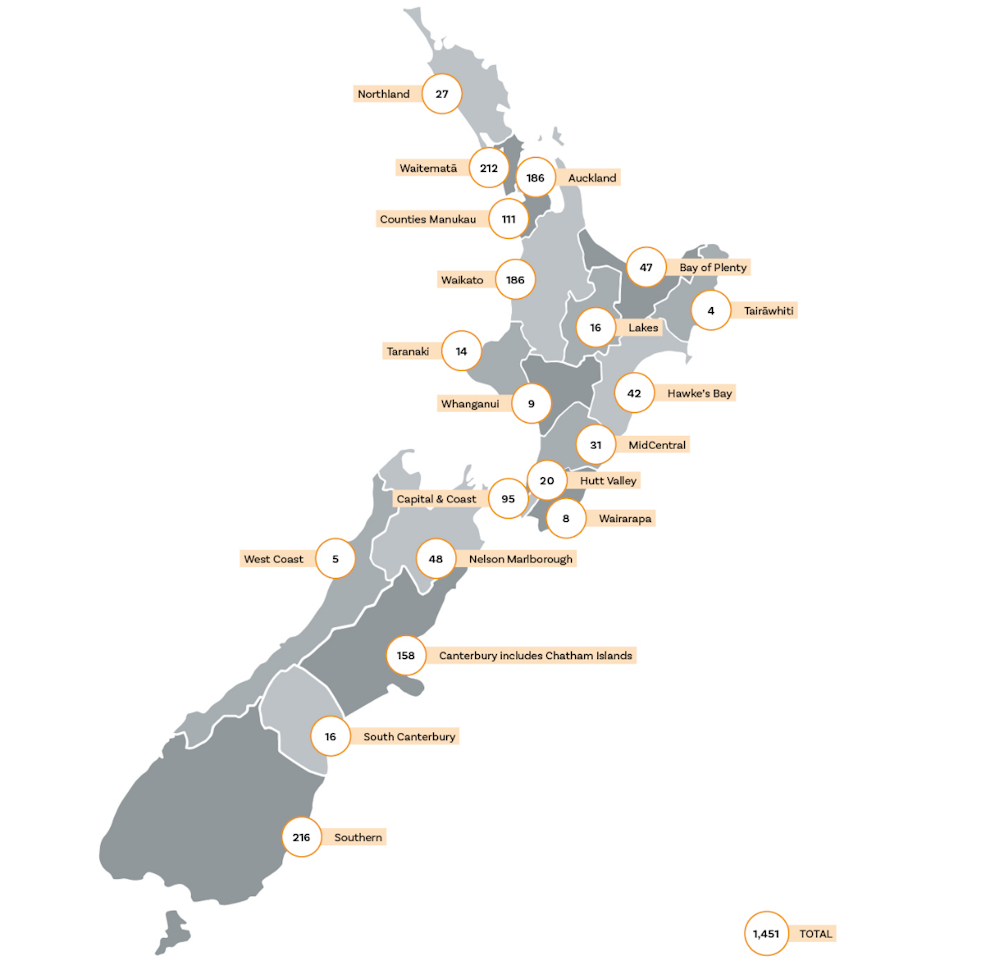 The location of identified COVID-19 cases across New Zealand, shown by district health board area, as of April 23.
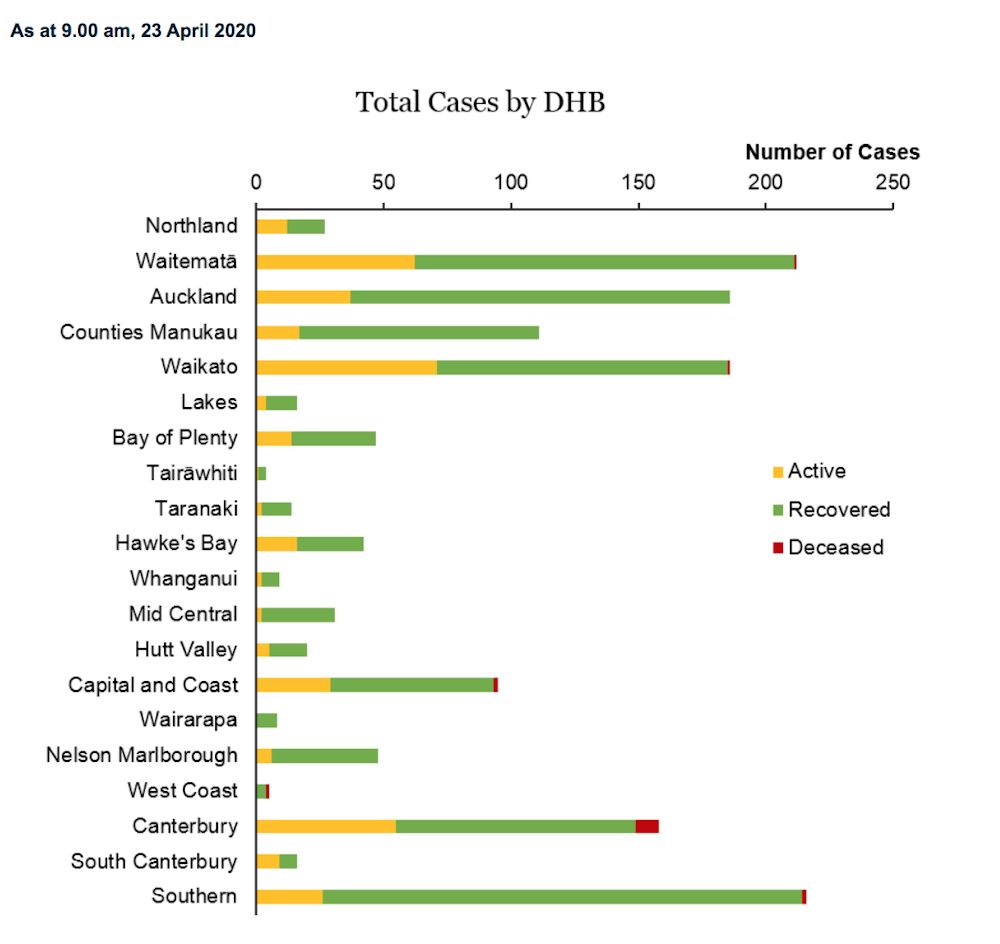 As of April 23, 1,065 of New Zealand’s 1,451 COVID-19 cases had recovered, while 16 people had died. This shows total cases by district health board area.
Clusters are the starting points of epidemics or local outbreaks. Epidemiologists think of clusters like networks through which an infection can propagate. If different networks are connected by one or more common members who can travel from one network to another, clusters can join and grow.
Likewise, if networks are kept isolated from each other, the chain of transmission is broken. This is how lockdowns work. Each of our household bubbles is a small network, and as long as we can maintain that bubble without connecting with others outside of our own, we prevent new clusters.
But new cases have continued to emerge because:
even under stringent lockdown conditions and self-isolation, people still need to access public places such as supermarkets where they are at risk of exposure
COVID-19 has a variable infectious period and many people don’t show symptoms but can still infect others
some people within clusters were infected before lockdown started, and continued to infect others within small networks.
Why contact tracing is crucial beyond lockdown
When lockdown conditions ease, people who return to work and children who go back to school will move between networks. This will increase the risk of new infections, but testing has ramped up significantly during the weeks under level 4 conditions and will continue to increase to capture new infections. In some regions, sentinel community testing was carried out to identify any symptom-free cases.
Testing laboratories now process thousands of COVID-10 tests every day, with a record 6480 tests carried out on April 22. The total number of tests is now 101,277.
At the same time, contact tracing has also increased to identify different network structures and clusters. Contact tracers start with an “index” person and track everyone who was connected to that individual to interrupt any forward transmission as the contacts are isolated.
Read more:
Coronavirus contact-tracing apps: most of us won’t cooperate unless everyone does
When the COVID-19 outbreak began in New Zealand, the capacity for contact tracing was limited, but rapid case detection, contact tracing and isolation now has over 90% efficacy against COVID-19 at the population level.
Contact tracing is important for mapping the networks of infected people. “Super spreaders” – individuals who move between clusters – can be identified quickly and their movements tracked. This will help to contain any new clusters.
Manual contact tracing for an outbreak on the scale of COVID-19 needs to be supplemented with digital tools such as Flutracker. The Ministry of Health is also considering a contact tracing app like Singapore’s TraceTogether to prevent large clusters.
With continued contact tracing, we expect the number of new cases to remain low and with border controls preventing imported cases, any emerging new clusters should be able to be detected and contained rapidly. This intervention is central to COVID-19 elimination in New Zealand.
As of April 23, 1,065 of New Zealand’s 1,451 COVID-19 cases had recovered, while 16 people had died. This shows total cases by district health board area.
Clusters are the starting points of epidemics or local outbreaks. Epidemiologists think of clusters like networks through which an infection can propagate. If different networks are connected by one or more common members who can travel from one network to another, clusters can join and grow.
Likewise, if networks are kept isolated from each other, the chain of transmission is broken. This is how lockdowns work. Each of our household bubbles is a small network, and as long as we can maintain that bubble without connecting with others outside of our own, we prevent new clusters.
But new cases have continued to emerge because:
even under stringent lockdown conditions and self-isolation, people still need to access public places such as supermarkets where they are at risk of exposure
COVID-19 has a variable infectious period and many people don’t show symptoms but can still infect others
some people within clusters were infected before lockdown started, and continued to infect others within small networks.
Why contact tracing is crucial beyond lockdown
When lockdown conditions ease, people who return to work and children who go back to school will move between networks. This will increase the risk of new infections, but testing has ramped up significantly during the weeks under level 4 conditions and will continue to increase to capture new infections. In some regions, sentinel community testing was carried out to identify any symptom-free cases.
Testing laboratories now process thousands of COVID-10 tests every day, with a record 6480 tests carried out on April 22. The total number of tests is now 101,277.
At the same time, contact tracing has also increased to identify different network structures and clusters. Contact tracers start with an “index” person and track everyone who was connected to that individual to interrupt any forward transmission as the contacts are isolated.
Read more:
Coronavirus contact-tracing apps: most of us won’t cooperate unless everyone does
When the COVID-19 outbreak began in New Zealand, the capacity for contact tracing was limited, but rapid case detection, contact tracing and isolation now has over 90% efficacy against COVID-19 at the population level.
Contact tracing is important for mapping the networks of infected people. “Super spreaders” – individuals who move between clusters – can be identified quickly and their movements tracked. This will help to contain any new clusters.
Manual contact tracing for an outbreak on the scale of COVID-19 needs to be supplemented with digital tools such as Flutracker. The Ministry of Health is also considering a contact tracing app like Singapore’s TraceTogether to prevent large clusters.
With continued contact tracing, we expect the number of new cases to remain low and with border controls preventing imported cases, any emerging new clusters should be able to be detected and contained rapidly. This intervention is central to COVID-19 elimination in New Zealand.
Authors: Arindam Basu, Associate Professor, Epidemiology and Environmental Health, University of Canterbury


















