

Disasters expose gaps in emergency services' social media use
- Written by: Tan Yigitcanlar, Associate Professor of Urban Studies and Planning, Queensland University of Technology
Australia has borne the brunt of several major disasters in recent years, including drought, bushfires, floods and cyclones. The increasing use of social media is changing how we prepare for and respond to these disasters. Not only emergency services but also their social media are now much-sought-after sources of disaster information and warnings.
We studied Australian emergency services’ social media use in times of disaster. Social media can provide invaluable and time-critical information to both emergency services and communities at risk. But we also found problems.
Read more: Drought, fire and flood: how outer urban areas can manage the emergency while reducing future risks
How do emergency services use social media?
The 2019-20 Australian bushfires affected 80% of the population directly or indirectly. Social media were widely used to spread awareness of the bushfire disaster and to raise funds – albeit sometimes controversially – to help people in need.
The escalating use and importance of social media in disaster management raises an important question:
How effective are social media pages of Australian state emergency management organisations in meeting community expectations and needs?
To answer this question, QUT’s Urban Studies Lab investigated the community engagement approaches of social media pages maintained by various Australian emergency services. We placed Facebook and Twitter pages of New South Wales State Emergency Services (NSW-SES), Victoria State Emergency Services (VIC-SES) and Queensland Fire and Emergency Services (QLD-FES) under the microscope.
Our study made four key findings.
First, emergency services’ social media pages are intended to:
- disseminate warnings
- provide an alternative communication channel
- receive rescue and recovery requests
- collect information about the public’s experiences
- raise disaster awareness
- build collective intelligence
- encourage volunteerism
- express gratitude to emergency service staff and volunteers
- raise funds for those in need.
Read more: With costs approaching $100 billion, the fires are Australia's costliest natural disaster
Examples of emergency services’ social media posts are shown below.
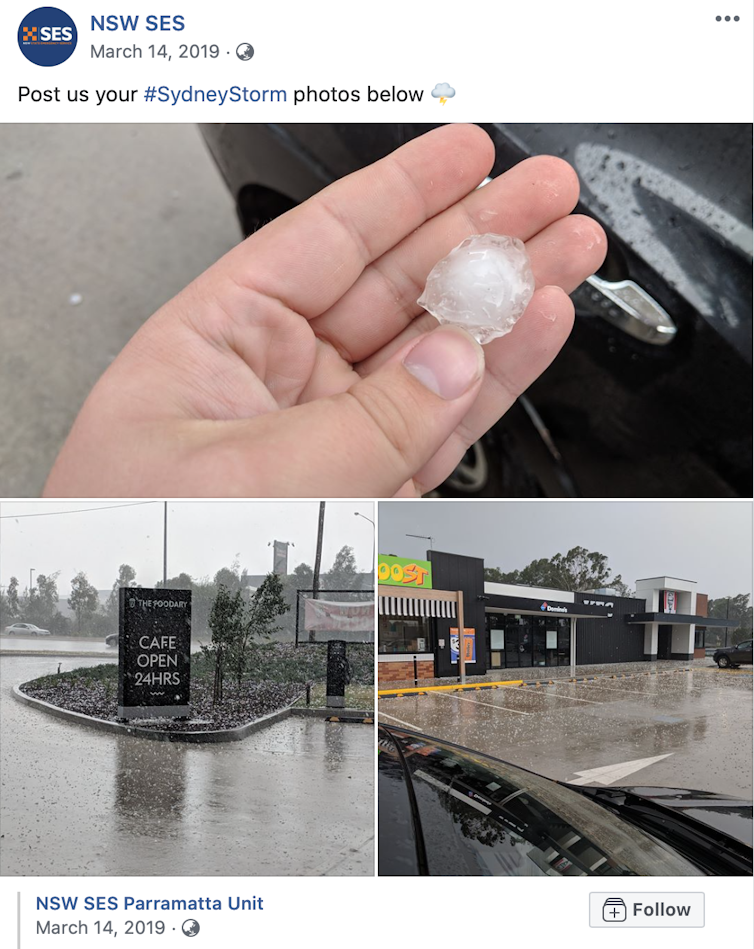 NSW-SES collecting data from the public through their posts.
Facebook
NSW-SES collecting data from the public through their posts.
Facebook
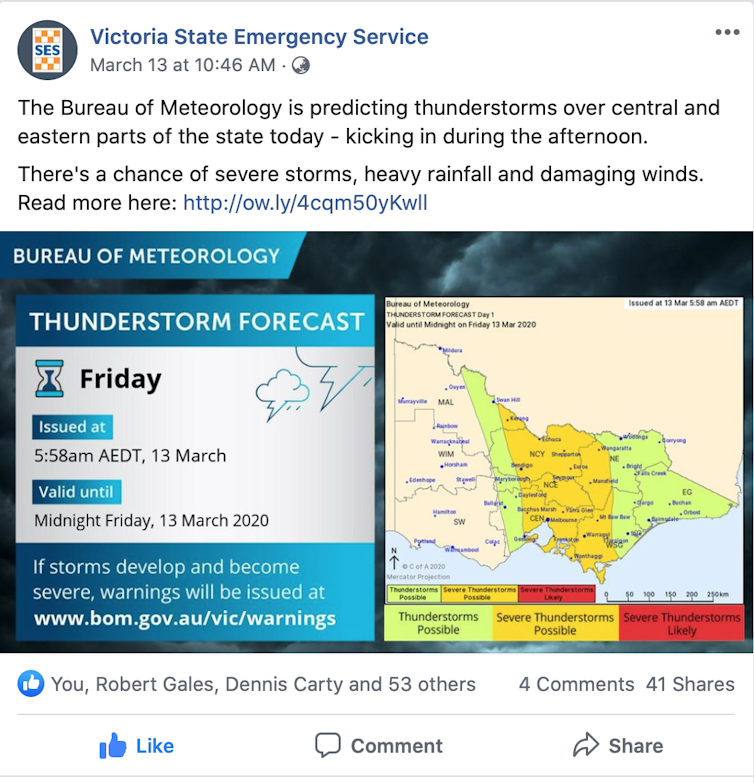 VIC-SES sharing weather warnings to inform the public.
Facebook
VIC-SES sharing weather warnings to inform the public.
Facebook
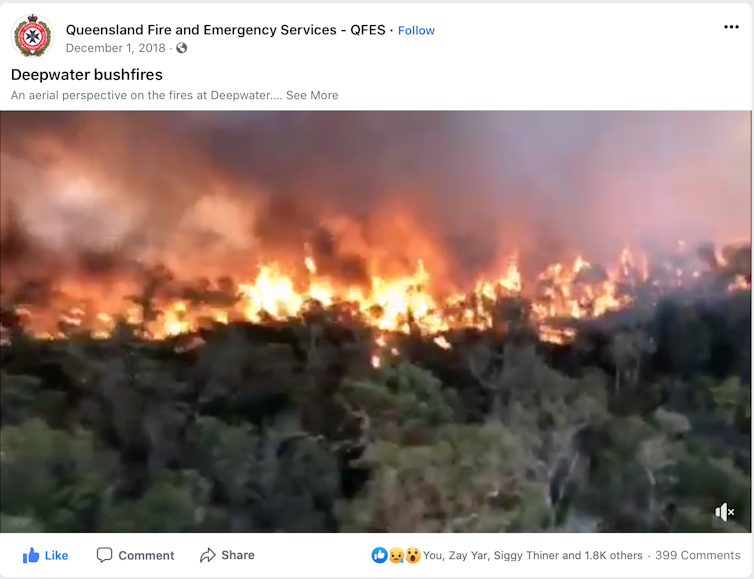 QLD-FES posting fire condition information to increase public awareness.
Facebook
QLD-FES posting fire condition information to increase public awareness.
Facebook
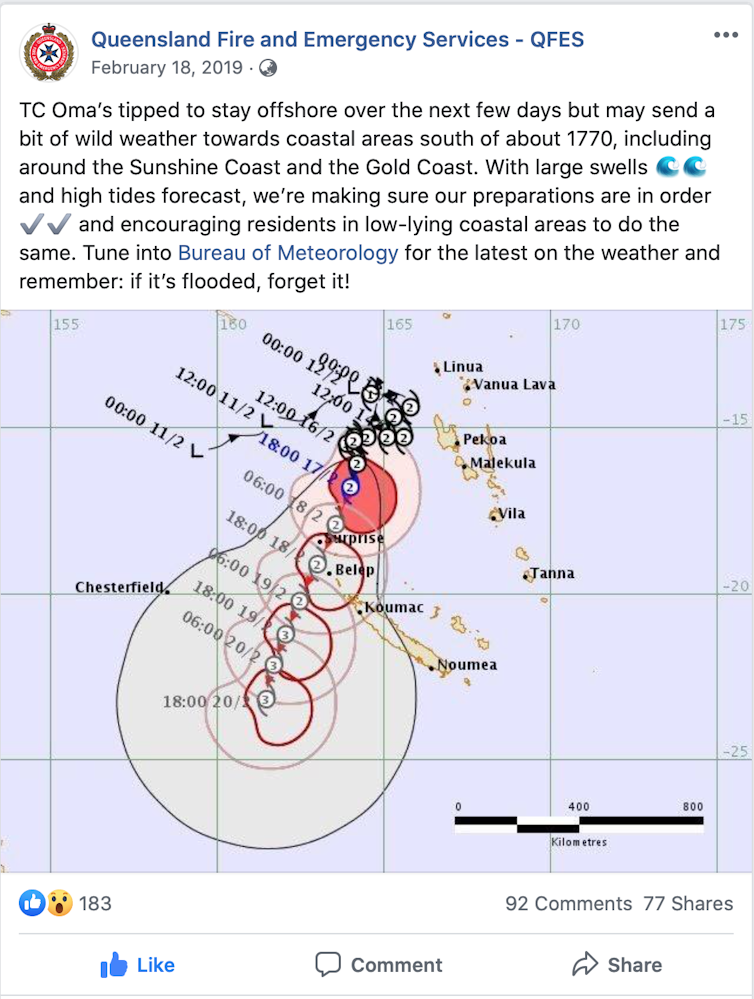 QLD-FES showing the direction of a cyclone and warning the community.
Facebook
QLD-FES showing the direction of a cyclone and warning the community.
Facebook
Second, Facebook pages of emergency services attract more community attention than Twitter pages. Services need to make their Twitter pages more attractive as, unlike Facebook, Twitter allows streamlined data download for social media analytics. A widely used Twitter page of emergency service means more data for analysis and potentially more accurate policies and actions.
Third, Australia lacks a legal framework for the use of social media in emergency service operations. Developing these frameworks will help organisations maximise its use, especially in the case of financial matters such as donations.
Fourth, the credibility of public-generated information can sometimes be questionable. Authorities need to be able to respond rapidly to such information to avoid the spread of misinformation or “fake news” on social media.
Services could do more with social media
Our research highlighted that emergency services could use social media more effectively. We do not see these services analysing social media data to inform their activities before, during and after disasters.
In another study on the use of social media analytics for disaster management, we developed a novel approach to show how emergency services can identify disaster-affected areas using real-time social media data. For that study, we collected Twitter data with location information on the 2010-11 Queensland floods. We were able to identify disaster severity by analysing the emotional or sentiment values of tweets.
Read more: Explainer: how the internet knows if you're happy or sad
This work generated the disaster severity map show below. The map is over 90% accurate to actual figures in the report of the Queensland Floods Commission of Inquiry.
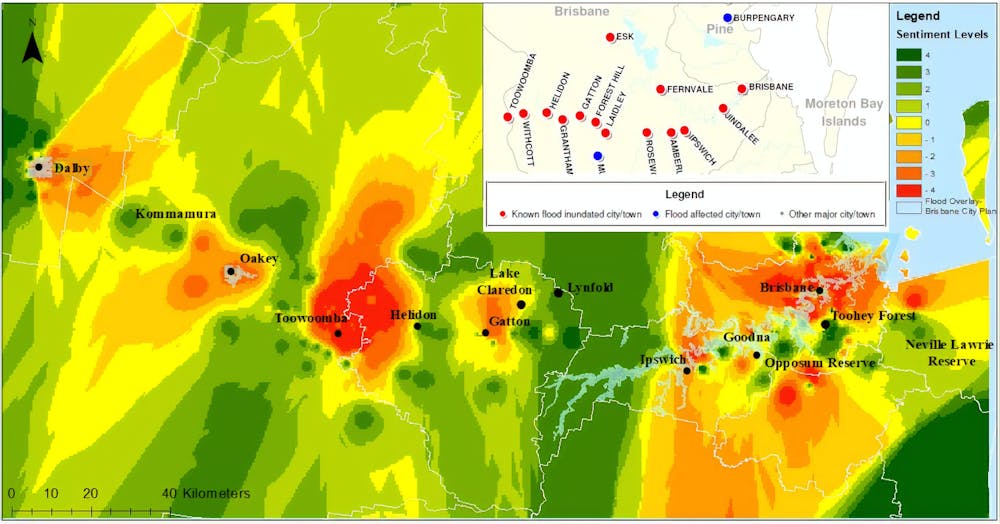 Disaster severity map created through Twitter analytics.
Authors
Disaster severity map created through Twitter analytics.
Authors
Concerns about using social media to manage disaster
The first highly voiced concern about social media use in disaster management is the digital divide. While the issue of underrepresented people and communities remains important, the use of technology is spreading widely. There were 3.4 billion social media users worldwide in 2019, and the growth in numbers is accelerating.
Read more: Online tools can help people in disasters, but do they represent everyone?
Besides, many Australian cities and towns are investing in smart city strategies and infrastructures. These localities provide free public Wi-Fi connections. And almost 90% of Australians now own a smart phone.
The second concern is information accuracy or “fake news” on social media. Evidently, sharing false information and rumours compromises the information social media provides. Social media images and videos tagged with location information can provide more reliable, eye-witness information.
Another concern is difficulty in receiving social media messages from severely affected areas. For instance, the disaster might have brought down internet or 4G/5G coverage, or people might have been evacuated from areas at risk. This might lead to limited social media posts from the actual disaster zone, with increasing numbers of posts from the places people are relocated.
In such a scenario, alternative social media analytics are on offer. We can use content analysis and sentiment analysis to determine the disaster location and impact.
How to make the most of social media
Social media and its applications are generating new and innovative ways to manage disasters and reduce their impacts. These include:
- increasing community trust in emergency services by social media profiling
- crowd-sourcing the collection and sharing of disaster information
- creating awareness by incorporating gamification applications in social media
- using social media data to detect disaster intensity and hotspot locations
- running real-time data analytics.
In sum, social media could become a mainstream information provider for disaster management. The need is likely to become more pressing as human-induced climate change increases the severity and frequency of disasters.
Today, as we confront the COVID-19 pandemic, social media analytics are helping to ease its impacts. Artificial intelligence (AI) technologies are greatly reducing processing time for social media analytics. We believe the next-generation AI will enable us to undertake real-time social media analytics more accurately.
Read more: Coronavirus: How Twitter could more effectively ease its impact
Authors: Tan Yigitcanlar, Associate Professor of Urban Studies and Planning, Queensland University of Technology
Read more https://theconversation.com/disasters-expose-gaps-in-emergency-services-social-media-use-134912


















