

The coronavirus survival challenge for NZ tourism: affordability and sustainability
- Written by: Sabrina Seeler, Postdoctoral Researcher, Nord University
With no international flights arriving for the foreseeable future, there is little doubt that, immediately post-COVID-19, the New Zealand tourism industry will rely entirely on domestic travel.
Without underplaying the impact the pandemic will have on discretionary spending, however, there may be a silver lining to the crisis.
New Zealand is in the fortunate position of having an already strong domestic tourism sector. Domestic tourists spent NZ$23.7 billion annually (or NZ$65 million a day) pre-COVID-19, compared to a total spend of NZ$12.7 billion (or NZ$47 million a day) by international visitors. Research pre-COVID-19 showed 65% of New Zealanders wanted to explore more of their country, a figure expected to increase.
True, New Zealanders generally don’t have the deep pockets international tourists have. Their higher overall spend is a reflection of their numbers, not their bank balances. But with the big ticket tourist attractions now missing the bigger spenders, the market will rule.
Regional tourism organisations, attractions and operators may need to rethink their offerings and their pricing. While tramping the great walks may be perfectly affordable for a family of four, taking the family on a whale watch, a bungy jump or a cruise on Milford Sound may not be – especially as parts of one big holiday. Indeed, it has been found that price is the major decision-making factor for 30% of New Zealanders when it comes to holidays.
Read more: We're in the era of overtourism but there is a more sustainable way forward
So this is also an opportunity to give New Zealanders back a piece of the summer pie – not only for the COVID-19 recovery but in the longer term. Summers have tended to be characterised by a large influx of international tourists, with Kiwis settling for shoulder seasons (and unfavourable weather) to tramp the famous tracks when they are less crowded.
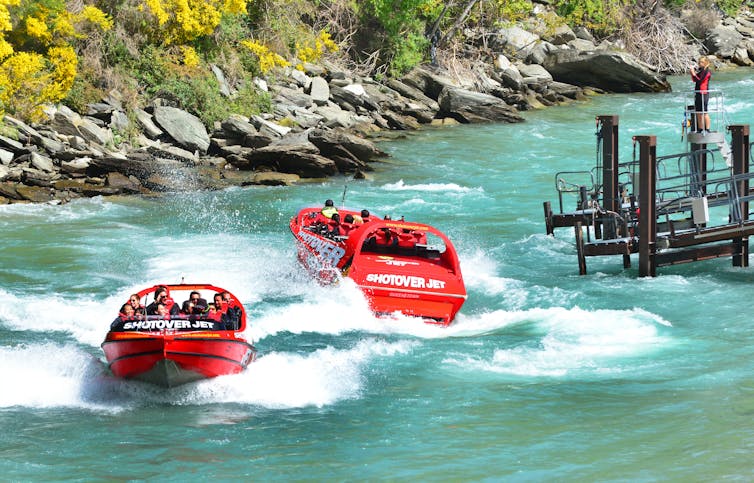 Attractions such as the famous Shotover Jet near Queenstown may have to adjust costs to suit Kiwi pockets.
www.shutterstock.com
Attractions such as the famous Shotover Jet near Queenstown may have to adjust costs to suit Kiwi pockets.
www.shutterstock.com
But domestic tourists who have grown accustomed to off-peak holidays away from high-cost destinations will soon tip the scales. Now is the time for operators to win back their hearts.
With New Zealand’s gradual easing of its strict lockdown (possibly to the stage of allowing non-essential travel by mid-May), tourism can clearly support the economic revival of local communities. The challenge is how to reinvent New Zealand tourism as an initially purely domestic industry.
Read more: This could be the end of the line for cruise ships
Overall, only a handful of New Zealand destinations have depended entirely on international tourists. These also happen to be the places most heavily associated with overtourism in the past. Given that the growth model driven by short-term, dollars-first business thinking has led to an unsustainable tourism market, might this also be a chance to restore some equilibrium?
That will mean no more killing the goose that lays the golden egg. Some hotspots, such as the Tongariro Alpine Crossing and Coromandel’s Hot Water Beach may be managed by restricting visitor numbers.
Such strategies have long been in place in other places, such as the booking requirement for the Milford Track. We have also seen tremendous problems associated with too many cruise ships in too small places. Akaroa is a prime example, and limiting both the number of visits and the size of vessels may be a feasible future strategy.
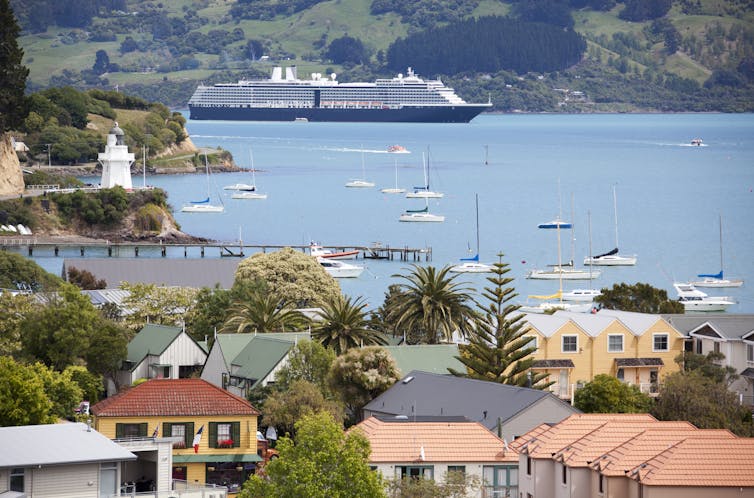 A cruise liner arrives at tiny Akaroa in the South Island: limiting the number of visits to small centres has already been proposed.
www.shutterstock.com
A cruise liner arrives at tiny Akaroa in the South Island: limiting the number of visits to small centres has already been proposed.
www.shutterstock.com
As part of our own research (yet to be published) into the pressing issues of overtourism we conducted interviews with various tourism stakeholders around New Zealand, including city and regional councils, the Department of Conservation, residents and operators. This took place just before New Zealand’s strictest lockdown level was imposed, without any real foreknowledge of the eventual economic impact of COVID-19.
Read more: The end of global travel as we know it: an opportunity for sustainable tourism
Nonetheless, our interviewees shared very similar sentiments when it came to how the industry can evolve sustainably only if New Zealanders themselves embrace the behaviours they expect (and sometimes demand) of foreign tourists. According to our subjects, too many Kiwis still hold on to a past when the country’s population was half its current size and SUVs and large motorhomes didn’t crowd the roads and parking lots.
Initiatives such as the Tiaki Promise, which promote environmental and cultural sensitivity to tourists, have largely targeted international visitors. These now need to turn the lens inwards so that Kiwis become better ambassadors within their own backyard.
Kiwis love their country, but they will now need to truly discover what it has to offer, not only for a weekend of tramping or a quick getaway, but for their main summer holiday. And they will have to become better kaitiaki (or guardians) of their homeland in the process.
The absence of international tourists will be a huge challenge, but also an opportunity. When those foreign visitors are allowed to return, if we get it right, we will have found ways to grow – or limit – their numbers and their expectations so that our tourism industry can thrive as well as survive.
Authors: Sabrina Seeler, Postdoctoral Researcher, Nord University


















