

does spraying the streets work against coronavirus?
- Written by Lisa Bricknell, Senior Lecturer in Environmental Health, CQUniversity Australia
As the COVID-19 pandemic has grown, you will probably have seen photos and video of workers in protective gear using high-pressure sprays to sanitise city streets. Spain has even taken the radical step of spraying bleach on beaches. You may have asked yourself if this really makes much difference to the risk of coronavirus transmission. If not, why would governments expend time, energy and dollars doing it?
Based on our knowledge of the conditions required for disinfectants to work, we suspect these activities are as much about authorities being seen to do something as about actually stopping the spread of COVID-19.
The likely effectiveness of spraying streets and other public places depends on how the virus spreads, how the disinfectants work and what conditions these are used in.
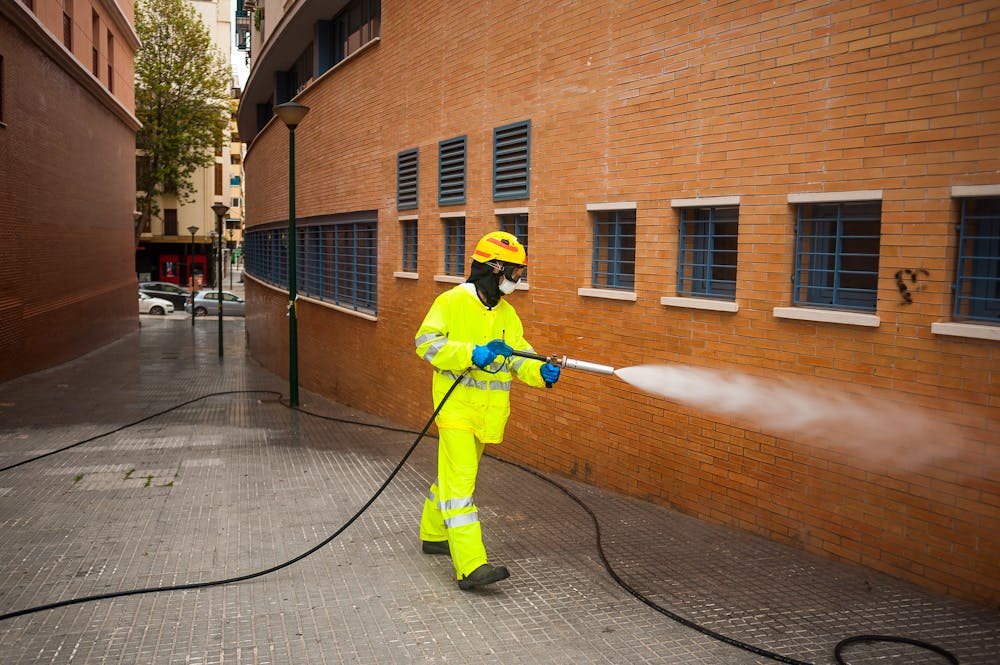 Spraying cities with disinfectant in Spain – Malaga in this case – appears to have done little to stop the spread of coronavirus.
Jesus Merida/Sipa USA/AAP
Spraying cities with disinfectant in Spain – Malaga in this case – appears to have done little to stop the spread of coronavirus.
Jesus Merida/Sipa USA/AAP
How does the virus spread?
We now know the virus is spread mainly in two ways.
The first is through airborne droplets and aerosols that originate from infected individuals. The droplets are expelled into the air through a cough or sneeze and can infect another person who encounters them at close range. Droplets are larger and do not remain in the air for very long, quickly settling to the ground or another surface.
Aerosols are smaller and remain suspended for longer – up to three hours. Aerosols will rapidly dry out and disperse over time. This makes it less likely a person will be exposed to enough viral particles – known as the infectious dose – to be infected.
The second way the disease is spread is via contamination of surfaces. When droplets settle, the virus can persist for varying periods, depending on the nature of the surface. For example, one study found the virus survives for up to 72 hours on plastic and stainless steel, 8 hours on copper and 4 hours on porous surfaces such as cardboard.
This experiment, however, was conducted under laboratory conditions indoors. So far, no information is available on how long the virus can survive outdoors. It’s also unknown how likely it is for you to become infected when you’re walking the city streets.
How might disinfectant work?
We must also consider the process of disinfection. According to news reports, most authorities are using a diluted bleach solution to disinfect city areas. Research suggests the COVID-19 virus is susceptible to bleach, but it requires a contact time of about one minute to be effective.
 Disinfectant is deactivated by a layer of organic matter on surfaces, including the same skin oils and sweat that leave fingerprints.
Shutterstock
Disinfectant is deactivated by a layer of organic matter on surfaces, including the same skin oils and sweat that leave fingerprints.
Shutterstock
Even if the disinfectant reaches every outdoor surface likely to be touched by people, including areas shielded from the spray, there is still a problem with using bleach in the typical conditions encountered outdoors. Sunlight and the build-up of organic matter on surfaces will rapidly deactivate the chlorine, the active ingredient in bleach. This means the disinfectant would probably become ineffective before the virus is killed.
For the virus to infect a person, it needs to enter the body. This can occur when your hands have become contaminated by touching a surface and you put your hands to your face, near your nose or mouth. But when was the last time you touched the ground and then touched your face without washing your hands?
The average person is rarely going to come into direct contact with city streets and footpaths with their hands. That’s another reason spraying these surfaces with disinfectant is unlikely to be an effective control measure.
Commonly touched surfaces such as handrails and road-crossing buttons are more likely sources of infection but would have to be cleaned before being sanitised with bleach. This is because organic matter builds up on frequently touched surfaces, including the natural oils on human skin. Even if cleaning were undertaken prior to sanitising, this process would need to be continuous as the next time an infected person touches the surface it can be recontaminated.
Spraying disinfectant into the air will have the effect of reducing the amount of virus that is suspended as aerosols. However, this will have a very limited effect as the disinfectant will rapidly disperse. Aerosols will be reintroduced the next time an infected person travels through the area.
Another consideration is that the droplets of bleach in the spray can be corrosive and cause harmful respiratory effects when inhaled. Spraying should only be done when there are no people around.
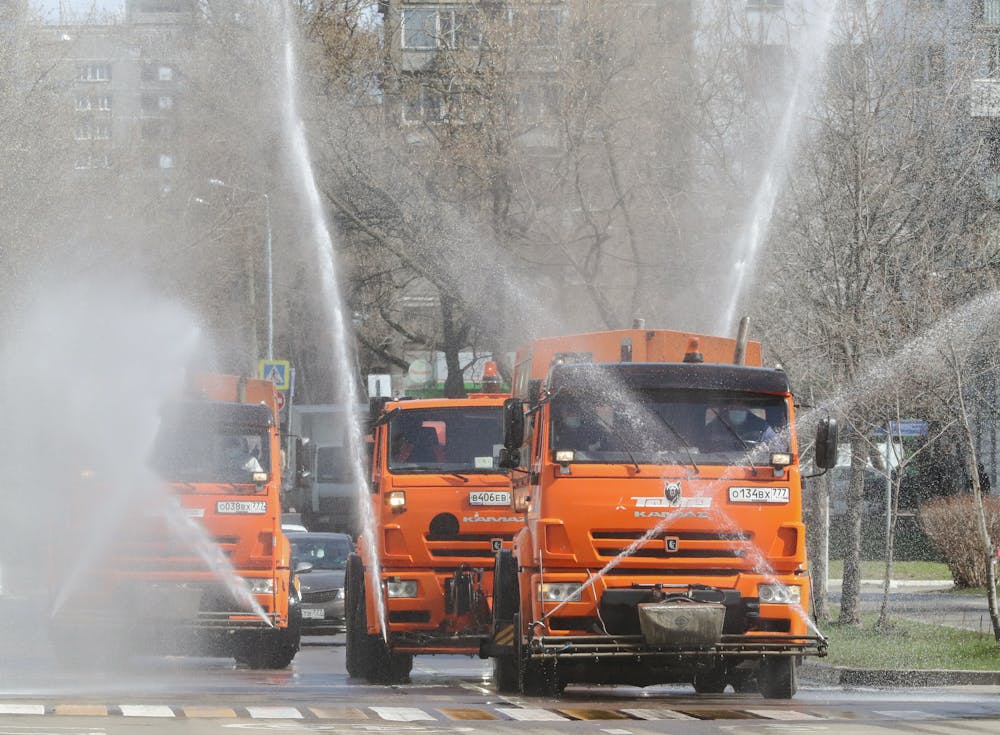 In Moscow, convoys of trucks spray the streets of the Russian capital with disinfectant.
Sergei Karpukhin/TASS/Sipa USA/AAP
In Moscow, convoys of trucks spray the streets of the Russian capital with disinfectant.
Sergei Karpukhin/TASS/Sipa USA/AAP
A far more effective regime is to recommend stringent personal hygiene. This includes regular hand washing with soap and water and the use of alcohol-based sanitiser when hand washing isn’t possible.
Why, then, are countries spraying streets?
So, if spraying disinfectant in urban areas is unlikely to be effective, why are we seeing some countries doing this?
Without being privy to the decision-making process, it’s hard to say. There are, however, a couple of possibilities. One is that the authorities want to create an environment that is free from COVID-19 but aren’t following the science. A more likely reason is to help people feel safe because they see authorities taking action.
In a crisis, people are less likely to take on board information that challenges their current beliefs. Although the science indicates urban disinfection is probably ineffective, it’s likely the general public believes otherwise. As a result, spraying city streets might have the effect of allaying fears and building trust in government and the messages it distributes.
A possible downside of this, however, is people who feel their environment is safe might be less stringent about personal hygiene and physical distancing. These precautions are vital in preventing the virus spreading through the community; if people stop observing these behaviours, the virus is likely to spread much more quickly.
The take-away message from this is that, while urban disinfection may increase public confidence, it is likely to be ineffective in protecting the public from infection.
Authors: Lisa Bricknell, Senior Lecturer in Environmental Health, CQUniversity Australia

















