

5 reasons why Zoom meetings are so exhausting
- Written by: Libby Sander, Assistant Professor of Organisational Behaviour, Bond Business School, Bond University
For many of us, working from home during COVID-19 has meant we are spending a lot of time on video meeting applications like Zoom. The effects of this have taken us by surprise.
Having giant heads staring at us up close for long periods can be off-putting for a lot of us. Never mind that we feel we should fix our iso-hair (COVID mullet anyone?), put on makeup, or get out of our pyjamas.
So why are online meetings more tiring than face-to-face ones?
People feel like they have to make more emotional effort to appear interested, and in the absence of many non-verbal cues, the intense focus on words and sustained eye contact is exhausting.
Read more: Here is why you might be feeling tired while on lockdown
Face-to-face meetings
Meetings in person are not only about the exchange of knowledge, they are also important rituals in the office. Rituals provide comfort, put us at ease, and are essential in building and maintaining rapport.
Face to face meetings are also important mechanisms for the communication of attitudes and feelings among business partners and colleagues.
Emotions precede and follow all our behaviours, and influence management decision-making. Sensitive topics are often canvassed, requiring us to notice subtleties and display empathy.
How are Zoom meetings different?
Our brains can only do so many things consciously at once, because we have limited working memory. In contrast, we can process much more information unconsciously, as we do with body language.
Meeting online increases our cognitive load because several of its features take up a lot of conscious capacity.
Read more: I had an idea in the 1980s and to my surprise, it changed education around the world
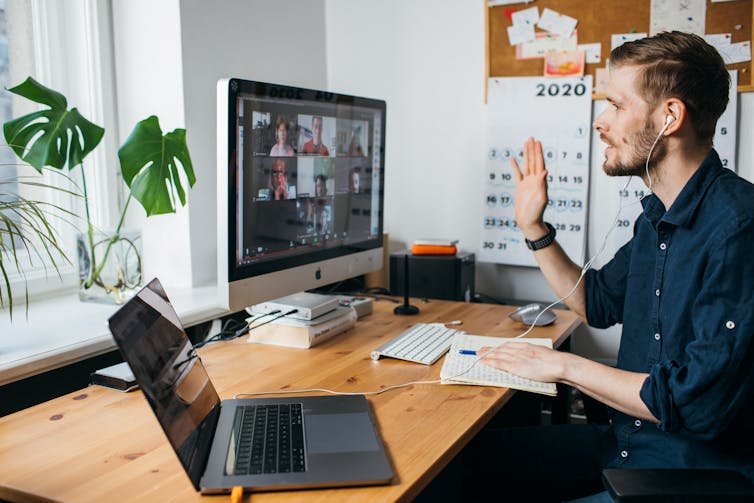 Video meetings take up a lot of cognitive resources, often leaving us feeling frustrated and drained.
www.shutterstock.com
Video meetings take up a lot of cognitive resources, often leaving us feeling frustrated and drained.
www.shutterstock.com
1. We miss out on a lot of non-verbal communication
Our feelings and attitudes are largely conveyed by non-verbal signals such as facial expressions, the tone and pitch of the voice, gestures, posture, and the distance between the communicators.
In a face-to-face meeting we process these cues largely automatically, and can still listen to the speaker at the same time.
But on a video chat, we need to work harder to process non-verbal cues. Paying more attention to these consumes a lot of energy. Our minds are together when our bodies feel we’re not. That dissonance, which causes people to have conflicting feelings, is exhausting.
Also, in face-to-face meetings we rely heavily on non-verbal cues to make emotional judgements, such as assessing whether a statement is credible. We automatically take in information such as, is the person fidgeting? Predominantly relying on verbal information to infer emotions is tiring.
2. What if the kids run in?
We feel anxious about our remote workspace and controlling events that might make us look bad to our colleagues. Will my Zoom background suddenly fail leaving my hoarding tendencies on full display?
And none of us want to be like Trinny Woodall, fashion guru and television presenter, who was doing a live stream when her partner walked naked across the room.
3. No water-cooler catch-ups
In person, we often meet people on the way to a meeting to catch up on issues or discuss our views before going in. We get coffee, and the simple act of relocating to a different room is energising.
But at home, we might be just working on a task and then we get on to Zoom, often without taking breaks.
Also, walking is known to improve creativity, highlighting the importance of discussions while walking to meetings, moving around during the meeting, and holding the now popular stand-up meetings. But we can’t walk on Zoom calls.
And where we meet matters. The physical environment acts as a cognitive scaffold – we attribute certain meanings to meeting rooms and this subtly changes our behaviour. This can include anchors to important topics such as creativity and problem solving.
4. Looking at our own face is stressful
The heightened emphasis on facial cues and the ability to see oneself, can also act as a stressor. Viewing our own negative facial expressions (like anger and disgust) can lead to more intense emotions than when viewing similar facial expressions in others.
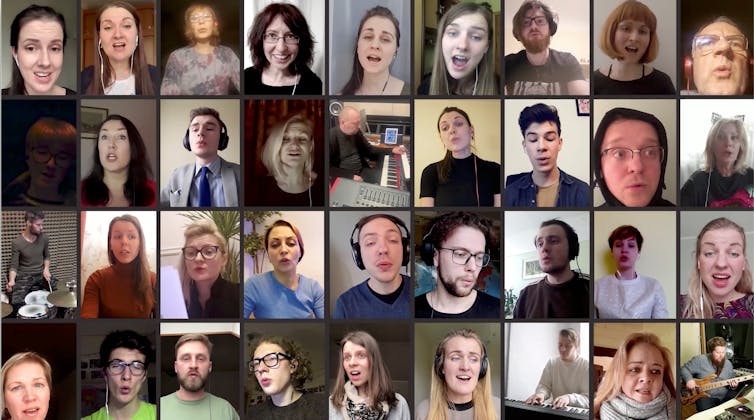 Seeing our own face on screen can make us self-conscious because we are very aware of being watched.
Reuters
Seeing our own face on screen can make us self-conscious because we are very aware of being watched.
Reuters
5. Are you listening or are you frozen?
Silence in real life conversation is important and creates a natural rhythm. But in a video call, silence makes you anxious about the technology. Even a 1.2 second delay in responding online made people perceive the person talking as less friendly or focused.
In addition, frustration with people turning their microphones on and off, lagging connections and background noise mean the meeting rarely flows as smoothly.
It’s not all Zoom and doom
On the upside, social anxiety is positively correlated with feelings of comfort online. So for people who dread physical meetings, meeting online might be a welcome respite.
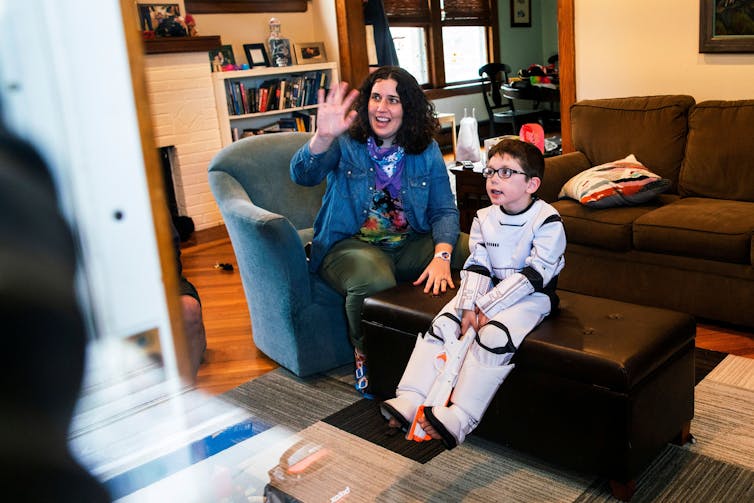 Meeting online might help people feel more relaxed if they tend to feel anxious socialising in-person.
Eduardo Munoz/Reuters
Meeting online might help people feel more relaxed if they tend to feel anxious socialising in-person.
Eduardo Munoz/Reuters
And even though the increased focus on verbal information in video meetings can be mentally more draining, it might also have some potential positive side effects by reducing biases due social and emotional signals.
For instance, certain physical factors are linked to social dominance, such as height. But these factors are less apparent in video meetings, which could lead to increased emphasis on the merits of arguments.
Read more: Online social networks can help fight social anxiety
How can we reduce the fatigue?
With predictions that the new workplace “normal” will be very different from the old one, it seems that Zoom is here to stay. There are a number of steps we can take to reduce the negative effects of online video meetings.
Firstly, consider whether the meeting needs to happen. In some cases, shared document platforms with detailed comments can reduce the need to meet.
Limiting the number of Zoom meetings in a day can assist, as well as using messaging and email.
Sometimes, the phone is better. On the phone we only have to concentrate on one voice and can walk around which can help thinking.
This article is supported by the Judith Neilson Institute for Journalism and Ideas.
Authors: Libby Sander, Assistant Professor of Organisational Behaviour, Bond Business School, Bond University
Read more https://theconversation.com/5-reasons-why-zoom-meetings-are-so-exhausting-137404


















