

coronavirus will hit Australia's research capacity harder than the GFC
- Written by: Frank Larkins, Professor Emeritus and Former Deputy Vice Chancellor, University of Melbourne
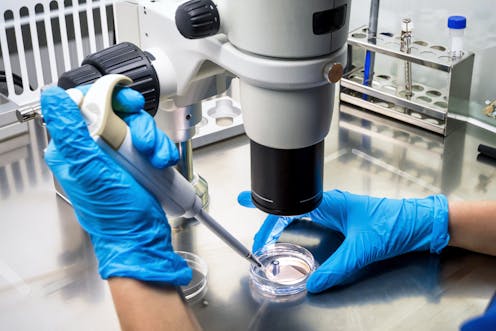
Australia’s researchers have answered the call to help with urgent pandemic clinical trials and other research needs, placing other work on hold. Experts across a broad range of disciplines are crucial to our health, mental health and economic well-being.
And yet the COVID-19 pandemic has posed one of the most significant threats in history to Australia’s national research sector, and well beyond the medical sciences.
We were lead authors on a report for the government’s National COVID Coordination Commission through the Chief Scientist’s Rapid Research Information Forum (RRIF). We answered the question:
What impact is the pandemic having and likely to have on Australia’s research workforce and its capability to support our recovery efforts?
Our report shows Australia’s research workforce will be severely impacted by the pandemic, with the effects likely to be felt for years, if not decades.
The universities sector estimates its revenue will drop by at least A$3 billion in 2020 due to the pandemic, and the decline could be as high as A$4.6 billion. This drop is likely to be worst for research-intensive universities.
Early and mid career researchers and recent graduates will be disproportionately affected due to the highly casualised and fixed-term nature of the university research workforce. This may also be the case for women, who more commonly than men have additional childcare and other home commitments.
Journals are already seeing that since the COVID-19 crisis began, submissions from women are underrepresented, especially articles authored solely by women.
Australia’s research spending
We canvassed and compiled evidence from across Australia’s universities, publicly and privately funded research institutes and agencies, and the private sector.
The Australian government provides support for the research workforce through grant funding and tax transfers to industry, paying the salaries of researchers in government agencies and departments, and providing grant funding through research councils and block funding to universities.
In 2019–20 this was budgeted to be a total of A$9.6 billion. Of this
A$2.1 billion went to industry
A$2.1 billion went to government research activities (including CSIRO, the Australian Institute of Medical Scientists, the Australian Nuclear Science and Technology Organisation and Defence)
A$3.6 billion went to universities
A$1.8 billion went to medical research institutes and other sectors like agriculture and energy.
Australian spending on research (from all sources, including government and industry) has flatlined over the last few years, and declined overall.
Investment increased from A$6,667 million in 2007-08 to A$10,072 in 2011-12. But it steadily declined from its peak of A$10,072 million 2011-12 to a low of A$9,396 million in 2018-19 (apart from a one-off A$10,285 million spike in 2017-18).
Government funding is steady at its budgeted A$9.6 billion this financial year. But given business spending on research and development dropped 3.1% during the global financial crisis, it is expected to drop precipitously due to the pandemic.
In Australia, industry is responsible for 86% of experimental development (where physical experiments are used to test a hypothesis). And small to medium enterprises (which comprise the vast majority of Australian businesses) are unlikely to have spare cash to invest in research and development.
Universities perform around 43% of all applied research (aimed at solving real-world problems) in Australia. This means industry sectors relying on universities and research institutions for research and development may be less able to collaborate, innovate and create new sources of employment.
Almost half of Australia’s 164,000 researchers are academic staff and postgraduate research students. Universities expect to lose up to 21,000 full-time equivalent staff over the next six months, of which an estimated 7,000 could be research-related.
Postgraduate research students work in research while earning their higher degree. They’re 57% of the university workforce and 6,000 could lose their jobs.
In medical research institutes, around 3,000 jobs are projected to go. There is widespread concern the diversity crucial to innovation will be lost along with these jobs.
International student revenue
The university sector supplements government research funding with income from full-fee paying international students. This represents an average 26% of individual universities’ total revenue.
Around A$4.7 billion is spent on research from university discretionary funds, the majority of which comes from international student fees (although it also includes donations and investment returns).
In 2018, 37% of PhD students in Australia were international students. And 75% of those were performing research in science, technology and engineering subjects.
Many international postgraduate students have limited options to extend their stay to make up for research interruptions. Some have already returned to their country of origin.
These factors, together with likely future travel restrictions, mean we can anticipate more than 9,000 international research students may not be able to resume their research programs in 2020.
Australia’s university research capacity has arguably taken a bigger blow than any other country because of our higher proportion of overseas students.
The overall loss of research capacity doesn’t just affect the creation of new knowledge. It will significantly affect Australia’s future potential for economic growth.
An opportunity for Australia
Corporate-sponsored research enables Australian industries – such as health, advanced manufacturing, transport and renewable energies – to be competitive. This subsequently creates new employment opportunities and supports economic growth.
Labs in medical research institutes not working on COVID-19 research have been closed. They have effectively paused much of Australia’s medical research including in cancer, heart disease, motor neurone disease and diabetes.
This will seriously impact Australia’s capacity to pick up when it is safe to re-open these laboratories
During the global financial crisis, the government recognised the threat to research and its capacity to pull Australia through. It injected an additional $1 billion in funding into academic research between 2008-09 and 2013-14.
During the COVID-19 pandemic, the Australian government has invested about an extra A$13 million into the Medical Research Future Fund to support COVID-related research.
Read more: For most universities, there's little point to the government's COVID-19 assistance package
The UK government has recognised the need to support research-led economic recovery. As well as establishing a research sustainability taskforce, it’s just announced it will bring forward £100 million of quality-related research funding for providers into this current academic year as immediate help to ensure Britain’s research activities can continue during the crisis.
The funding is paired with guarantees to protect tertiary student places and PhD student grants.
The Australian government also has the opportunity to show visionary leadership by investing to support the broader research and development that will be vital to the nation’s economic recovery.
The report this article is based on was produced by the The Rapid Research Information Forum, a group of 35 research sector organisations and science leaders. The forum is chaired by Australia’s Chief Scientist, Dr Alan Finkel, and its operations are led by the Australian Academy of Science.
Authors: Frank Larkins, Professor Emeritus and Former Deputy Vice Chancellor, University of Melbourne


















