

even in a pandemic, mixed emotions are more common than negative ones
- Written by: Luke Smillie, Associate Professor, University of Melbourne
Much has been written on the impact of the coronavirus pandemic on negative emotions, such as rising anxiety and the loneliness of self-isolation.
But while things may seem all doom and gloom, new data reveals it’s surprisingly rare for a person to experience purely negative emotions. More commonly, people are instead experiencing mixed emotions.
Read more: Social distancing can make you lonely. Here's how to stay connected when you're in lockdown
What are mixed emotions?
Psychologists have traditionally viewed emotions as falling along a single dimension, ranging from positive (such as happy or excited) to negative (such as sad or anxious). This implies at any given moment we feel “good” or “bad”, but not both. Positive and negative emotions have even been said to mutually inhibit each other – so if you are enjoying your day but receive some bad news, your positive mood is supposedly replaced by a negative one.
However, an alternative view suggests positive and negative emotions vary independently, and can therefore occur simultaneously. This allows for the experience of “mixed emotions”, such as feeling both happy and sad, or nervous but excited, at the same time.
There is now extensive evidence for the existence of mixed emotions. And new data reveals they may be surprisingly common.
Mixed emotions are more common than purely negative ones
A recent study led by Kate Barford (an author of this article) examined how mixed emotions arise in day-to-day life. Across three participant samples, Barford and her colleagues found mixed emotions typically emerge when negative emotions intensify (such as following a negative event), and blend with ongoing positive emotions.
Thus, bad feelings do not always extinguish positive ones, like flicking off a light switch. Rather, they more often transform a positive mood into mixed emotions.
Intriguingly, the study also found purely negative emotions (the absence of any concurrent positive emotions) are surprisingly rare. In all three samples, participants reported purely negative emotions less than 1% of the time during one to two weeks of daily life. In contrast, mixed emotions were reported up to 36% of the time.
This shows our negative emotions are rarely so strong that they overwhelm our positive ones, at least during everyday circumstances.
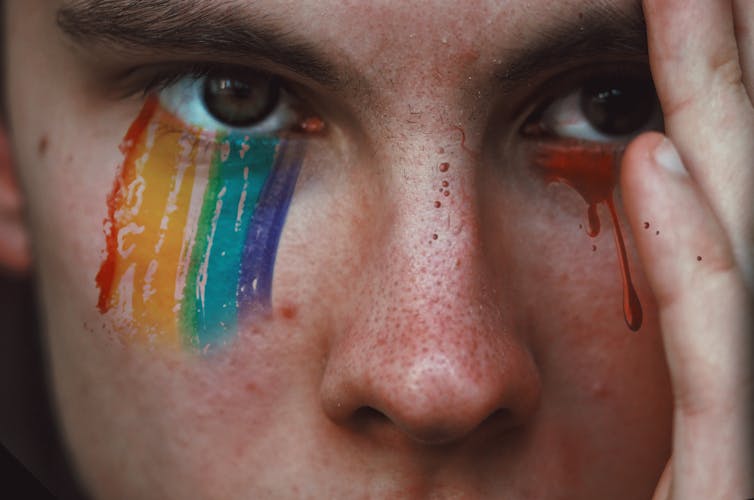 Mixed emotions are much more common than purely negative feelings.
Adrian Swancar/Unsplash
Mixed emotions are much more common than purely negative feelings.
Adrian Swancar/Unsplash
Mixed emotions during the COVID-19 pandemic
Currently, most of us are not facing everyday circumstances. As the coronavirus spreads around the globe many nations have gone into lockdown, and most of us are wondering when life might return to normal. You might think negative emotions would dominate during such ominous times.
Read more: Coronavirus: three ways the crisis may permanently change our lives
To find out, we surveyed 854 Australian residents about their emotional experiences in late March, as government restrictions were introduced. In line with widespread reporting, we found 72% of our sample were indeed experiencing negative emotions.
However, almost all of these people also reported feeling positive emotions, such as joy and contentment. And only 3% of our sample reported purely negative emotions as the crisis unfolded. In comparison, around 70% of people reported feeling mixed emotions – much higher than previous found by Barford and colleagues.
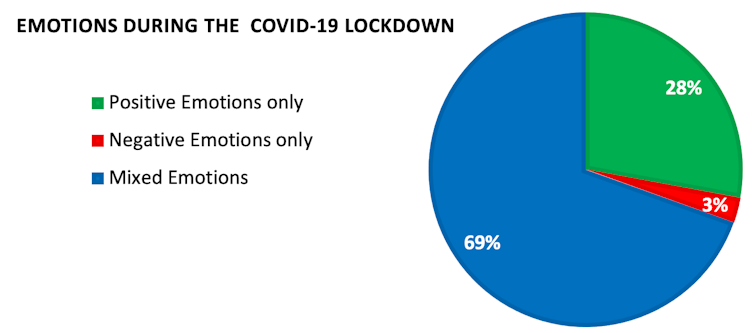 This chart shows the prevalence of mixed emotions, alongside purely positive and negative emotions, in a representative sample of 854 Australians aged 18-89 (about 44% males and 56% females). Data was collected by the authors in early April, 2020.
The high rate of mixed emotions during the COVID-19 crisis may be the result of increased negative emotions that blend with positive ones – as Barford and colleagues found previously.
Mixed emotions might also arise from conflicted thoughts and feelings about this predicament. For instance, we might dislike social distancing, but approve of it for the sake of our collective health. Or we might enjoy the novelty and flexibility of altered working arrangements (such as working from home), even though they can be disruptive.
Indeed, almost half of the participants in our sample reported they enjoyed tackling some of the challenges of lockdown.
Who experiences mixed emotions?
Our emotions are not determined simply by our circumstances, but also our personalities.
In the study by Barford and her colleagues, individuals scoring lower on a personality trait called “emotional stability” experienced more mixed emotions. This was because these individuals were more susceptible to increases in negative emotion, which blended with ongoing positive ones to create an overall bittersweet experience.
This same finding emerged in our survey in the context of COVID-19. We found the personality trait of low emotional stability was a stronger predictor of mixed emotions than other situational and demographic factors. These included age (younger people experienced more mixed emotions) and the extent of disruption to one’s day-to-day activities.
Read more: Personalities that thrive in isolation and what we can all learn from time alone
Could mixed emotions be helpful?
Interestingly, psychologists think mixed emotions may have some benefits. Specifically, whereas purely negative emotions can lead us to disengage from our goals, mixed emotions may prepare us to respond to uncertain situations in flexible ways, such as re-proritising our work projects, or socialising via Zoom.
There is even evidence the experience of mixed emotions may cushion the impact of uncertainty on our wellbeing.
So, while sentiments of fear and sadness are dominating the headlines, the high prevalence of mixed emotions during this pandemic may be good news for our mental health.
Authors: Luke Smillie, Associate Professor, University of Melbourne


















