

Is isolation a feeling?
- Written by: Carly Osborn, Visiting Research Fellow, University of Adelaide
I am feeling isolated. Is this a state, or an emotion? Rather than getting into the semantics of language, I will ask another question: what does isolation feel like?
Isolation feels like being stuck on the couch despite having time for a walk. Isolation feels like comfort eating nachos and box wine.
Our bodies are tired. Our minds slip and skid between blank boredom and anxious overthinking. What is happening to us, here in our homes, away from the routines and interactions that used to shape our days?
I am feeling isolated. Scholars of emotion talk about feelings as judgements – our considered response to what’s happening. These judgements tint our experience as we live it: like the transferred epithets of Wodehouse’s Bertie Wooster, “pronging a moody forkful” of eggs, or “balancing a thoughtful lump of sugar” on his teaspoon. Experience reaches us through these filters of judgement.
This morning I made myself a lonely piece of toast and am writing this article drinking a grateful-for-free-childcare cup of tea.
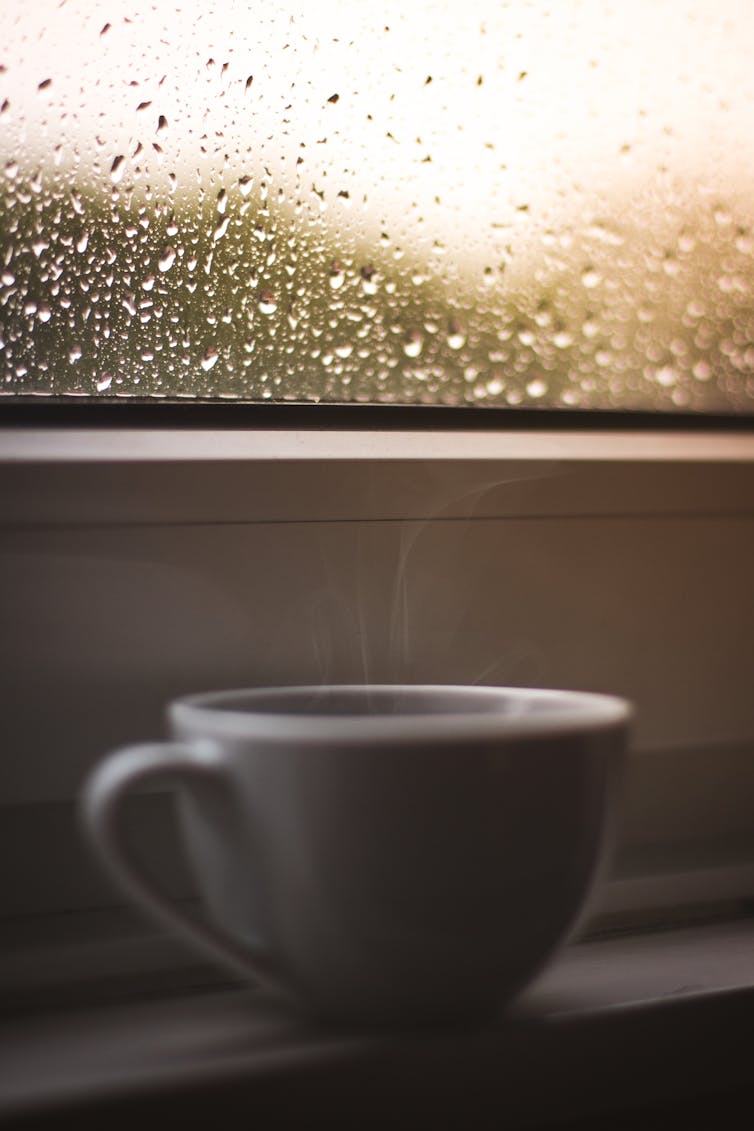 Would you like a grateful-for-free-childcare cup of tea?
Kira auf der Heide/Unsplash
Would you like a grateful-for-free-childcare cup of tea?
Kira auf der Heide/Unsplash
Every lonely person is lonely in their own way
Some of the effects of isolation are common to all human beings, across times and places. Humans have evolved as communal animals living in “families, tribes, and communities”. We feel “the pain of social isolation and the rewards of social connection”.
Beyond these human constants, our emotional experiences are powerfully shaped by our individual circumstances. Our communal and personal histories affect our expectations of life and our responses to events. In this sense, your feeling of isolation is different to mine. Like Tolstoy’s unhappy families, each of us is feeling this crisis in our own way.
Medical researchers of isolation note this recursive flow of emotion: symptoms like poor sleep and high blood pressure correlated not with measures of patients’ objective isolation, but their perceived isolation.
One person’s agonising loneliness is another’s boring staycation. We are as isolated as we feel.
 Is this a place of loneliness, or a place of staycation joy?
Sven Brandsma/Unsplash
Is this a place of loneliness, or a place of staycation joy?
Sven Brandsma/Unsplash
This does not mean our feelings aren’t real. They are, in fact, the only reality we can know. Is there a meaningful difference between asking “How are you?” and “How are you feeling?”
Full bodied feeling
Our feelings are experienced by our whole selves: bodies, minds, emotions, all intertwined.
We feel the absence of human touch, we feel anxiety as we obsess over daily statistics, we feel exhausted by shopping trips that feel like ventures into no-man’s-land, we feel grief at the horrific headlines of death, and frustration at government responses. We feel loss and confusion about our about our identity and value as jobs disappear.
Those who contract COVID-19 report not only fear of dying, but boredom and anger at being isolated from family and friends.
We are feeling isolated. Despite our Tolstoyan uniqueness, we find comfort in shared feelings. We share memes about interminable Zoom meetings, or homeschooling, or day drinking. We feel seen, heard, understood – less isolated. These are called affiliative behaviours and they are a powerful coping strategy for all kinds of crises. Somehow our suffering is more bearable if another human being knows how we feel, and feels it too.
Connecting with one another, and feeling that we are in this together, can mitigate some of the pain of isolation. Sufferers during previous pandemics who felt their isolation was serving an altruistic goal of protecting their neighbours reported less negative emotions about isolation.
Political exiles have, throughout history, found ways to endure isolation. Early modern English nuns in exiled European convents drew upon antique history to comfort themselves, identifying with Biblical stories of suffering that finally resolve in homecoming and restored community.
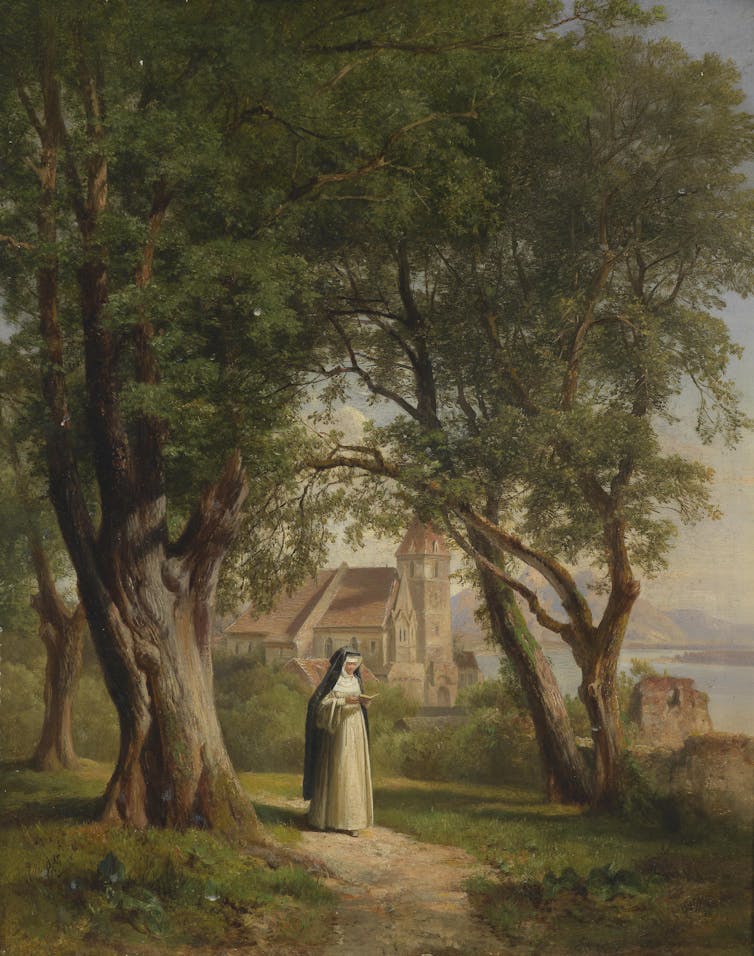 Exiled nuns drew upon Biblical stories of suffering for comfort.
Anton Hansch c1876/Wikimedia Commons
Exiled nuns drew upon Biblical stories of suffering for comfort.
Anton Hansch c1876/Wikimedia Commons
Prisoners in solitary confinement have relied on simple things like sunlight and human voices on the radio to keep the worst at bay.
They are feeling isolated. Isolation feels like being alone but it also feels like reaching beyond our usual spheres, feeling new empathy with people who were strangers before.
Isolation is a long-term state for many. From professional women in male-dominated fields, to caregivers and those in remote communities, to religious and queer minorities.
Asylum seekers in detention report deep feelings of isolation and invisibility. Their poems open up for us in new ways now.
New parents, especially mothers, experience isolation with feelings familiar to many of us right now: “powerlessness, insufficiency, guilt, loss, exhaustion, ambivalence, resentment and anger”. Those who are young, or poor, or single, are especially at risk of feeling isolated, overwhelmed and worried.
In our empathy we are connected across social and economic gaps.
Emotional force
We are feeling isolated. Now, our shared emotions become a central part of how we make sense of the crisis.
Shared, collective emotion can be a strong driver of collective activity. Enough shared emotion can cause us to feel like a unified nation, our common humanity stronger than our superficial differences. Conversely, emotional sparks can create political cliques who cohere around shared anger towards other groups.
Scholars of emotion describe emotions as a force, not only felt within, but acting upon the external world. Emotions do things. Big, collective emotions do big things. We are only beginning to discover what isolation is doing to us.
Authors: Carly Osborn, Visiting Research Fellow, University of Adelaide
Read more https://theconversation.com/is-isolation-a-feeling-138009


















