

Experts are back in fashion – now more than ever we need to question them
- Written by: Richard Shaw, Professor of Politics, Massey University
Once upon a very different time, British cabinet minister Michael Gove sneered that “people have had enough of experts from organisations with acronyms saying that they know what is best and getting it consistently wrong.”
But that was then and this is now. One or two obvious exceptions aside, we are all in love with experts these days. And the New Zealand government’s announcement that for the next two years a small expert consulting panel will take decisions regarding large infrastructure projects – without public or local authority input – confirms that experts are back with a vengeance.
Of course, it is less the experts themselves we are drawn to than their expertise. In times of profound uncertainty, most of us find reassurance and comfort in knowing that policy decisions are based on information and knowledge gained through rigorous, rational and methodical inquiry.
Read more: New Zealand's pandemic budget is all about saving and creating jobs. Now the hard work begins
 New Zealand’s director-general of health Ashley Bloomfield has been immortalised in art as ‘The Curve Crusher’.
Andy Giesecke/The Bold, Author provided (No reuse)
New Zealand’s director-general of health Ashley Bloomfield has been immortalised in art as ‘The Curve Crusher’.
Andy Giesecke/The Bold, Author provided (No reuse)
In Aotearoa New Zealand, if you’re one of those who has bought a t-shirt, hand towel or tote bag featuring the nation’s director-general of health Dr Ashley Bloomfield, what you’ve really done is expressed confidence in the scientific method.
You may also be expressing admiration for Dr Bloomfield as a person, albeit one with sweeping emergency powers, but one flows from the other.
A musical tribute to the reassuring face of New Zealand’s COVID-19 health response, Dr Ashley Bloomfield.Politics is about to take over again
As we slowly emerge into what many are hoping will be a brave new world, however, the executive arm of government – political and bureaucratic – will play the central role in charting social and economic reconstruction.
Equally, the further away we travel from full lockdown the more frequently we will confront policy challenges that are distributional rather than public health-related in nature. Tackling those in the years ahead is going to require expertise of many stripes: socio-cultural, historical, scientific, economic.
It will also mean that politics will reassert itself. You can see this happening already, with debate around an ill-advised leaked memo from someone in Prime Minister Jacinda Ardern’s office suggesting there was no need to defend lockdown policies due to the government’s popularity.
As the pre-election contest revs up, questions will inevitably be asked of people who have spent the lockdown on a public pedestal. Thus far, questioning experts has risked being dismissed as the sort of person prone to chopping down 5G cellphone towers or injecting detergent.
But in democratic politics it is in the public interest to ask questions of those in positions of intellectual, economic or political authority. It is one of the ways in which we hold people who exercise influence to account.
It is also part of the process by which we try to ensure that various voices and types of knowledge are heard within public debates about the way ahead.
Probing experts and their expertise in this way long predates the advent of right-wing populism. Most populists simply dismiss science, without which it is fairly hard to have either experts or expertise. The far older practice of democratic scepticism does not do this.
Read more: New Zealand’s ‘catch up, patch up’ health budget misses the chance for a national overhaul
Experts and expertise are not the issue. What is up for debate is how we define those things. Which forms of knowledge are recognised as expert and which are not? What methodologies are used in the production of knowledge (and what insights might this leave out)? And how does policy-making work to privilege certain voices but not others?
Those are democratic questions, not populist ones. They encourage us to think about the different types of knowledge that are permissible in policy-making.
There are many kinds of expert – and not all have degrees
At times, experts reproduce their expertise within relatively closed communities of interest. It is perfectly reasonable to ask if this devalues the voices of citizens who may lack the formal credentials of experts, but who nonetheless possess significant knowledge about how issues affect their communities.
Above all, it is eminently sensible to worry that an over-reliance on “objective” evidence can take the politics out of politics. Unless you happen to think that policy-making is simply a value-free exericse in solving technical problems, you’re likely to want more politics as we move into an uncertain future, not less.
I am not sure, for instance, that many of us would be comfortable leaving decisions about digital contact tracing or immunity certificates to tech experts. Or, for that matter, irreversible environmental decisions to a three-person expert panel. Fundamentally, these are political issues that we should all be debating.
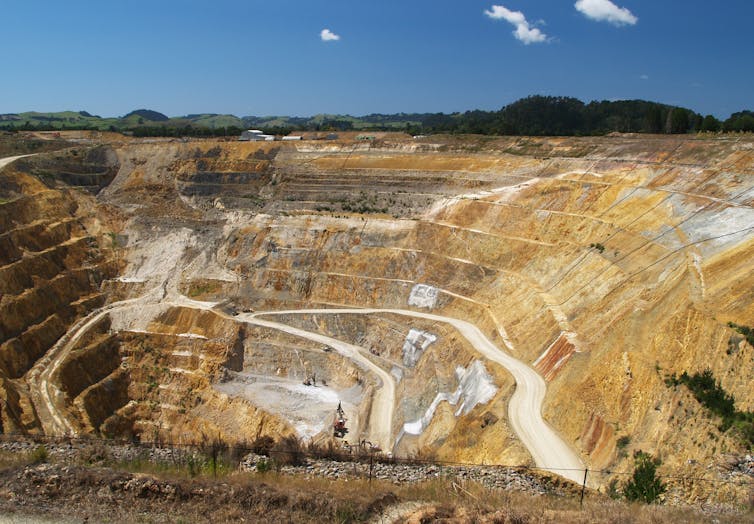 The massive Martha opencast gold mine at Waihi: can crucial environmental decision be left to experts alone?
www.shutterstock.com
The massive Martha opencast gold mine at Waihi: can crucial environmental decision be left to experts alone?
www.shutterstock.com
Listening to and arguing over alternatives is the essence of representative democracy. So as we set about the business of rebuilding, let’s try learn from all of our experts.
Those with expertise in the humanities, social sciences, biophysical sciences, economics and so on have much to offer. But we should also harness the deep knowledge of those who, through these long days of lockdown, have become expert at keeping people connected, creating social capital or building futures markets for local businesses.
These are the people who know their way around the issues in local communities and who have done so much to rejuvenate the village square and the public domain. Let’s make sure we listen to those experts too.
Stay in touch with The Conversation’s coverage from New Zealand experts by signing up for our weekly NZ newsletter – delivered to you each Wednesday.
Authors: Richard Shaw, Professor of Politics, Massey University


















