

Garden Clean-Up vs. Regular Maintenance: Which Do You Really Need?
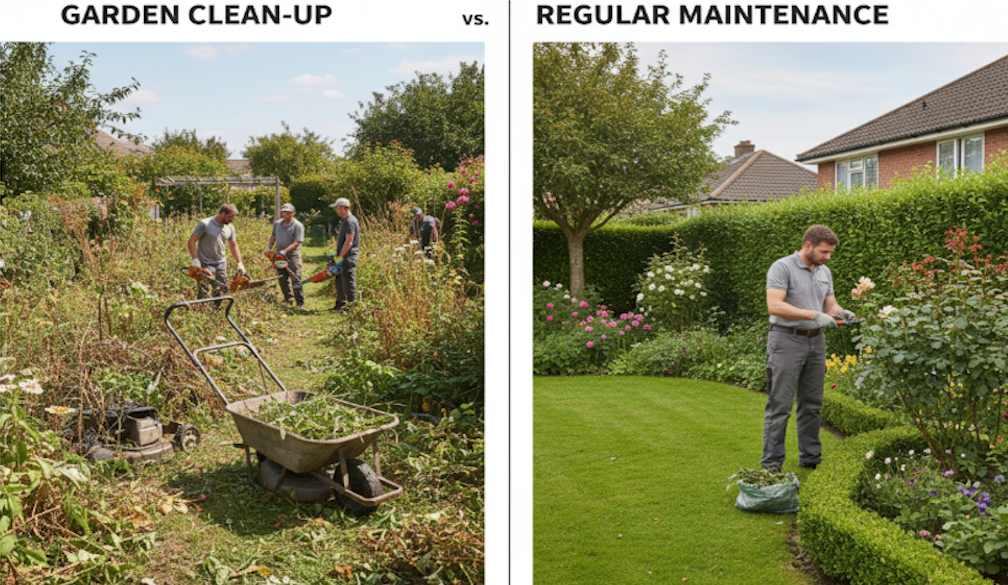
Most people ring a gardener and ask for a "tidy up." What they mean by that, and what the garden actually needs, are often two completely different things. Getting it wrong doesn't just cost money. It means the problem comes back, usually worse, and you're back on the phone six months later wondering why nothing ever sticks.
The answer depends on where your garden is right now. Once you understand the difference between a clean-up and regular maintenance, the right choice becomes obvious.
What a Garden Clean-Up Actually Is
A garden clean-up is an intensive, one-off service designed to bring a neglected or overgrown garden back to a manageable state. It covers the kind of work that regular maintenance simply can't address once things have gotten out of hand. Think heavily overgrown lawn, shrubs that have spread well beyond their beds, weed populations that have taken over, dead plant material piling up, and garden beds that are no longer visible under the mess.
A clean-up is not a luxury. It's a reset. It removes what shouldn't be there and gives the garden a foundation that maintenance can actually work from.
What Regular Maintenance Actually Is
Regular maintenance is scheduled, recurring care that keeps a garden in good condition over time. Fortnightly or monthly visits that cover mowing, edging, pruning, weeding, and general tidying. The goal is prevention, not correction. A well-maintained garden doesn't reach crisis point because problems are caught early and dealt with before they compound.
Regular maintenance works well when the garden is already in reasonable shape. When it isn't, it struggles. A mower can't get through grass that's knee-high. Pruning shears can't bring back shrubs that have been left for two seasons. Maintenance is an ongoing service, not a rescue operation.
The Sequence Nobody Tells You About
Here's where most people go wrong. They book regular maintenance on a garden that needs a clean-up first, or they get a clean-up and never follow through with ongoing care. Both approaches cost more in the long run than doing it in the right order.
A neglected garden needs to be reset before it can be maintained. Clean it up properly, get it back to a workable state, then put a maintenance schedule in place to protect that investment. Without the second step, the garden returns to the same state within a season. Without the first step, the maintenance crew is fighting a losing battle every visit.
Signs Your Garden Needs a Clean-Up First
If any of these sound familiar, a clean-up is where you should start.
The lawn hasn't been mowed in months and the grass is well above ankle height. Weeds have taken over the beds and are spreading into the lawn. Shrubs and hedges have grown into each other or are blocking pathways. There's a build-up of dead leaves, fallen branches, and debris across the property. You can no longer clearly see the garden beds, edges, or lawn borders.
A standard maintenance visit won't resolve these issues. The tools aren't suited to it, the time allocated isn't sufficient, and the underlying problem, accumulated neglect, won't be addressed by a once-over mow and trim.
Why Clean-Up and Maintenance Work Best Together
A clean-up on its own is a short-term fix. It transforms the garden quickly, and that transformation is real. But without a regular schedule to follow it, the garden deteriorates again. Melbourne's climate doesn't take breaks. Growth accelerates in spring and autumn, weeds seed constantly, and leaf fall can overwhelm a garden bed in a matter of weeks.
The clients who get the best long-term results treat the clean-up as the starting point rather than the solution. They get the garden to where it should be, then hand it over to a regular team to keep it that way.
What This Means for NDIS and Aged Care Clients
For anyone accessing NDIS gardening services or Home Care Package funding, this distinction matters practically. Garden maintenance is the funded service in most plans, not a one-off clean-up. Understanding where your garden sits, and whether it needs an initial reset before maintenance begins, helps ensure funded visits are used as effectively as possible. A good provider will assess the garden honestly and tell you what it needs before committing to a schedule.
Getting the Assessment Right
The easiest way to get clarity is to have someone walk through the garden with you before booking anything. An honest assessment takes ten minutes and saves a lot of money. It tells you what state the garden is in, what it needs to get back to a good standard, and what a realistic maintenance schedule looks like from there.
Must Have Maintenance does this as standard before any new engagement. It means clients aren't paying for the wrong service, and the garden gets the right treatment from the first visit.
A clean-up without maintenance is a temporary fix. Maintenance without a clean-up is an uphill battle. Get the right service in the right order and the garden looks after itself.


















