

How to Choose the Right POS Hardware for Your Business in Australia
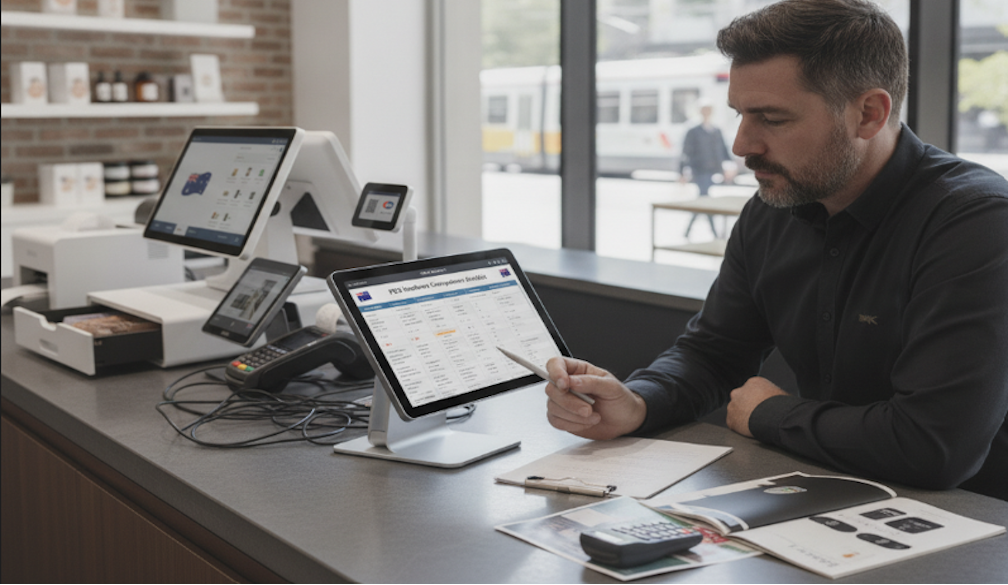
A lot of Australian business owners spend weeks researching POS software but buy hardware almost as an afterthought. That's a mistake. The wrong hardware slows down service, frustrates staff, creates compatibility headaches, and can even drive customers away during checkout bottlenecks.
Your hardware is what your team touches every shift and what your customers see at the counter. Picking the wrong terminal for your environment — or a printer that doesn't talk to your software — creates problems that are annoying to fix and expensive to replace.
The good news: with a bit of structured thinking, choosing the right POS hardware for an Australian business isn't complicated. Here's how to do it properly.
Step 1: Start With Your Software, Not Your Hardware
This is the single most important rule. POS software and hardware must be compatible, and in most cases, your software choice should come first. Once you've settled on a POS platform — whether that's POSApt, Square, Lightspeed, or something else — check their officially supported hardware list before buying anything.
Some POS providers sell bundled hardware packages. These are tested combinations of devices that work together out of the box, which saves you the frustration of discovering that your receipt printer doesn't communicate properly with your terminal. If you're starting from scratch, a bundle is often the safest way to begin.
If you already own hardware — say, an Android tablet or a cash drawer from a previous setup — check whether it's compatible with your new software before assuming you can carry it across.
Step 2: Define What Your Business Actually Needs
Before comparing products, be honest about your setup. Walk through a typical transaction in your business and identify every point where hardware plays a role. Here are the key questions to answer:
- How many transactions do you process per day? A high-volume café doing 300 coffees on a Saturday needs faster, more durable hardware than a boutique store doing 30 sales.
- Do you handle cash? If yes, you need a cash drawer. If you're going cashless, you can skip it.
- Do you sell products with barcodes? Retail businesses nearly always need a barcode scanner. Hospitality venues often don't.
- Do you have a kitchen? Restaurants and cafés should seriously consider a Kitchen Display System or at minimum a kitchen printer.
- Will staff move around? Mobile businesses, food trucks, and venues with table service need portable hardware and wireless connectivity.
- How many terminals do you need? A single café counter needs one. A restaurant with a bar, a host stand, and table service might need three or four.
Step 3: Think About Your Industry
Retail Stores
Retail businesses need hardware that handles high transaction volumes, manages inventory, and scans products quickly. A countertop all-in-one terminal with a barcode scanner and receipt printer is the baseline. Add a customer-facing display to improve transparency at checkout, and consider a label printer if you're printing your own product tags.
If you sell online as well as in-store, look for hardware that integrates with your e-commerce platform, so inventory syncs in real time across both channels.
Restaurants and Cafés
Speed and accuracy are everything in hospitality. A touchscreen terminal that responds quickly and lets staff input orders with minimal taps is non-negotiable. Integrated EFTPOS — where the POS sends the amount directly to the card terminal rather than staff manually re-entering it — is worth every cent in a busy service.
A kitchen display system or kitchen printer keeps orders moving from front-of-house to back-of-house without paper getting lost. For venues that take table service, handheld ordering devices that connect to your POS can eliminate the back-and-forth trip to the register entirely.
Mobile and Pop-Up Businesses
If you're running a market stall, food truck, or pop-up event, your hardware needs to be portable, reliable on battery, and capable of operating on a mobile data connection. A tablet-based POS with a Bluetooth card reader is the most popular setup in this category. Look for a solution with solid offline functionality — if your mobile signal drops, you don't want to stop trading.
Service-Based Businesses
Salons, clinics, and service providers often don't need a barcode scanner or kitchen printer. Their key hardware requirements are a tablet or all-in-one terminal for bookings and checkout, an integrated EFTPOS terminal, and a receipt printer or the option to send digital receipts via email or SMS.
Step 4: Check EFTPOS Integration
Australia is one of the most EFTPOS-reliant markets in the world. Contactless card payments are the norm, and customers expect to tap and go. Any hardware setup you choose needs to handle this seamlessly.
The best setups have the EFTPOS terminal tightly integrated with the POS software — sometimes even built into the same device. This eliminates the need to enter the sale amount twice, reduces errors, and speeds up checkout significantly. When comparing hardware options, ask specifically how EFTPOS integration works and whether it's built-in or requires a separate terminal.
Also check that the hardware supports Apple Pay, Google Pay, and the major card networks. In 2025, customers increasingly expect to pay with their phone or watch as much as with a physical card.
Step 5: Consider Durability and Environment
Think about where your hardware will actually live. A POS terminal on a café counter faces coffee splashes, crumbs, and constant touching by staff with wet hands. A terminal in a fast-food kitchen faces grease, heat, and steam. Hardware that isn't rated for your environment will fail faster, cost more to replace, and create service interruptions at the worst moments.
Look for IP-rated devices (particularly IP54 or higher) if you're in a food service environment. For retail, standard commercial hardware is usually fine, but check for build quality and screen responsiveness — a slow, unresponsive touchscreen is a daily frustration that adds up quickly.
Step 6: Factor in Total Cost of Ownership
The price tag on a POS terminal is only part of the story. Before committing to any hardware, map out the full cost picture over two years:
- Upfront hardware cost: Purchase price or lease fee.
- Software subscription: Monthly or annual fees for your POS platform.
- Payment processing fees: Transaction fees charged per sale by your payment provider.
- Support and maintenance: Is technical support included, or do you pay per call?
- Hardware replacement: What's the warranty period? Who pays for repairs?
Many POS providers in Australia offer free or subsidised hardware as part of a subscription or merchant services agreement. These deals can be attractive, but read the fine print — some lock you into long-term contracts with exit fees. A system that appears cheap upfront can end up more expensive over two years than one with a higher sticker price and lower ongoing fees.
Step 7: Prioritise Local Support
When your POS goes down at 11am on a Saturday morning, you don't want to be on hold with an overseas call centre. Local support — whether that means an Australian-based support team, a local reseller who can come on-site, or at minimum support hours that align with Australian time zones — is genuinely important.
Ask every provider you're considering: what happens when my hardware fails during business hours? How fast can you get me back online? The answers will tell you a lot about what your actual experience will be after the sale.
Step 8: Plan for Growth
Buy hardware that fits your business today, but don't paint yourself into a corner. If you're planning to open a second location in 18 months, make sure your hardware ecosystem can scale. Can you add terminals without replacing the entire setup? Will your POS software handle multi-site management, and does the hardware support it?
It's also worth thinking about payment trends. Buy Now, Pay Later services like Afterpay are increasingly expected by Australian consumers. QR code ordering and self-service kiosks are becoming standard in high-traffic venues. Choose hardware that can accommodate these without needing a full replacement.
A Quick Hardware Checklist for Australian Businesses
- Software compatibility confirmed before purchasing any hardware.
- EFTPOS integration is seamless, not manual entry.
- Terminal supports tap, chip, PIN, Apple Pay, and Google Pay.
- Receipt printer compatible with your POS and appropriate for your environment.
- Cash drawer included if you accept cash payments.
- Barcode scanner included for retail product-based businesses.
- Kitchen display or kitchen printer for food service venues.
- Hardware rated for your environment (food safe, dust/spill resistant if needed).
- Total cost of ownership calculated over 24 months.
- Local or Australian-based support available during trading hours.
- Scalability confirmed for additional terminals or locations.
Final Word
Choosing POS hardware for your Australian business doesn't have to be overwhelming. The key is to start with your software, understand your day-to-day operational needs, and buy for your environment rather than just the spec sheet. Prioritise EFTPOS integration, local support, and total cost of ownership — and you'll end up with a setup that earns its keep from day one.
Take the time to ask providers the hard questions before signing anything. The best POS system for your business is the one that fits your workflow, survives your environment, and keeps your customers moving through the door quickly.



















