
How Natural Pearls Shaped Trade Routes and Global Economies
- Written by Modern Australian
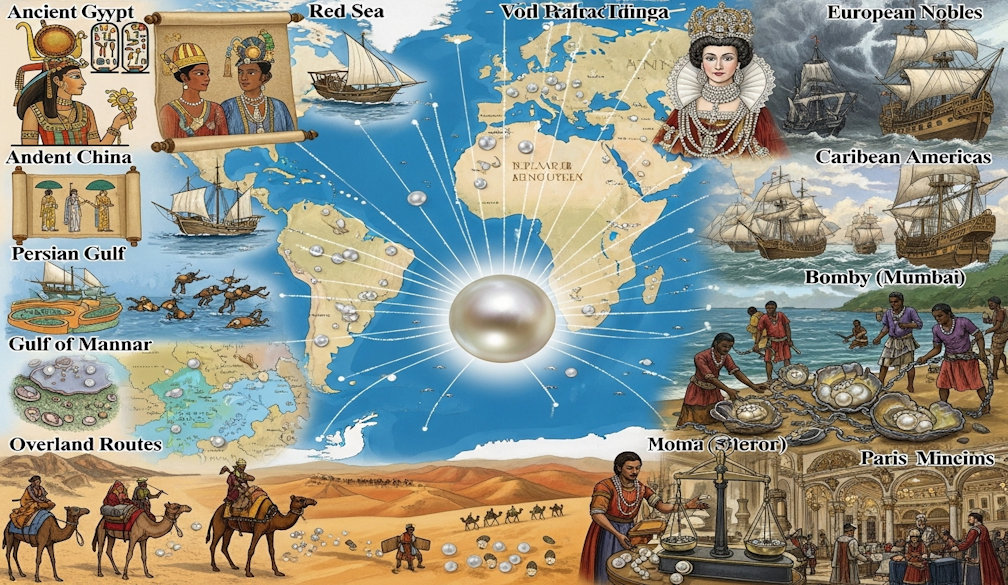
Throughout history, natural pearls—those rare, untamed treasures formed by nature itself—have exerted a powerful influence on trade networks, politics, and economies large and small. Their magnetic allure prompted expeditions, rewrote maritime maps, and even altered the fortunes of entire regions. In this post, we explore how these luminous gems shaped global commerce—and how regions like Australia, with their own storied pearling past, fit into that broader saga.
The Allure of Nature’s Gift
Pearls have occupied a unique place in human culture for millennia. In ancient civilisations from Egypt to China, they adorned royalty, religious artefacts, and ceremonial dress. Because they require no cutting or polishing to reveal their beauty, pearls symbolised purity, status, and divine favour.
Yet, natural pearls are exceedingly scarce—only a tiny fraction of molluscs produce them, and even fewer yield ones of gemstone quality. This rarity elevated their value and turned them into commodities worth chasing across seas and deserts.
When European and Asian elites clamoured for these lustrous gems, the geography of supply and demand forced merchants and monarchs alike to link far-flung corners of the world by trade. In the process, natural pearls carved new corridors of exchange and redrew economic lines of influence.
Ancient Routes and the Foundations of Pearling Trade
The Eastern Pearl Basins
Long before European navies roamed the seas, pearl beds in the Persian Gulf, the Red Sea, and the Gulf of Mannar (between southern India and Sri Lanka) were world-renowned. Merchants, divers, and rulers vied for control over those beds. In ancient times, the Persian Gulf in particular depended heavily on pearls: until well into the 20th century, pearls remained a main source of income for the local population.
Pearls from these regions were traded via marine and land routes. From the Gulf, pearls moved to ports like Hormuz, Basra, and Bahrain, and from there onward via Indian Ocean networks or through overland routes to the Mediterranean.
Because the demand for pearls overshadowed that of bulk commodities like spices or textiles, these routes often specialised in luxury commerce. The pearls might pass through many hands—Arab merchants, Indian brokers, Persian traders—before ultimately gracing European courts.
Pearl Influence on Overland Routes
While pearls were dominantly a maritime commodity, their trade did reinforce the significance of terrestrial corridors too. From Mediterranean cities eastward, pearls often traveled alongside luxury goods—silks, incense, precious metals, and spices—on paths that would later evolve into the Silk Road network.
In many regions, local control of pearl-rich coastal areas enabled inland polities to extract wealth. Strategic coastal cities became trading hubs, leveraging pearl commerce to fund armies, build infrastructure, and cement influence.
The New World and Expansion of the Pearl Frontier
With the European voyages of discovery came new pearl sources—especially along the Caribbean and Gulf coasts of the Americas. Spanish explorers encountered indigenous communities already harvesting marine and freshwater pearls.
As European demand surged, so did exploitation. Massive pearling operations mobilised labour—often forced or coerced—and shipped vast tonnages of molluscs and shells back to Europe, fueling a new phase in the global pearl economy.
But the boom was not sustainable. Overharvesting led to depletion of beds, and as supply declined, pearl prices soared—yet the ecological and social costs were substantial.
The Atlantic pearl trade also reinforced transoceanic shipping lanes, port infrastructure, and colonial economic systems. Pearl-derived revenue helped finance colonial expansion, plantation economies, and maritime logistic networks.
Pearls, Centres of Commerce, and Economic Power
As pearl trade matured, certain cities emerged as nodes of influence—where supply, grading, auction, and distribution converged.
Bombay and Paris: Dual Hubs
For centuries, Bombay (now Mumbai) was a dominant trading hub for natural pearls. Its strategic location between traditional pearling regions (Persian Gulf, Gulf of Mannar, Red Sea) and its position on East–West shipping lanes gave it a natural advantage.
Pearl merchants in Bombay aggregated supply, managed grading and sorting, and dispatched consignments to Europe and beyond.
By the late 19th and early 20th centuries, Paris began to usurp Bombay’s role in controlling valuation and marketing. French jewellers developed refined classification systems, centralised auctions, and imposed standards—effectively steering global pricing.
This shift illustrates how pearls, though harvested in remote seas, became instruments of economic centralisation: controlling the grading, classification, and marketing of the gem allowed a few powerful intermediaries to capture far more value than the original harvesters.
Regional Centres: Gulf Towns, Zubarah, Bahrain
In the Gulf region, towns like Zubarah (in present‑day Qatar) were built on pearling economies. At its peak, Zubarah served as both a departure point for diving fleets and a market centre for pearls, connecting local production to wider trade networks.
Bahrain’s pearling economy also left a strong legacy: the modern Bahrain Pearling Trail acknowledges how the island’s fortunes were intimately tied to pearling.
In many cases, up to a third of male labor in some Gulf communities was invested in pearl diving. Thus pearls weren’t merely luxury goods—they were a central pillar of livelihoods, urban development, and social organisation.
Pearl Economies, Scarcity, and the Shift to Cultured Pearls
By the early 20th century, the pressures of relentless exploitation, declining stocks, and rising demand were clear. Natural pearls had become almost prohibitively rare.
The advent of cultured pearl technology—pioneered by innovators such as Kokichi Mikimoto in Japan—dramatically altered the balance. What had once been a rare and precarious luxury became, in many forms, an industrialised product.
As cultured pearls scaled, the global pearl trade shifted away from wild harvesting toward aquaculture. Strikingly, the centres of power in the trade also shifted—from Paris and Bombay to Tokyo and then to new producing nations.
Natural pearls, when they remained, became ultra‑luxury items—trophies in auctions or bespoke pieces. Their scarcity made them symbols of rarity and prestige once more.
Australia’s Role in the Pearling Story
While many early narratives centre on Asia, the Middle East, and the Americas, Australia also plays an intriguing part—particularly in the later phases of pearling history.
The northwest Australian coast, the Torres Strait, and the Arafura Sea host oyster species of high commercial importance (notably Pinctada maxima and Pinctada margaritifera).
Natural pearls from Australian oyster beds were not prolific, but their beauty, size, and quality made them prized. Indeed, in 1868, shells from Australian oyster beds fetched about 60,000 pounds sterling in London—an enormous sum at the time.
Over time, Japanese investors entered the Australian pearling industry, and by the late 19th century many divers were Japanese.
In modern times, Australia’s pearl legacy continues—not only in its wild oyster beds but also in cultured production and marketing. As one example, producers emphasise the heritage and quality of Australian pearls in their branding.
The influence of Australian pearl production is most pronounced in the South Sea pearl market, where large, lustrous pearls command premium positions. By contributing to global supply, Australian producers have shaped pricing, standards, and expectations in the luxury pearl world.
The Economic Legacy of Natural Pearls
When we step back, what emerges is a powerful truth: pearls—delicate, rare gifts of the sea—acted as economic catalysts. Their influence manifested in several dimensions:
- Maritime and Transport Investment
The pursuit of pearls encouraged investment in ships, navigational knowledge, ports, and supply lines—foundations that later could be extended to other goods. - Colonial and Imperial Dynamics
Colonial powers leveraged pearl-rich territories for revenue, often imposing control over pearl beds, labour systems, and export monopolies. - Commodity Specialisation
Regions with pearl resources often specialised economically, depending heavily on pearling in their balance of trade, taxation systems, and social structure. - Market Centralisation and Value Capture
A few centres mastered grading, classification, auction, and marketing—capturing a disproportionate share of value compared to producers and harvesters. - Technological and Institutional Responses
As natural supply faltered, the move toward cultured pearls was as much institutional and economic as it was scientific—reshaping how pearls were produced, sold, and regulated. - Luxury, Identity, and Soft Power
Beyond raw economics, pearls became symbols—of royal status, national prestige, and cultural identity. Ownership of spectacular pearls elevated monarchs, diplomats, and collectors alike.
Final Thoughts
Natural pearls, by their very nature, invoke ideas of beauty, chance, and rarity. Yet their influence on human society has been anything but passive. They spurred expeditions, anchored towns, enriched traders, and rewired global commerce.
While the era of abundant natural pearls has largely passed, their legacy endures—in our museums, our auction houses, and our cultural memory. And where modern pearl farming has grown, the echo of that legacy still informs markets, branding, and economic strategy.
If you ever explore the modern pearl world, you’ll find that the echoes of those ancient trade currents still ripple in every lustrous sphere.