

Australia wants to level the playing field, Facebook politely disagrees
- Written by: Tim Dwyer, Associate Professor, Department of Media and Communications, University of Sydney
The Australian government is setting out to develop a “bargaining code” to address power imbalances between news media publishers and digital platforms such as Facebook and Google. The creation of this code was recommended last year in the final report of the Digital Platforms Inquiry held by the Australian Consumer and Competition Commission (ACCC).
The ACCC is planning to publish a draft version of the code at the end of July, but in the meantime it has asked interested parties to contribute their views. Most submissions won’t be made public until the draft code is released, but some stakeholders – including Facebook – have published their submissions themselves.
In Facebook’s submission, it sets out to rebut the ACCC’s understanding of the digital media landscape.
Facebook argues it doesn’t really need news publishers because news content is substitutable, and anyway the platform prioritises content from family and friends in people’s news feeds.
In effect, Facebook is saying it does more good than harm to journalism and news media businesses. The bargaining process hinges on a dispute over the value of news content and exactly what it contributes to the platform’s business – which is currently unclear, particularly to those outside the tent.
Read more: No more negotiating: new rules could finally force Google and Facebook to pay for news
Valuing news
Facebook’s approach plays into a narrative about how consumers and advertisers migrated to the web in the early 21st century, collapsing the 150-year-old advertising model of newspapers.
Historically, news was the “poor cousin” in direct commercial arrangements between advertisers and newspapers (and later broadcasters). News evolved as byproduct of this exchange and so it remains, secondary to the main game, a kind of subsidy and a “filler” to be used by these giant digital machines of platform capitalism.
But news is also acknowledged as a public good with broader societal benefits. Platforms are slowly realising they cannot avoid regulation to reduce the harms that result from their own market dominance.
Facebook’s chief executive Mark Zuckerberg has identified the platform’s key problematic areas as “harmful content” (such as hate speech and inappropriate imagery) and “election content” (such as targeted political advertising).
Facebook itself has moved from strongly opposing external regulatory interventions to guardedly accepting the idea, as long as the particular regulation suits them.
A strategic rebuttal
In its ACCC submission, Facebook argues it hasn’t contributed to the demise of news businesses by hoovering up advertising revenue. Instead, it points out the rise of the internet had already sent news media into structural decline.
If anyone is to blame, according to Facebook, it is the news businesses themselves who didn’t see the digital tsunami on the horizon.
Unsurprisingly, Facebook does not mention its own substantial market power: with Google, the social media giant carries the bulk of online advertising. As US media scholar Victor Pickard has noted, Facebook and Google between them collect 85% of all growth in digital advertising revenue, leaving very little for news publishers.
Facebook’s take on the news market
Facebook argues the ACCC, the news industry and the rest of us are all suffering from “misconceptions”. In broad terms these are: that Facebook is responsible for the market failure of news; that it “steals” news content and news publishers have no control over its surfacing; and that there’s a value imbalance between the platforms and news media businesses which favours Facebook, and therefore Facebook should compensate the businesses at commercial rates.
However, Australians are increasingly getting their news via social media newsfeeds. Research from the University of Canberra shows the COVID-19 pandemic has boosted this trend, and Reuters has found older Australians too are increasingly using social media as a pathway to news.
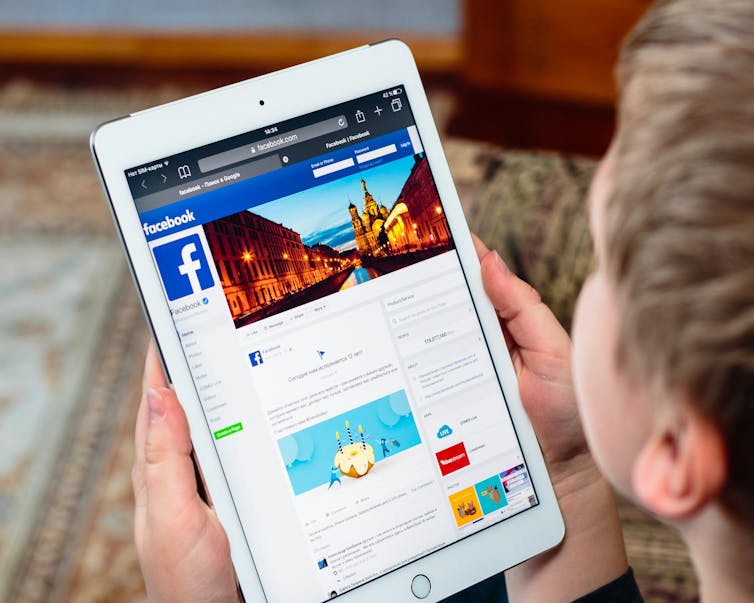 Australians are increasingly getting their news via social media.
Shutterstock
Australians are increasingly getting their news via social media.
Shutterstock
Clearly, digital platforms and news media businesses have a symbiotic relationship. But it is far from an equitable one: with a market capitalisation of US$671 billion, annual revenue of more than US$70 billion, and around 1.73 billion users every day, Facebook dwarfs any news media business.
As social media platforms are growing more important when it comes to accessing news, and news is a social good, the ACCC is calling for a more sustainable, if not an aspirationally equitable relationship.
Facebook likes the idea of a new Australian Digital Media Council modelled on the Australia Press Council. It would arbitrate disputes between news media publishers and digital platforms.
But is this a reasonable comparison? Can news publishers be equated with individual complainants who seek remedies?
Trying to dodge responsibility?
The central theme of Facebook’s submission is a refusal to acknowledge there is a power imbalance between news media businesses and Facebook and Google that needs to be addressed.
Facebook questions the idea of even casting their relationship to the news media sector in that way. Indeed, the company appears to be in denial about the simple fact noted by Treasurer Josh Frydenberg’s comment on the handing down of the Digital Platforms Inquiry report:
Make no mistake, these companies are among the most powerful and valuable in the world.
If nothing else, Facebook has demonstrated its well-oiled PR machine and the phalanx of people ready to defend its surging revenue base. Its counter-arguments to the ACCC are evidence of this, and also a determination to maintain absolute algorithmic control over the news feed.
From Facebook’s perspective, a key impact of COVID-19 has been that people are now spending increasing amounts of time on their platform.
Authors: Tim Dwyer, Associate Professor, Department of Media and Communications, University of Sydney


















