

Melbourne's COVID-19 hotspots are also housing crisis hotspots
- Written by: Rebecca Bentley, Professor of Social Epidemiology, Centre for Health Equity, Melbourne School of Population and Global Health, University of Melbourne
Melbourne is once again grappling with increasing COVID-19 rates. Ten suburbs in Melbourne have been designated COVID-19 outbreak hotspots: Broadmeadows, Keilor Downs, Maidstone, Albanvale, Sunshine West, Hallam, Brunswick West, Fawkner, Reservoir and Pakenham.
The outbreaks have sparked discussions about lockdowns and travel restrictions for people living in these parts of Melbourne and generated intensive suburb-specific testing.
The outbreaks have been attributed to family gatherings in homes and people failing to self-isolate, even after positive test results. This has occurred alongside possible breaches of infection control protocols in hotels accommodating people in quarantine – with security guards from major hotels having contracted the virus.
Read more: The housing boom propelled inequality, but a coronavirus housing bust will skyrocket it
Socio-spatial clues
While chance and circumstances converge to create outbreaks there are also some obvious factors related to where and how people live that impact their capacity to isolate.
As we potentially face a two year-long wait for vaccines (16 are in clinical evaluation internationally (with one being developed in Australia), we need to acknowledge the spatial concentration of these sites of vulnerability is not random. There are socio-spatial clues as to why we have had outbreaks in these locations.
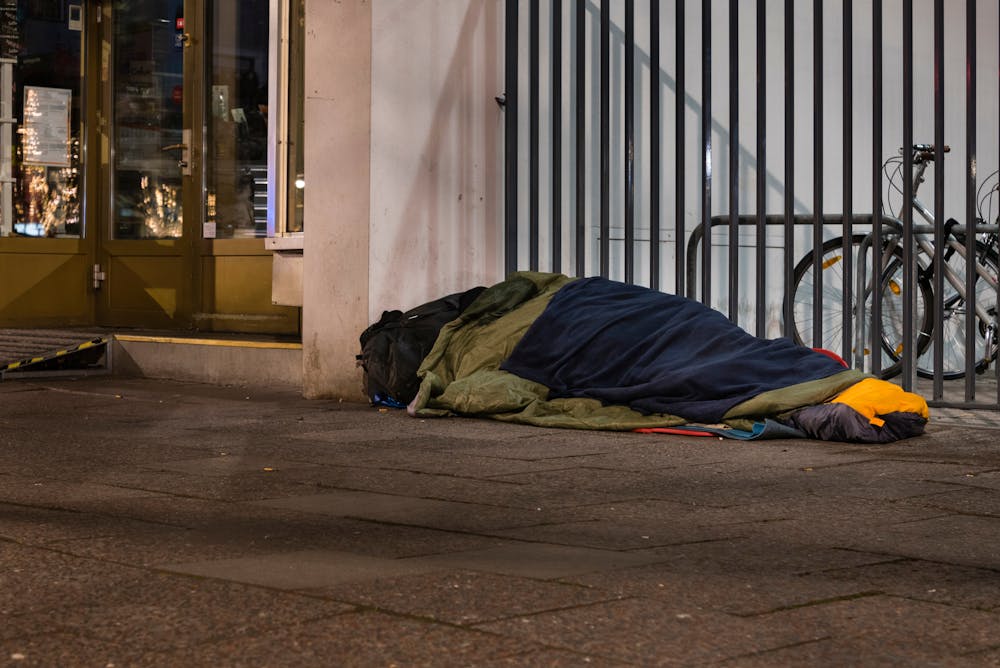 Four measures: overcrowding, homelessness, housing affordability stress and financial hardship often occur in the same areas.
Shutterstock
Four measures: overcrowding, homelessness, housing affordability stress and financial hardship often occur in the same areas.
Shutterstock
First, the hotspots have some of the highest rates of housing precarity and financial hardship across Melbourne. People in overcrowded or unaffordable or insecure housing may have less control over their immediate environment and less capacity to isolate themselves than other community members.
Read more: Homelessness and overcrowding expose us all to coronavirus. Here's what we can do to stop the spread
The recent Melbourne outbreaks have occurred largely in areas with:
high housing affordability stress: where those in the lowest 40% of income spend more than 30% of their household income on housing,
overcrowding: measured in terms of the number of people in a household, their age and gender in relation to the number of bedrooms in a dwelling, and/or
homelessness: where a person does not have suitable accommodation alternatives and their current living arrangement is in a dwelling that is inadequate, has no tenure, or if their initial tenure is short and not extendable or does not allow them to have control of, and access to space for social relations.
While housing security seems like an obvious problem to fix, it remains a long-standing, difficult issue for governments to tackle. Going into the COVID-19 pandemic, Australia exhibited high rates of homelessness and spiralling housing costs.
Many people in Melbourne and Sydney live in overcrowded or inadequate forms of housing as a result of what has become known as our “housing affordability crisis”. Alongside this, the numbers of people who require emergency accommodation far outstrip our cities’ capacity to house them on a medium- to long-term basis.
Second, people without savings may be compelled to go to work despite feeling unwell. They need to meet their weekly housing costs and don’t have savings enough to go two weeks (or longer) without income. This can occur even if people have negotiated reduced rent with their landlords.
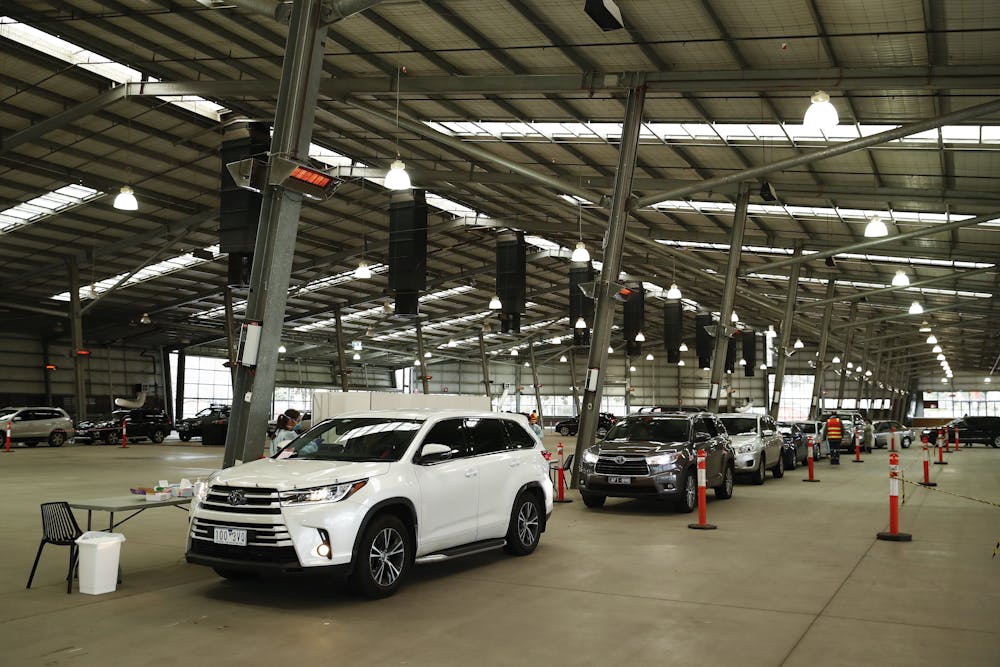 A spike in cases in Victoria has led to widespread testing in hotspots.
Daniel Pockett/AAP
A spike in cases in Victoria has led to widespread testing in hotspots.
Daniel Pockett/AAP
Where housing and COVID-19 collide
When one considers these housing and financial factors from the perspective of COVID-19 suppression, their geographical clustering should not be disregarded. The areas in Melbourne with high rates of household overcrowding, homelessness, housing affordability stress and (related to this) financial hardship (often measured using people’s self-reported capacity to access funds in an emergency) map closely to areas where there are now high numbers of COVID-19 cases.
Using publicly available data, we created a simple index describing capacity isolate based on the above four characteristics. We created maps of Greater Melbourne to examine the relationship between current COVID-19 cases and these housing and financial vulnerability factors. Our index shows Hallam, Sunshine West, Albanvale, Broadmeadows, Falkner, Reservoir and Maidstone are all in the top two quintiles.
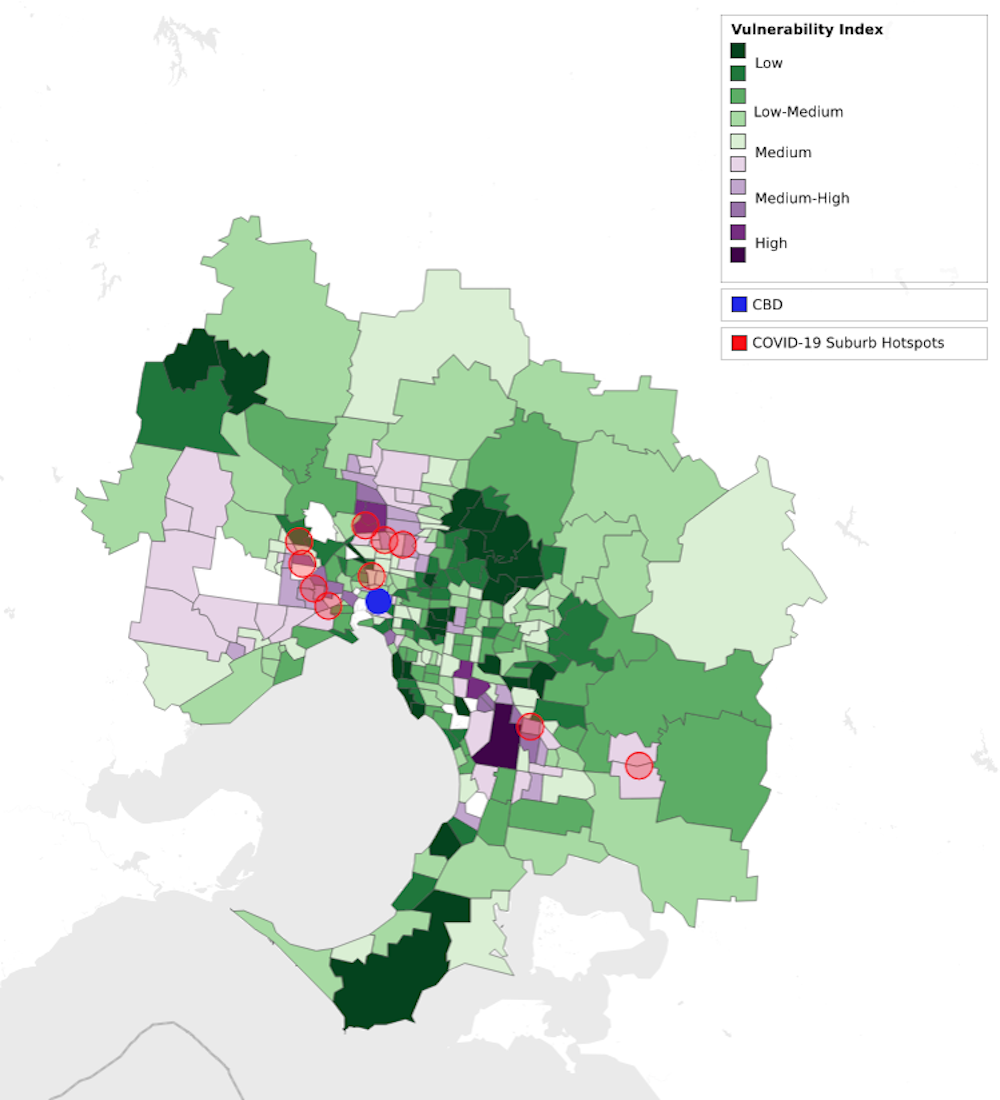 Housing Vulnerability Index for Greater Melbourne.
NATSEM - Social and Economic Indicators - Synthetic Estimates SA2 2016; ABS - Data by Region - Family & Community (SA2) 2011-2016; and UNSW CFRC - Overcrowded Households Australia (SA2) 2016. Data were accessed on 26 June 2020 from AURIN Portal (https://portal.aurin.org.au/), Author provided
Housing Vulnerability Index for Greater Melbourne.
NATSEM - Social and Economic Indicators - Synthetic Estimates SA2 2016; ABS - Data by Region - Family & Community (SA2) 2011-2016; and UNSW CFRC - Overcrowded Households Australia (SA2) 2016. Data were accessed on 26 June 2020 from AURIN Portal (https://portal.aurin.org.au/), Author provided
Over the last decade, Melbourne has seen itself become more spatially segregated. And household overcrowding and precarity are geographically clustered.
Acknowledging correlation is not causation, these findings suggest solving some of Melbourne’s housing problems might reduce the spread of COVID-19 now and in future outbreaks as we await a vaccine.
Taking this further, when assessing where in cities we are likely to see a spike in cases in the future, we should take housing-related vulnerabilities into account alongside other factors.
While steps have been taken by the Victorian government to address some of the issues we have flagged, such as the one-off payment of up to A$2,000 for eligible renters who are unable to afford rent, and the A$1,500 payment to people who test positive and have no leave cover, more could be done in the medium to long term to reduce the risk of overcrowding, housing related financial stress and precarious forms of housing (that lead to homelessness) across the city.
The past months of COVID-19 restrictions have highlighted how critical housing and financial security are to our health and well-being at both an individual and population level. The Victorian Council of Social Service has noted disasters can be “profoundly discriminatory” in where they occur, and in their impacts.
Successful COVID-19 suppression requires safe and equitable cities and addressing housing vulnerability is one of the many challenges we must take up.
Authors: Rebecca Bentley, Professor of Social Epidemiology, Centre for Health Equity, Melbourne School of Population and Global Health, University of Melbourne


















