

Thinking about working from home long-term? 3 ways it could be good or bad for your health
- Written by: Carol T Kulik, Research Professor of Human Resource Management, University of South Australia
The coronavirus pandemic has forced many of us to work from home, often in less than ideal circumstances.
Many employees had little choice in the decision, limited time to prepare, patchy technology skills, and inadequate home workspaces. Some managers neglected remote workers, while others zealously monitored them.
And yet some people thrived. Having tried it, many employees anticipate they will continue to work from home, and value employers who encourage it.
So if you decide to continue working from home after the pandemic, is it good or bad for your health in the long run?
Read more: Coronavirus could spark a revolution in working from home. Are we ready?
1. Less fit or more fit?
Easy access to snacks meant some employees may have gained weight while working from home during the pandemic. Some employees stared at their screen for hours, sitting in awkward positions with no breaks.
Excessive screen time can damage the retina, and poorly designed workspaces can generate back pain and stress injuries. In the long run, sedentary behaviour is associated with a range of physical health problems, including higher cancer risks.
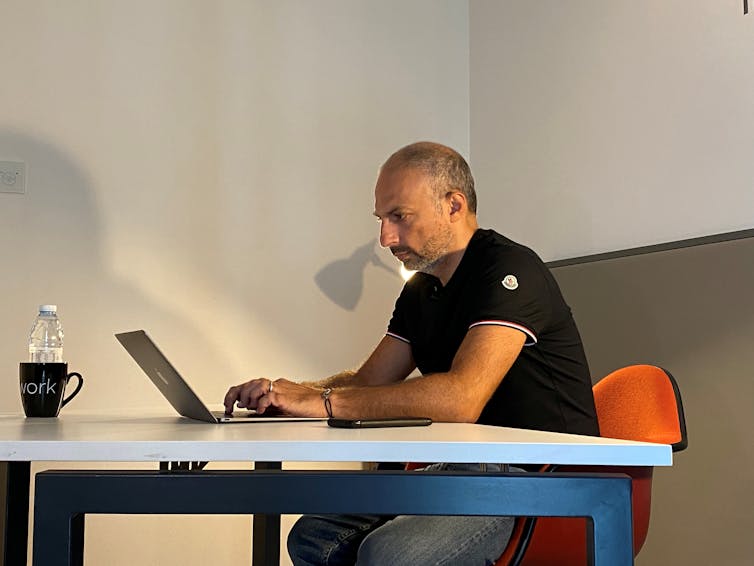 Sitting down all day is linked with various health problems. Employees working from home need to be supported to take breaks and engage in physical activity.
Reuters/Abdel Hadi Ramahi
Sitting down all day is linked with various health problems. Employees working from home need to be supported to take breaks and engage in physical activity.
Reuters/Abdel Hadi Ramahi
But properly supported working from home could improve employees’ health. It enables them to work toward aspirational fitness goals by scheduling workouts at convenient times.
It creates opportunities for employees to take breaks from the laptop to toss in a load of laundry, take the dog for a quick walk, vacuum the carpets, or do a few stretches in another room. Small bits of activity, interspersed throughout the day, have long-term positive impacts on physical and psychological health. Ten minutes of energetically climbing the stairs in your house could boost your lung capacity and raise your spirits.
Achieving those benefits requires employees to have control over their work schedule. Organisations can help by providing resources to design better home workspaces and software that nudges employees to take breaks throughout the day.
2. More free time, or just more time working?
Commuting — especially by car in dense communities — exposes employees to air pollution and raises their risk of respiratory or cardiovascular problems. In theory, working from home should let employees breathe easier, both physically and psychologically. Avoiding the commute saves time and money, two crucial resources that can be channelled to improve the quality of employees’ personal lives.
However, the commute serves a valuable function that is often overlooked. It gives employees time to transition between work and non-work roles, which is especially important for people in difficult service and professional jobs.
The loss of a 30-minute commute can blur boundaries and increase stress spillover between work and non-work. When we lose the defined “buffer zone” of a commute, too often the “saved time” is gobbled up by more work. Long work hours are associated with more stress, lower-quality sleep and higher blood pressure.
Working from home therefore needs to incorporate transitional periods that substitute for a commute. This might be as simple as a walk around the block before sitting down at the desk, or doing a meditation practice before cooking dinner.
Organisations need to respect role boundaries too. This involves clarifying when employees need to be available, and establishing clear policies about email and phone access outside business hours.
3. Less distraction, or lonely and disconnected?
Working from home can create opportunities for employees to engage in “deep work” — focusing on a demanding task without distraction. It helps employees fully engage with their work when they are working, and be more psychologically present with their family when they are not working.
Employees who work from home can intersperse their work and family time to benefit the entire family, for example by using a work break to read a story or share a meal. Quality moments of connection with parents have a more significant impact on children’s academic achievement, behaviour, and emotional well-being than the quantity of interactions.
 Workers who engage in office chatter tend to enjoy work more.
Shutterstock
Workers who engage in office chatter tend to enjoy work more.
Shutterstock
But not every employee has those close family relationships, and contact with coworkers can be an essential source of support for many workers. Employees who participate in office small talk experience more positive emotions, go out of their way to help coworkers, and end the workday in a better frame of mind.
The spontaneity of office small talk is hard to replicate in a virtual context, so employees working from home can experience loneliness. This can lead to depression, insomnia, and substance abuse. In terms of death and disease, loneliness is in the same league as smoking, obesity and alcoholism.
Read more: In praise of the office: let's learn from COVID-19 and make the traditional workplace better
Organisations can help by providing “virtual cafés” to foster informal interactions. Research also recommends hybrid models of remote work that can achieve the benefits of working from home (more focused time for deep work) alongside those of the office environment (more collaboration with coworkers). For example, employees might work from home four days a week, with the fifth day in the office.
Employees need to be supported
Working from home is not always better or worse for an employee’s health than traditional office arrangements.
It will be most beneficial when employees make wise decisions about their time, and employers provide support in the form of technology, ergonomic equipment, and managers trained to supervise remote workers.
Most importantly, when employees are given choice over the schedule and location of their work, the psychological, physical and productivity benefits can double.
Read more: Working from home: what are your employer's responsibilities, and what are yours?
This article is supported by the Judith Neilson Institute for Journalism and Ideas.
Authors: Carol T Kulik, Research Professor of Human Resource Management, University of South Australia


















