

Humans inhabited North America in the depths of the last Ice Age, but didn't thrive until the climate warmed
- Written by: Lorena Becerra-Valdivia, Postdoctoral Research Fellow, UNSW
Humans lived in what is now Mexico up to 33,000 years ago and may have settled the Americas by travelling along the Pacific coast, according to two studies by myself and colleagues published today.
It has been commonly believed that the first people to enter the Americas were big-game hunters from Asia, who arrived after the last Ice Age around 13,000 years ago. This narrative is known as the “Clovis first” theory, based on distinctive stone tools produced by a people archaeologists call the Clovis culture.
For most of the 20th century, this theory was widely accepted. However, more recent archaeological evidence has shown humans were present in the Americas before the Clovis people.
Just how much earlier, however, is unclear and a topic of intense academic debate.
Read more: Ancient DNA in lake mud sheds light on the mystery of how humans first reached America
What we found in Chiquihuite Cave
Chiquihuite Cave is an archaeological site more than 2,740 metres above sea level in Zacatecas, Mexico. Ciprian Ardelean of the University of Zacatecas has been leading excavations of the site for more than seven years. Nearly 2,000 stone tools and pieces created through their manufacture have been found.
The tools belongs to a type of material culture never before seen in the Americas, with no evident similarities to any other cultural complexes. Importantly, more than 200 specimens were found below an archaeological layer that corresponds to the peak of the last Ice Age. (Archaeologists call this peak the Last Glacial Maximum.)
During this time, between 26,000 and 19,000 years ago, ice sheets were at their greatest extent. Evidence from Chiquihuite Cave, therefore, strongly suggests that humans were present in North America well before Clovis.
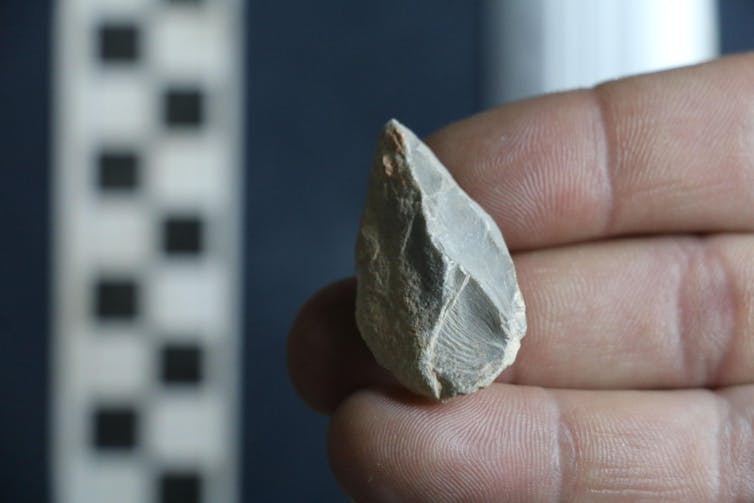 A stone tool found below the Last Glacial Maximum layer.
Ciprian Ardelean, Author provided
A stone tool found below the Last Glacial Maximum layer.
Ciprian Ardelean, Author provided
Given the significance of the discovery, myself and a team of international researchers joined in the interdisciplinary study of Chiquihuite Cave. Some of us had the opportunity to visit the site following a four-hour long journey by foot, and see the evidence at first hand. Our aims were to reconstruct the environment humans lived in and define exactly when they occupied the site.
My own research at Chiquihuite Cave focused on the latter. I helped to build a chronology of more than 50 radiocarbon and optical dates.
Combined with the archaeological evidence, the results showed humans inhabited Chiquihuite as early as 33,000 years ago, until the cave was sealed off at the end of the Pleistocene period (around 12,000 years ago).
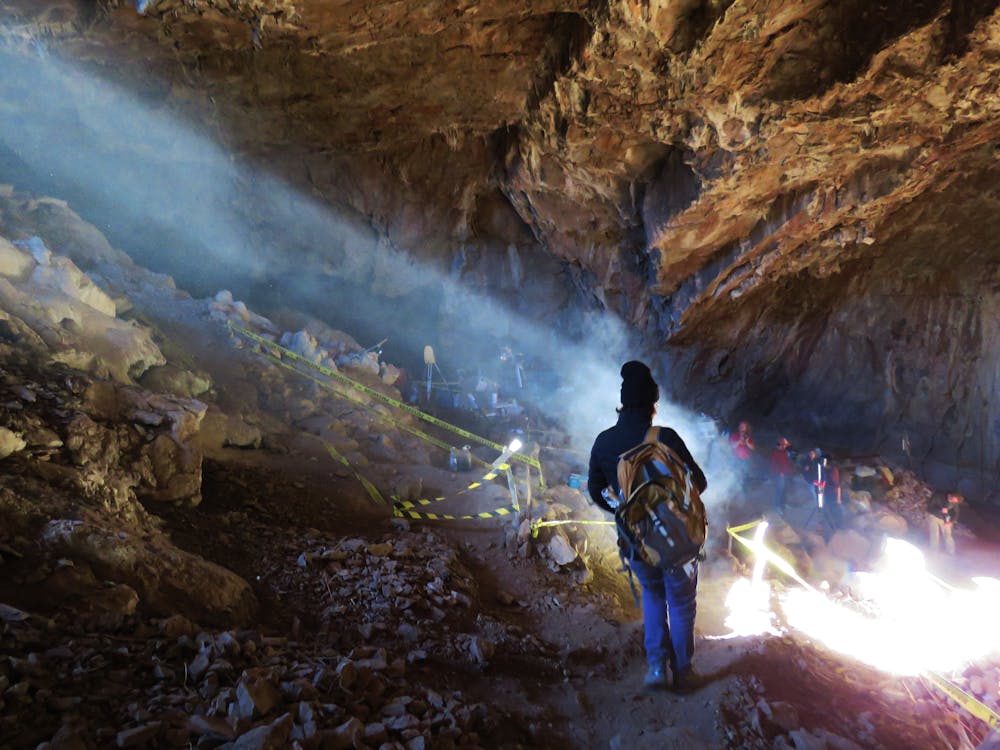 Lorena Becerra-Valdivia inside Chiquihuite Cave in 2019, walking towards the archaeological excavations.
Thomas L.C. Gibson, Author provided
Lorena Becerra-Valdivia inside Chiquihuite Cave in 2019, walking towards the archaeological excavations.
Thomas L.C. Gibson, Author provided
The pattern of settlement
In a second paper, I explore the wider pattern of human occupation across North America and Beringia (the ancient land bridge connecting America to Asia). This involved analysing hundreds of dates obtained from 42 archaeological sites in North America and Beringia, including Chiquihuite Cave, using a statistical tool called Bayesian age modelling.
The analysis showed there were humans in North America before, during and immediately after the peak of the last Ice Age. However, it was not until much later that populations expanded significantly across the continent.
This occurred during a period of climate warming at the end of the Ice Age called Greenland Interstadial 1. The warming began suddenly with a pulse of increased global temperature around 14,700 years ago.
We also observed that the three major stone tool traditions in the wider region started around the same time. This coincides with an increase in archaeological sites and radiocarbon dates from those sites, as well as genetic data pointing to marked population growth.
This significant expansion of humans during a warmer period seems to have played a role in the dramatic demise of large megafauna, including types of camels, horses and mammoths. We plotted the dates of the last appearance of the megafauna and found they largely disappeared within this, and a following, colder period.
However, the contribution of climate change in faunal extinctions, represented by abrupt warming and cooling, cannot be fully excluded.
The first human arrivals came from eastern Eurasia, yet it looks as though there was a surprisingly early movement of people into the continent.
We think the path of earlier arrivals to these new lands was probably along the coast. Inland travel would have been blocked, either because Beringia was partly underwater or because modern-day Canada was covered by impenetrable ice sheets.
Together, the two studies and their results depart from previously accepted models, and allow us to uncover a new story of the initial peopling of the Americas. This journey, marking one of the major expansions of modern humans across the planet, will continue to mystify and spark debate.
Authors: Lorena Becerra-Valdivia, Postdoctoral Research Fellow, UNSW


















