

Collaborating with communities delivers better oral health for Indigenous kids in rural Australia
- Written by Kylie Gwynne, Senior Lecturer, Health Leadership, Macquarie University
Aboriginal children in rural Australia have up to three times the rate of tooth decay compared to other Australian children.
Tooth decay can affect a person’s overall health and nutrition because it can affect how they chew and swallow. Tooth decay can also reduce self esteem because of its effect on appearance and breath. And importantly, poor oral health increases the risk of chronic disease such as heart disease.
Yet tooth decay is both preventable and treatable.
Broadly speaking, improving oral health is critical to closing the gap in health outcomes between Aboriginal and Torres Strait Islander Australians and Australians overall. Tackling this gap requires customised, community-led solutions.
Read more: Bulging ear drums and hearing loss: Aboriginal kids have the highest otitis media rates in the world
Our research demonstrates co-design — that is, engaging communities to design and deliver services for their own communities — is associated with significantly improved oral health among Aboriginal primary school children.
This approach may also hold the answer for closing the gap in other areas of health care.
Oral health among Aboriginal children
In the middle of last century, Aboriginal children actually had significantly better oral health than other Australian children. But today, Aboriginal children have roughly double the rate of tooth decay compared to other Australian children.
A range of factors have contributed to this recent problem, starting with colonisation — the effects of which have been compounded over time — and the shift to a highly processed Westernised diet.
Where interventions to prevent common oral diseases like tooth decay have become available to most Australian children in recent decades, Aboriginal children in rural Australia have historically had limited access to public dental services.
The disparity is compounded by the cost of basic supplies like toothpaste and toothbrushes, which may be unattainable for some families, and poor availability of cool filtered drinking water in remote communities.
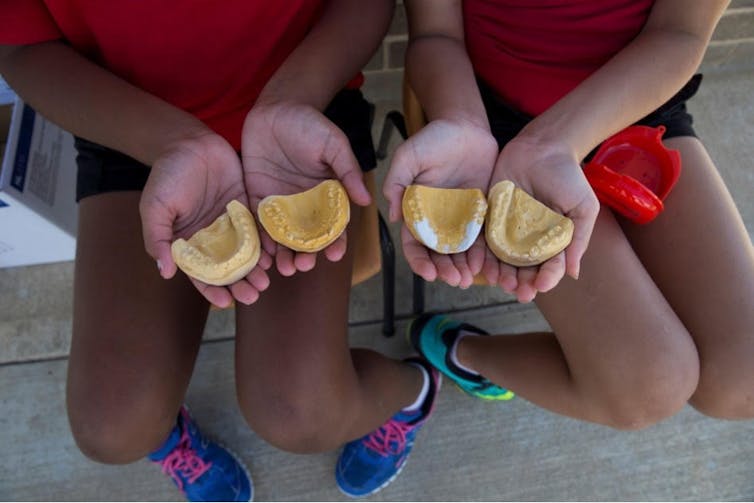 Children made mouth guards as part of our programs.
Poche Centre for Indigenous Health, Author provided (No reuse)
Children made mouth guards as part of our programs.
Poche Centre for Indigenous Health, Author provided (No reuse)
What we did
We began our research in 2013 at primary schools in three rural communities in New South Wales.
We sought to reduce consumption of sugary drinks by installing refrigerated and filtered water fountains in schools and communities. We also engaged teachers to encourage students to fill up their water bottles and drink from them throughout the school day.
As well as this, we sought to increase fluoride intake (a naturally occurring mineral that helps to prevent tooth decay) by establishing daily in-school tooth brushing programs, supplying toothbrushes and toothpaste for school and home, and applying fluoride varnish to the children’s teeth once each term.
We also provided treatment for existing tooth decay and gum disease.
Read more: Antibiotic resistance is an even greater challenge in remote Indigenous communities
In 2018, we looked at the oral health and oral hygiene behaviours of children from the participating schools. Our findings have recently been published and show the project is working well.
What we found
In just four years we found a reduction in tooth decay, plaque and gingivitis (gum disease).
The average number of teeth with tooth decay per child in 2018 was 4.13, compared to 5.31 in 2014. Notably, the proportion of children with no tooth decay increased from 12.5% in 2014 to 20.3% in 2018.
There was also a dramatic reduction in the proportion of children with severe gingivitis from 43% in 2014 to 3% in 2018.
We also saw an increase in positive oral hygiene behaviour including tooth brushing, consumption of drinking water and reduced consumption of sugar-sweetened beverages.
In 2014, 13% of children reported brushing their teeth on the morning they took the survey. This increased to 36% in 2018.
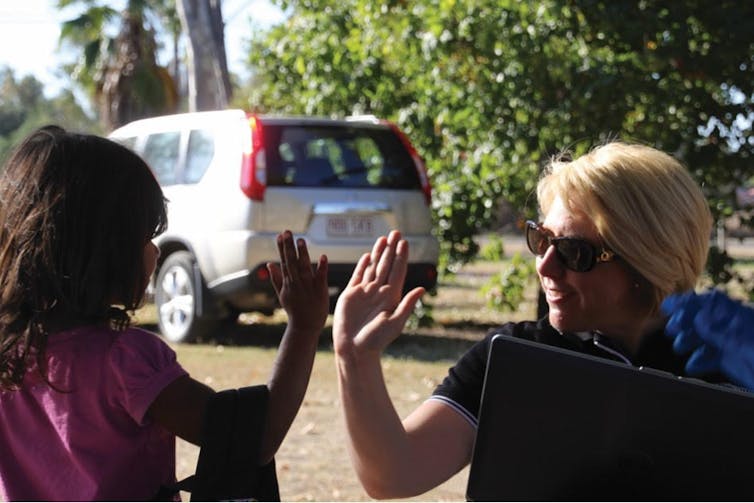 A girl gets a high five from one of the program staff after receiving a 10/10 at her dental check.
Poche Centre for Indigenous Health, Author provided (No reuse)
A girl gets a high five from one of the program staff after receiving a 10/10 at her dental check.
Poche Centre for Indigenous Health, Author provided (No reuse)
Collaborating with communities
Co-design means working alongside communities to establish the most effective ways to implement evidence-based strategies, and sustain these. It’s about sharing knowledge to enable long-term, positive change to complex problems.
In our project, the co-design process has been central to these outcomes:
local Aboriginal staff coordinate the programs and dental treatment services
clinical staff live and work locally
we’ve established scholarships for locals to obtain qualifications as dental assistants, allied health assistants and oral health therapists
we’ve implemented daily in-school tooth brushing, regular fluoride varnish application and drinking water programs
the community decided on the location and installation of water fountains
we’ve set up highly cost-effective oral health services for the communities.
Read more: Dental report card fail: half of adults and one-third of kids don't brush twice a day
Co-design and closing the gap
We’ve now moved through all phases of implementing our co-designed programs, and are focusing on maintaining them with the support of school staff and the local Aboriginal Community Controlled Health Service.
Our research shows engaging communities to design and deliver oral health services was associated with reduced tooth decay and increased healthy behaviours.
The following elements of co-design in our project could readily be incorporated into the design and delivery of health-care services for Aboriginal Australians:
improved cultural safety — Aboriginal people feel safe and welcome
co-design and shared ownership — local Aboriginal people shape the service model
local employment — Aboriginal people work in the service and lead local delivery
skills development — Aboriginal people complete qualifications that are nationally recognised
long-term commitment — programs are designed and delivered with sustainable and reliable funding.
The gap in health outcomes between Aboriginal and non-Aboriginal Australians remains stubbornly wide. Co-design enables much needed health-care services to be delivered in ways that strengthen communities, respect culture and build capacity.
Authors: Kylie Gwynne, Senior Lecturer, Health Leadership, Macquarie University

















