

why so little is known about the reasons people go missing
- Written by Sarah Wayland, Lecturer, University of Sydney
As part of new research into missing persons in Australia, I have been asking people who return after disappearing what they needed or wanted. Mary, who has gone missing four times in the last few years, responded,
I just wanted someone to ask if I was OK when I came back.
Voices like Mary’s are not often heard, nor are their problems understood, when we talk about the mystery and intrigue of missing persons cases.
Every hour in Australia, 100 police reports are generated about the safety and well-being of a missing person. In the past decade, the rate of reports has increased by 30%, from 30,000 per year to almost 40,000 in 2019.
Nearly all missing persons (97%) return within two weeks, which causes these cases to be seen, by both the public and police, as simple search operations. Viewing missing persons in this way ignores the underlying issues that trigger disappearances, making prevention strategies more difficult to put in place.
As we mark National Missing Persons Week, we must recognise the need for new solutions to address the broader social and emotional factors that cause people to go missing to help stem the tide.
Missing episodes can be triggered by numerous factors: substance abuse, trauma, relationship breakdowns and the need to escape dangerous situations, such as domestic and family violence.
The responsibility for finding missing people usually falls to police and, in some circumstances, emergency search and rescue services. But police are often ill-equipped to handle these cases, especially when it involves searching for people with complex emotional health needs or those at risk of harming themselves.
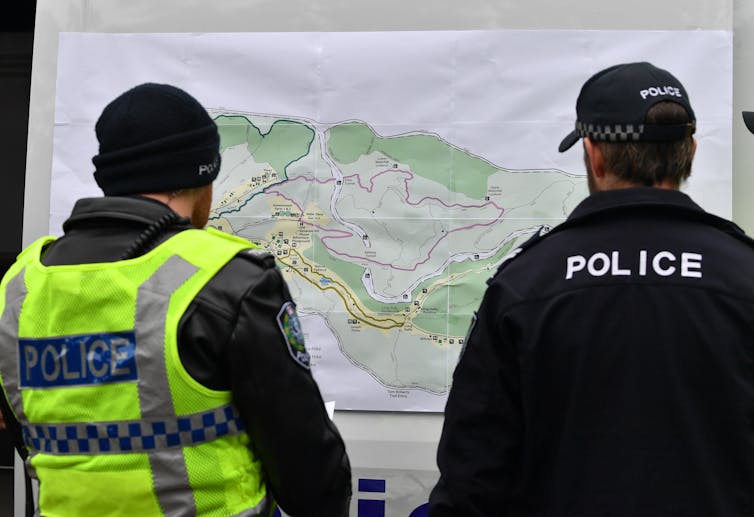 Police are often the front-line responders in missing persons cases, but may be ill-equipped to help those with mental or emotional health issues.
David Mariuz/AAP
Police are often the front-line responders in missing persons cases, but may be ill-equipped to help those with mental or emotional health issues.
David Mariuz/AAP
These cases can also strain police and community resources. In 2000, each missing person was estimated to cost communities A$2,360 on average in search costs, loss of earnings while family members looked, and health and legal costs.
Our limited research in Australia can be enhanced by looking to other countries like Canada, where more funding has been invested in studying vulnerable population groups at risk of going missing.
This could help police more effectively respond to missing persons cases in partnership with health services.
What do returned missing people say?
Sarah Wayland (author of this piece) has been conducting research asking returned missing people to share their stories. In the last month, she has heard from 50 people who have painted a picture of vulnerability and disconnection that isn’t simply resolved when they return or are found.
A majority (80%) of respondents expressed shame on their return, explaining they didn’t want to be seen by family and friends, as well as those who helped search for them, as “attention seeking”.
Some also expressed frustration and anger at the lack of support services after they were found. As one respondent explained,
There’s no village and when you ask for help, no one is truly there to help, even though they say so.
Most respondents said they went missing primarily due to periods of distress or poor mental health, as well as in response to trauma in their families. Many chose not to tell others they were going to disappear.
Half of the respondents returned home on their own volition, while half were located by police.
What researchers have found in Canada
In Canada, missing persons reports have remained relatively stable since 2015 — the first year national figures were collected — increasing by around 3% from 71,368 to 73,184 in 2019.
Lorna Ferguson and other Canadian researchers have found the vast majority of missing persons are dealing with mentally or emotionally distressing issues — similar to those in the Australian study.
Indigenous people (primarily women) and those struggling with addictions, mental illness or cognitive disabilities are also at a higher risk for going missing, research shows.
Read more: Missing and murdered Indigenous women inquiry: We must listen and act
Many of these mental and emotional health issues cannot be resolved by simply locating the individual, pointing to the strong need for enhanced strategies involving police and social services working together.
Several Canadian inquiries into missing persons have also noted the lack of international data on the number of people who go missing each year and the affect on police and public health resources. This makes it difficult to develop evidence-based prevention and intervention strategies to address the factors that cause people to disappear.
What can be done differently
1) Change the awareness focus
We need to view missing persons as a public health issue, rather than taking a whole of community approach. UK research has found that to be effective, awareness campaigns on missing persons must be targeted to doctors, mental health workers and emergency departments so they can recognise the signs that lead people to go missing earlier.
2) Enhance partnerships
Police and social workers need to work together to provide wraparound care. In both Australia and Canada, there is currently no routine follow-up care offered by health care professionals to missing people when they come back. Instead, police make referrals on a case-by-case basis depending on the health needs of the individual.
We need more effective partnerships between police and social workers, particularly in hot spots where people are more likely to go missing and when they return, to assist people in getting the help they need.
3) Invest more in research
We need to invest more funding in research on the factors that lead to disappearances, for instance, by conducting interviews with people who have returned. This will help us better understand the underlying triggers for disappearances and lead to more effective policies and services for those at risk of going missing.
Authors: Sarah Wayland, Lecturer, University of Sydney

















