

A new community case of COVID-19 in New Zealand is a matter of when, not if. Is the country prepared for it?
- Written by Michael Plank, Professor in Mathematics, University of Canterbury
Our latest modelling shows New Zealanders need to redouble their efforts to keep track of people they meet, if we are to have a chance of controlling any re-emergence of COVID-19.
The director general of health, Ashley Bloomfield, recently warned that a new case of COVID-19 community transmission is a matter of when, not if. He said:
We’re working on the basis it could be anytime, of course coupled with doing everything we can to intercept the virus at the border and stop it coming any further.
So far, our border restrictions and quarantine have kept the virus out, but with the pandemic accelerating globally, the threat of re-emergence is small but ever present. Should an infectious person slip through the border, our modelling shows comprehensive contact tracing and quick isolation are our best defences, without having to resort to another lockdown.
Read more: 100 days without COVID-19: how New Zealand got rid of a virus that keeps spreading across the world
Speed is of the essence
New Zealand has now gone for 100 days with no community transmission of COVID-19.
One way to measure the effectiveness of public health measures such as contact tracing is the virus reproduction number: the number of secondary infections for each new positive case. If this number can be kept below one, then one missed case at the border won’t lead to an outbreak.
Our new modelling results show that if we can trace and quarantine 80% of contacts within two days on average, we can reduce the effective reproduction number from 2.5 to 1.5. Some additional physical distancing and mask use could bring the number below one.
But contact tracing can only do this if we all help. So far, more than 600,000 new Zealanders have registered for the NZ COVID Tracer app, which now allows manual entries as well as scanning business QR codes. But regular use has been slow to catch on.
Our modelling also shows people will need to quarantine themselves promptly, even before they have symptoms. This might sound obvious, but it is easier said than done, especially for people in insecure employment, without paid sick leave, or with care-giving responsibilities.
The statutory sick leave entitlement in New Zealand is only five days but traced contacts may need to quarantine for up to 14 days, in some cases without showing any signs of illness. In England, there are fears people are reluctant to pass on details of contacts who may not have the financial resources to self-isolate.
In Australia, the state of Victoria has recently introduced a A$1,500 payment for people required to isolate after they or a household member tests positive. The Scottish government has also recognised the importance of this, adopting a “test, trace, isolate, support” approach. We need similar support put in place in New Zealand.
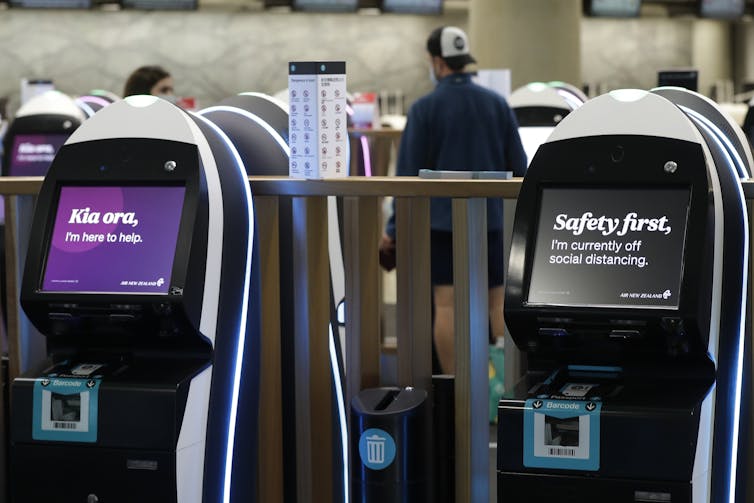 People who work in airports are at higher risk of catching the virus.
AAP/Mark Baker
People who work in airports are at higher risk of catching the virus.
AAP/Mark Baker
Targeted testing
Once an outbreak gets too large, the contact tracing system will not cope. The earlier we can catch an outbreak, the better chance we have of containing it. This means doing lots of testing. Our current testing rate has dropped to around 2,000 per day from a high of around 7,500 per day in late June. We could be testing more people, but it is important to target high-risk groups.
At the moment, New Zealand’s biggest risk is at the border. We already test international arrivals twice during their quarantine.
People who work at the border, either in airports or at quarantine facilities, are also at higher risk of catching the virus. This is how Melbourne’s current outbreak started. It is crucial these workers are trained in infection prevention and proper use of protective equipment, and separated from people in quarantine.
Staff at quarantine hotels in Rotorua and Hamilton are now being tested fortnightly and have daily symptom checks. This needs to be extended to all staff at airports and quarantine facilities who have any contact with quarantined arrivals.
People with symptoms of COVID-19 should also be offered tests. If the border keeps doing its job, all of these tests will come back negative. But if we do get a case, we are much more likely to find it by testing people with symptoms rather than just testing randomly.
Digital contact tracing
Because speed is essential, there is interest around the world in digital tracing systems such as Bluetooth apps or cards. But an effective digital tracing system needs to be well integrated with manual contact tracing.
A system that immediately provides a list of close contacts and phone numbers could make the job easier and faster for contact tracers. Apps that just send an automatic notification with no follow-up are less likely to result in effective quarantine.
Even with gold-standard contact tracing, our model suggests we would need to follow moderate social distancing rules to bring the reproduction number below one. If we don’t get on top of an outbreak very quickly, we can expect limits on gathering size, or even regional or national lockdowns. Past experience has shown that starting these measures as early as possible is the key to successful elimination.
Authors: Michael Plank, Professor in Mathematics, University of Canterbury

















