

understanding your menstrual cycle can be key to achieving exercise goals
- Written by Nicholas Fuller, Charles Perkins Centre Research Program Leader, University of Sydney
It’s pretty normal to feel full of energy for exercise some days, and as though you can’t be bothered on other days.
For women, there’s a physiological explanation behind this. While men’s hormone levels do change over a lifetime, day-to-day they remain quite stable. Women, however, experience fluctuating levels of sex hormones daily.
Scientists haven’t yet worked out the complete picture when it comes to how the menstrual cycle affects exercise. But we know different phases of the menstrual cycle, due to the fluctuation of hormones, can affect metabolism and recovery from exercise, particularly for women participating in endurance activities.
Understanding the rise and fall of hormones during the menstrual cycle can allow women to adapt their exercise routines, and optimise their chances of succeeding with any training or weight loss goals they may have.
The follicular phase: low hormones
A woman’s cycle, which is generally 28 days, can be broken up into two main stages: the follicular and luteal phases.
The follicular phase — days 1 to 14 — starts on the first day of a woman’s period. During this phase, levels of oestrogen (the primary female sex hormone) progressively increase and progesterone (the other female sex hormone released from the ovaries, which stimulates the uterus to prepare for pregnancy) stays stable.
At this time, women are physiologically similar to men in their metabolism and recovery. Training will feel easier and you will recover more quickly than during the luteal phase, which we’ll get to shortly.
This ease of training and speed of recovery become more pronounced during the later part of the follicular phase.
Around day 12, levels of oestrogen and another type of hormone, the luteinising hormone, surge, triggering ovulation. You’re likely to experience an increase in energy and strength at this time, allowing you to put even more effort into your workouts.
So the follicular phase, particularly at the end, is the time to train hard: to incorporate new exercises and train at higher intensities. This is particularly relevant for women trying to lose weight.
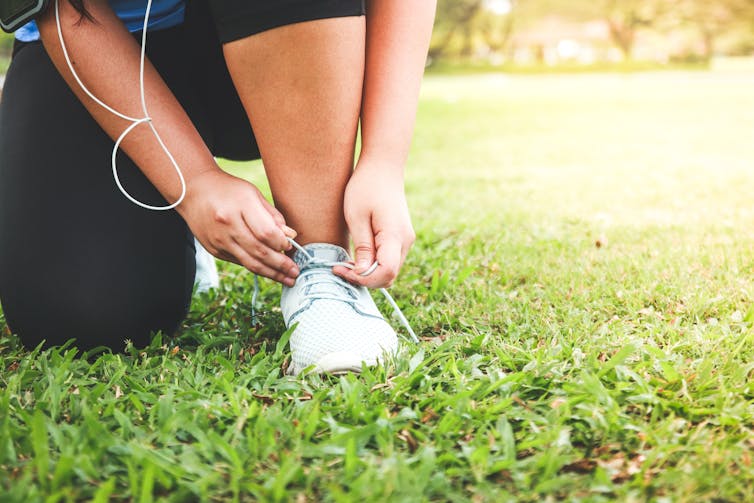 The first phase of a woman’s menstrual cycle, or the follicular phase, is the best time for high-intensity exercise.
Shutterstock
The first phase of a woman’s menstrual cycle, or the follicular phase, is the best time for high-intensity exercise.
Shutterstock
The luteal phase: high hormones
The luteal phase represents the second half of a woman’s cycle.
During this phase progesterone levels peak, resulting in an increase in resting heart rate, and decreases in aerobic capacity and ability to tolerate heat. Exercise may feel like an uphill struggle and you will tire more quickly.
The body burns more fat during the luteal phase, as the peak in oestrogen and progesterone suppress gluconeogenesis (the making of sugar from protein and fat).
This increase in fat burning may seem like good news from a weight loss perspective, but it makes it harder for the body to access sugar. This means exercise will feel harder.
So during this phase, the focus should be on incorporating lower-intensity cardio and strength sessions, and active recovery sessions such as walking, yoga and stretching.
Read more: Period pain is impacting women at school, uni and work. Let's be open about it
Progesterone also breaks down muscle, so you won’t enjoy the same gains from your workouts, and recovery is slower.
Finally, the hormonal changes during this phase result in a shift of fluid from your blood plasma to your cells, resulting in bloating or fluid retention. Coupled with pre-menstrual symptoms such as headaches and fatigue, exercise is likely to seem harder than usual, so it’s not a time to be smashing your goals.
 During the luteal phase, hormonal changes will often mean women don’t feel up to strenuous exercise.
Shutterstock
During the luteal phase, hormonal changes will often mean women don’t feel up to strenuous exercise.
Shutterstock
At this time your metabolism peaks (an increase by 5-10% from the lowest point one week before ovulation), and so can your appetite. The best way to manage all of this is with exercise — just of the low-intensity variety.
Eating carbohydrates and protein within a couple of hours of exercise also helps as it reduces your reliance on making glucose from other sources. This results in increased energy levels and quicker recovery.
You could try chopped fruit with 100% nut butter, some wholegrain bread with 100% fruit spread, or a serve of dairy, such as yoghurt.
And make sure to surround yourself with plenty of foods naturally high in sugar and fat — such as fruit, avocado, nuts and seeds. These foods release the same pleasure response in the brain as the processed and packaged foods you might be craving.
Tracking your cycle
It seems counter-intuitive, but when your period starts, you will start to feel normal again, as hormone levels return to baseline.
A well-planned food and exercise program will allow you to work with your cycle, not against it. This is worth thinking about even if you don’t usually experience menstrual symptoms — these hormonal changes are happening in your body regardless.
Start by tracking your menstrual cycle. Circle the first and last days of your period and count the days between the first days of two consecutive periods to determine cycle length. Or you might choose to use an app.
By recognising these phases of the menstrual cycle, women are better placed to deal with common pre-menstrual symptoms, and achieve their health, training and weight loss goals.
Authors: Nicholas Fuller, Charles Perkins Centre Research Program Leader, University of Sydney

















