

Pain-sensing electronic silicone skin paves the way for smart prosthetics and skin grafts
- Written by Madhu Bhaskaran, Professor, Electronic and Communications Engineering, RMIT University
Skin is our largest organ, made up of complex sensors constantly monitoring for anything that might cause us pain. Our new technology replicates that – electronically.
The electronic artificial skin we’ve developed reacts to pain stimuli just like real skin, and paves the way for better prosthetics, smarter robotics and non-invasive alternatives to skin grafts.
Our prototype device mimics the body’s near-instant feedback response and can react to painful sensations with the same lighting speed at which nerve signals travel to the brain.
Our new technology, details of which are published in Advanced Intelligent Systems, is made of silicone rubber with integrated electronics. It mimics human skin, both in texture and in how it responds to pressure, temperature and pain.
Human skin senses things constantly, but our pain response only kicks in at a certain threshold. Once this threshold is breached, electric signals are sent via the nervous system to the brain to initiate a pain response.
You don’t notice when you pick up something at a comfortable temperature. But touch something too hot, and you’ll almost instantly recoil. That’s our skin’s pain-sensing system in action.
Helping hand
Our new pain-sensing electronic skin is a crucial step towards the development of “smart prosthetics” featuring sophisticated feedback systems. We want to develop medical devices and components that show similar pain sensing responses to the human body.
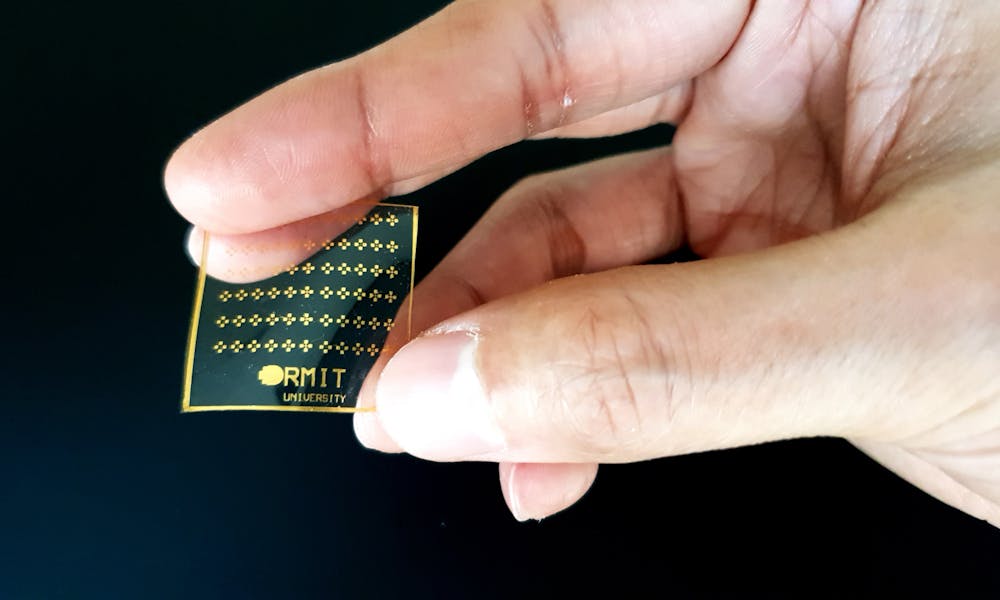 Stretchable, smart silicone skin.
RMIT University, Author provided
Stretchable, smart silicone skin.
RMIT University, Author provided
Prosthetics significantly improve an amputee’s quality of life, but they still lack the ability to sense danger. A prosthetic hand does not sense when it’s placed on a hot surface, while someone with a prosthetic arm might lean on something sharp but won’t realise the damage being caused.
Technology that provides a realistic skin-like response can make a prosthetic much more like a natural limb.
With further development, our electronic skin could also potentially be used for skin grafts, in cases where the traditional approach is not viable.
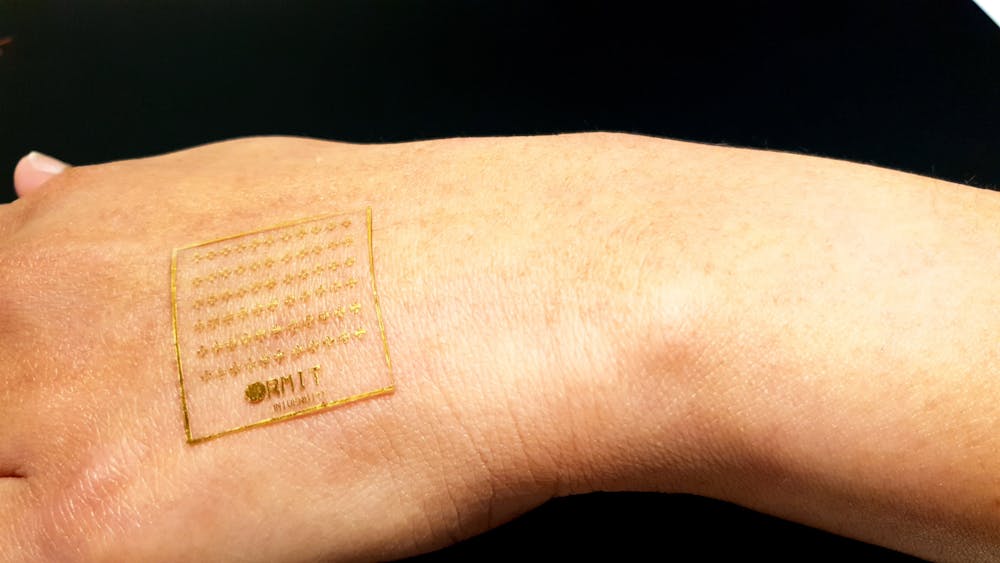 The new silicone skin could pave the way for smarter skin grafts.
RMIT University, Author provided
The new silicone skin could pave the way for smarter skin grafts.
RMIT University, Author provided
Skin in the game
We created our electronic skin by building on our research group’s previous breakthroughs in stretchable electronics, temperature-sensitive materials, and brain-mimicking electronics.
For example, we used our process for integrating temperature-sensitive vanadium oxide, a material that can change its electronic behaviour in reaction to temperatures above a particular threshold (65℃ in this case).
This material then triggers electrical signals similar to those generated by our nerve endings when we touch something hot. The electrical signal from the sensing part of the system (which is temperature- or pressure-sensitive) goes to a brain-mimicking circuit which processes the input and makes a decision based on threshold values.
The electrical output from the brain-mimicking circuit is like the nerve signals that initiate a motor response (such as moving your hand away) in the human pain response.
In our experiment, we measured the current generated. To use the silicone skin for real, this would need to be connected to nerve endings or apparatus that could initiate a motor response.
Read more: It's not easy to give a robot a sense of touch
Our material responds just as fast as a real human pain response, mimicking the entire process from stimulus to response triggers from the brain – or in our case, the brain-mimicking circuit. The response is stronger depending on both the intensity and time of stimulation – just like a real human pain response.
The electronic skin brings to reality the threshold-based responses to pain, both in the way the skin reacts differently to pain above a certain threshold and how it takes longer for skin to “recover” from something that’s more painful. This is because stronger stimuli generate more voltage across the brain-mimicking circuit.
We can also modify this threshold in our devices to mimic the way injured skin (such as sunburnt skin) can have a lower pain threshold than normal skin. The electronic skin can also be used to increase sensitivity, which could be particularly useful in sports and defence as well as for skin grafts.
Another unique application could be smart gloves that could provide precise feedback from a surgeon’s hands when palpating tissue.
Our silicone skin will need further development to integrate the technology into biomedical applications. But the fundamentals – biocompatibility and skin-like stretchability – are already there.
The next steps are working with medical researchers to make this even more “skin-like”, and to figure out how best to integrate it with the human body.
Authors: Madhu Bhaskaran, Professor, Electronic and Communications Engineering, RMIT University

















