

Sharp claws helped ancient seals conquer the oceans
- Written by: David Hocking, Research associate, Monash University
If you’ve ever seen seals frolicking in the water, you know they are agile swimmers, with perfectly adapted paddle-like limbs. But if you think those flippers are just for swimming, then think again.
In a study published today in Royal Society Open Science, we took a fresh look at how one group of seals – the northern true seals, including grey and harbour seals – use their forelimbs to process and eat their prey. This behaviour is rare among living marine mammals, and shows how ancient seals evolved to feed in water.
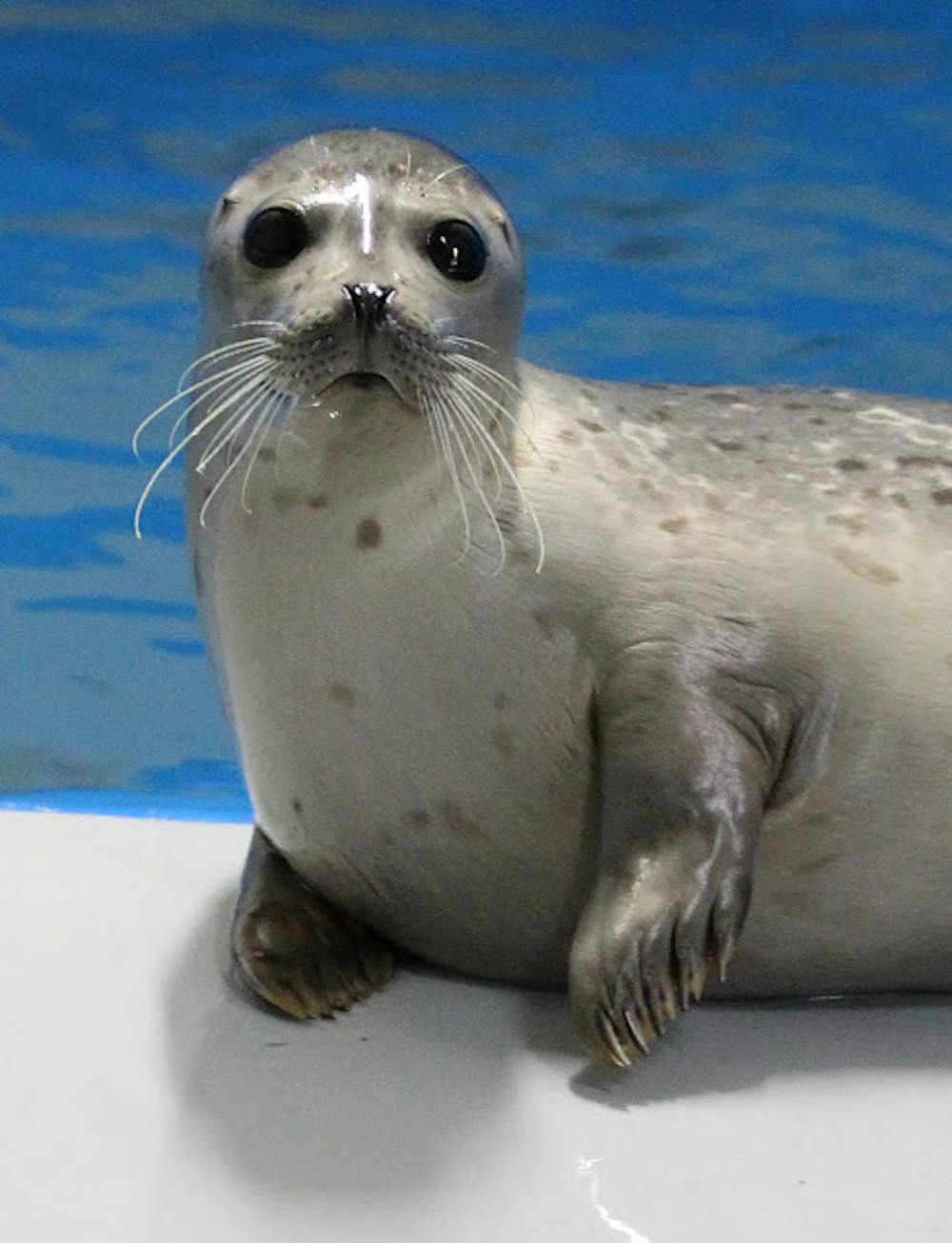 Northern ‘true’ seals, like this harbour seal, have paw-like forelimbs bearing long claws.
Renae Sattler, Alaska SeaLife Center
Northern ‘true’ seals, like this harbour seal, have paw-like forelimbs bearing long claws.
Renae Sattler, Alaska SeaLife Center
Read more: When mammals took to water they needed a few tricks to eat their underwater prey
What’s in a flipper?
Seals are best known for having long, streamlined forelimb flippers, much like those of a dolphin.
Flippers and fins are great for steering and swimming, and independently evolved in many aquatic vertebrates: fish, seals, whales, dolphins, turtles, and extinct marine reptiles such as plesiosaurs and ichthyosaurs.
But northern seals are an exception. Rather than wing-like, their hands are short, with mobile fingers that end in large protruding claws.
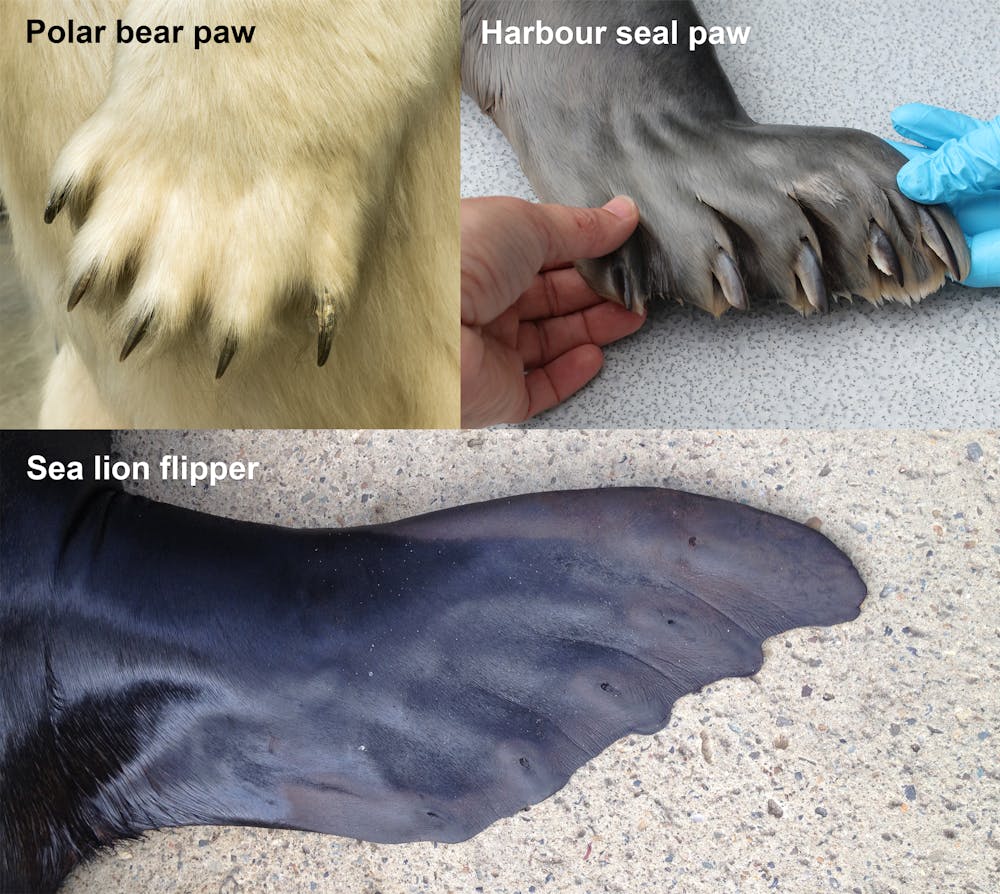 Unlike the flipper-like forelimbs of sea lions, northern ‘true’ seals have long robust claws, similar to those of a bear.
David Hocking
Unlike the flipper-like forelimbs of sea lions, northern ‘true’ seals have long robust claws, similar to those of a bear.
David Hocking
Instead of flippers, they really have paws - more like a dog than a dolphin. The question is: why?
The clawed seals of the north
The answer has to do with how these animals eat. When watching how northern seals feed, both in captivity and in the wild, we found that they don’t just take a bite out of their catch.
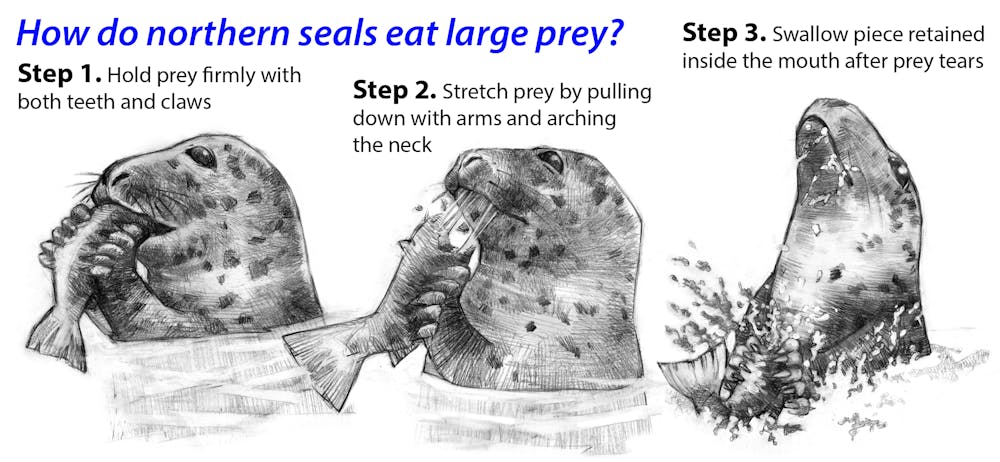 Northern ‘true’ seals need to process large prey into pieces small enough to swallow. They do this by tearing it between their teeth and claws.
Kai Hagberg
Northern ‘true’ seals need to process large prey into pieces small enough to swallow. They do this by tearing it between their teeth and claws.
Kai Hagberg
Instead, after securing a large fish in their jaws, they swim up to the surface before sinking their claws into its flesh. Finally, they pull down their arms to stretch their prey, gradually tearing it between the teeth and claws.
Prey processing in northern ‘true’ seals.Claws in the deep
The use of claws to process prey harks back to the ancient past, and tells us how ancient seals switched from feeding on land to hunting in water.
Seals originally descended from a land-dwelling predator, distantly related to bears and wolverines.
Early seals probably first took to the water in pursuit of food, where they would have faced the challenge of stopping slippery prey from floating away.
Clues as to how they mastered this task are provided by Enaliarctos, an ancestral seal that lived more than 20 million years ago along the ancient shores of Northwest America.
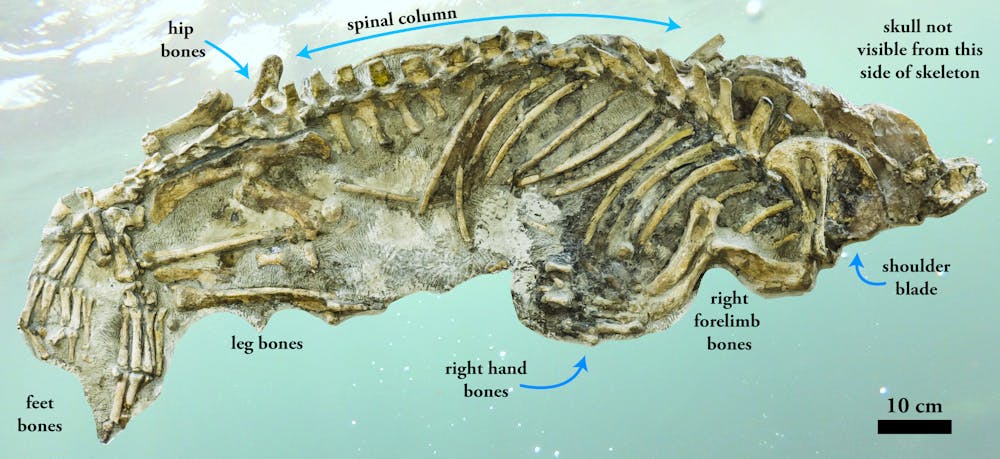 Remarkable near-complete skeleton of the ancient seal Enaliarctos mealsi, discovered by Douglas Emlong in 1975, now held in the Smithsonian Institution, Washington DC.
David Hocking
Remarkable near-complete skeleton of the ancient seal Enaliarctos mealsi, discovered by Douglas Emlong in 1975, now held in the Smithsonian Institution, Washington DC.
David Hocking
Like the living northern seals, Enaliarctos had long claws and flexible finger joints, suggesting that it would have been able to grasp prey during feeding. But unlike living seals, Enaliarctos also had sharp cutting teeth similar to those found in its meat-eating, land-dwelling cousins.
To use these teeth effectively, Enaliarctos needed to place food carefully in its mouth. This is a difficult task when floating in water, but holding onto prey with its hands would certainly have helped. Perhaps Enaliarctos even still brought its quarry ashore, much like living river otters.
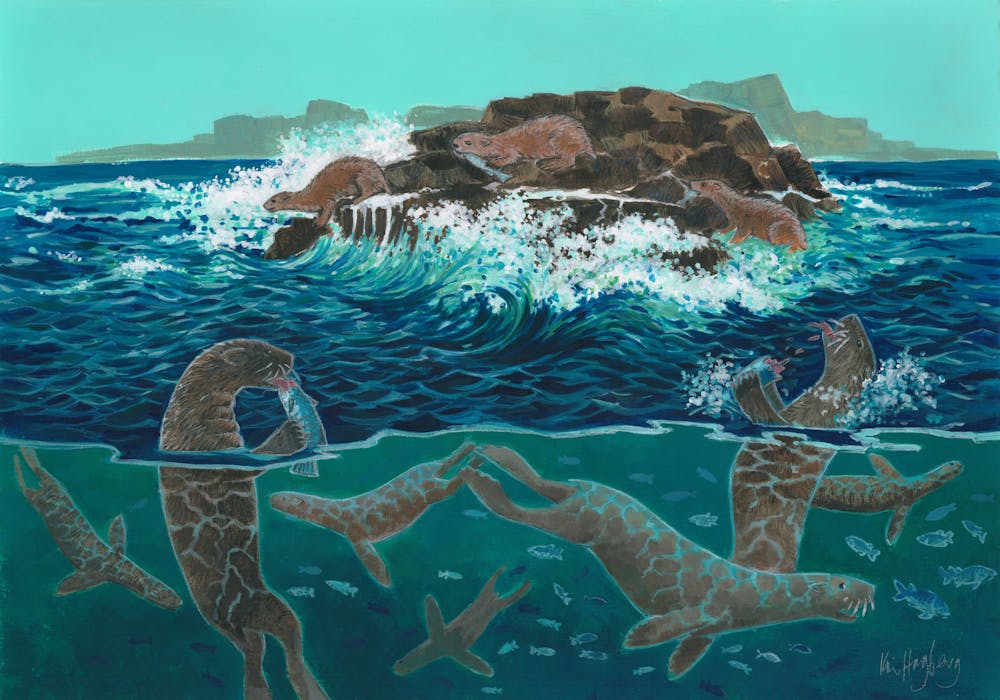 Like the modern Northern seals, ancient species like Enaliarctos likely used their forelimbs to help process prey into pieces. But unlike modern seals, these ancestral species still had sharp cutting teeth that may have allowed them to chew their food while hauled out on the shore.
Kai Hagberg
Like the modern Northern seals, ancient species like Enaliarctos likely used their forelimbs to help process prey into pieces. But unlike modern seals, these ancestral species still had sharp cutting teeth that may have allowed them to chew their food while hauled out on the shore.
Kai Hagberg
Later seals lost the sharp cutting teeth of Enaliarctos, but retained its ability to grasp prey.
This gradual transition helped to smooth the switch from feeding on land to hunting underwater. Rather than changing all at once, the behaviour and anatomy of early seals changed gradually, remaining effective at each step along the way.
Clawed forelimbs: a relic of the ancient past or useful modern adaptation?
Given the importance of clawed forelimbs to ancient seals, why are northern true seals the only ones that still use them?
The answer, partly, is simply because they could. Unlike their close relatives, the fur seals and sea lions, northern seals primarily swim with their hind limbs. Their paws thus remained free to perform other tasks, and simply kept doing what they always had done.
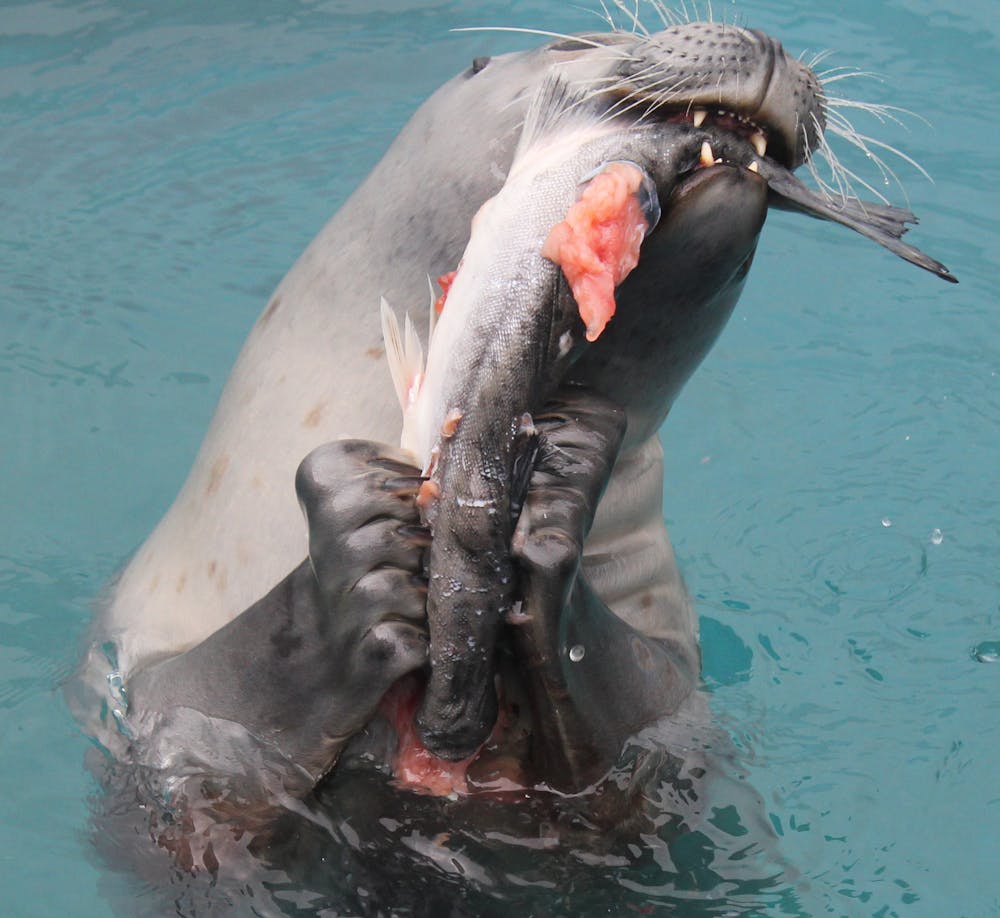 Harbour seal stretching a fish between its teeth and strong claws during feeding experiments carried out at the Alaska SeaLife Center as part of this study. See how the claws dig deep into the salmon, helping the seal to keep a firm grip on its prey.
Renae Sattler, Alaska SeaLife Center
Harbour seal stretching a fish between its teeth and strong claws during feeding experiments carried out at the Alaska SeaLife Center as part of this study. See how the claws dig deep into the salmon, helping the seal to keep a firm grip on its prey.
Renae Sattler, Alaska SeaLife Center
But there is also a more sinister part to this story. Mobile paws may give seals an advantage when handling large prey. Grey seals, in particular, have put this skill to deadly use.
For years, scientists have noted carcasses of harbour porpoises and various seals with peculiar spiral injuries. The true nature and cause of these wounds was revealed only recently.
Grey seals prey on other marine mammals, using their paws and claws in the process. Somewhat shockingly, they even fed on members of their own kind.
Their claws connect northern seals with their ancient past, and help us understand how their ancestors conquered the ocean. Cases like the grey seals also show that claws are not just an evolutionary hangover. Instead, they remain a key tool, allowing northern seals to exploit niches not – or perhaps no longer – available to most of their kin.
Authors: David Hocking, Research associate, Monash University
Read more http://theconversation.com/sharp-claws-helped-ancient-seals-conquer-the-oceans-92828


















