

Astronomers create 40% more carbon emissions than the average Australian. Here's how they can be more environmentally friendly
- Written by: Adam Stevens, Research Fellow in Astrophysics, University of Western Australia
Astronomers know all too well how precious and unique the environment of our planet is. Yet the size of our carbon footprint might surprise you.
Our study, released today in Nature Astronomy, estimated the field produces 25,000 tonnes of carbon dioxide-equivalent emissions per year in Australia. With fewer than 700 active researchers nationwide (including PhD students), this translates to 37 tonnes per astronomer per year.
Read more: Carbon footprints are hard to understand — here’s what you need to know
As a point of reference, the average Australian adult was responsible for 26 tonnes of emissions in 2019, total. That means the job of being an astronomer is 40% more carbon-intensive than the average Australian’s job and home life combined.
While we often defer to governments for climate policy, our global carbon footprint can be dramatically reduced if every industry promotes strategies to reduce their own footprint. For individual industries to make progress, they must first recognise just how much they contribute to the climate emergency.
Where do all the emissions come from?
We found 60% of astronomy’s carbon footprint comes from supercomputing. Astronomers rely on supercomputers to not only process the many terabytes of data they collect from observatories everyday, but also test their theories of how the Universe formed with simulations.
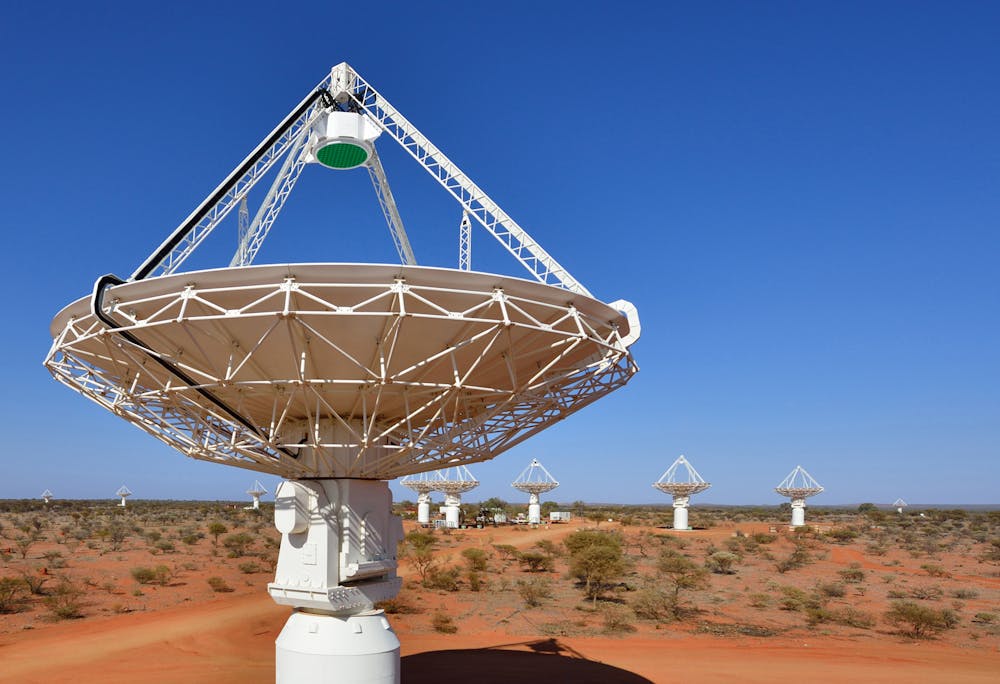 Antennas of CSIRO’s ASKAP telescope at the Murchison Radio-astronomy Observatory in Western Australia.
CSIRO Science Image
Antennas of CSIRO’s ASKAP telescope at the Murchison Radio-astronomy Observatory in Western Australia.
CSIRO Science Image
Frequent flying has historically been par for the course for astronomers too, be it for conference attendance or on-site observatory visits all around the world. Prior to COVID-19, six tonnes of annual emissions from flights were attributed to the average astronomer.
An estimated five tonnes of additional emissions per astronomer are produced in powering observatories every year. Astronomical facilities tend to be remote, to escape the bright lights and radio signals from populous areas.
Some, like the Parkes radio telescope and the Anglo-Australian Telescope near Coonabarabran, are connected to the electricity grid, which is predominately powered by fossil fuels.
Others, like the Murchison Radio-astronomy Observatory in Western Australia, need to be powered by generators on site. Solar panels currently provide around 15% of the energy needs at the Murchison Radio-astronomy Observatory, but diesel is still used for the bulk of the energy demands.
Finally, the powering of office spaces accounts for three tonnes of emissions per person per year. This contribution is relatively small, but still non-negligible.
They’re doing it better in Germany
Australia has an embarrassing record of per-capita emissions. At almost four times the global average, Australia ranks in the top three OECD countries for the highest per-capita emissions. The problem at large is Australia’s archaic reliance on fossil fuels.
A study at the Max Planck Institute for Astronomy in Germany found the emissions of the average astronomer there to be less than half that in Australia.
The difference lies in the amount of renewable energy available in Germany versus Australia. The carbon emissions produced for each kilowatt-hour of electricity consumed at the German institute is less than a third pulled from the grid in Australia, on average.
The challenge astronomers in Australia face in reducing their carbon footprint is the same challenge all Australian residents face. For the country to claim any semblance of environmental sustainability, a swift and decisive transition to renewable energy is needed.
Taking emissions reduction into our own hands
A lack of coordinated action at a national level means organisations, individuals, and professions need to take emissions reduction into their own hands.
For astronomers, private arrangements for supercomputing centres, observatories, and universities to purchase dedicated wind and/or solar energy must be a top priority. Astronomers do not control the organisations that make these decisions, but we are not powerless to effect influence.
Read more: Climate explained: what each of us can do to reduce our carbon footprint
The good news is this is already happening. A recent deal made by Swinburne University to procure 100% renewable energy means the OzSTAR supercomputer is now a “green machine”.
CSIRO expects the increasing fraction of on-site renewables at the Murchison Radio-astronomy Observatory has the potential to save 2,000 tonnes of emissions per year from diesel combustion. And most major universities in Australia have released plans to become carbon-neutral this decade.
As COVID-19 halted travel worldwide, meetings have transitioned to virtual platforms. Virtual conferences have a relatively minute carbon footprint, are cheaper, and have the potential to be more inclusive for those who lack the means to travel. Despite its challenges, COVID-19 has taught us we can dramatically reduce our flying. We must commit this lesson to memory.
Read more: The carbon footprint of tourism revealed (it's bigger than we thought)
And it’s encouraging to see the global community banding together. Last year, 11,000 scientists from 153 countries signed a scientific paper, warning of a global climate emergency.
As astronomers, we have now identified the significant size of our footprint, and where it comes from. Positive change is possible; the challenge simply needs to be tackled head-on.
Authors: Adam Stevens, Research Fellow in Astrophysics, University of Western Australia


















