

why Kevin Rudd's call for a royal commission into News Corp may lead nowhere
- Written by: Denis Muller, Senior Research Fellow, Centre for Advancing Journalism, University of Melbourne
Kevin Rudd’s petition to parliament for a royal commission into the dominance of the Murdoch media in Australia is entitled to be seen as more than an embittered ex-politician’s desire for revenge.
The fact is that in the three mature English-speaking democracies where Rupert Murdoch’s News Corporation has a dominant presence – the United States, the United Kingdom and Australia – politics are deeply polarised and conducted with a toxicity and dishonesty that is harmful to the public good.
There are differences in degree, of course. Australia has not elected a reactionary extremist such as US President Donald Trump, nor found itself riven with political divisions of the kind shown up by the Brexit referendum. Neither has Australian political discourse descended to the depths of racism that have scarred politics in those two countries.
Australia has not seen its national leader equivocate over white supremacy, as Trump did after the Charlottesville protests of 2017. It has not seen a political campaign poster about immigration modelled on a Nazi poster on the same subject, as the United Kingdom Independence Party (UKIP) produced during the Brexit referendum campaign.
Yet there is one fundamental similarity among the three countries that reflects the anti-democratic influence of the Murdoch media: in each country, political leaders see Murdoch as a decisive factor in electoral success.
He controls about two-thirds of Australia’s capital city daily newspaper circulation, owns The Times, The Sunday Times and mass-circulation The Sun in England, and Fox News, the most-watched cable TV service in the US.
A procession of Australian prime ministers or would-be prime ministers from Bob Hawke onwards, including Rudd, have openly and publicly paid court to Murdoch, on occasion travelling to the other side of the world to do so.
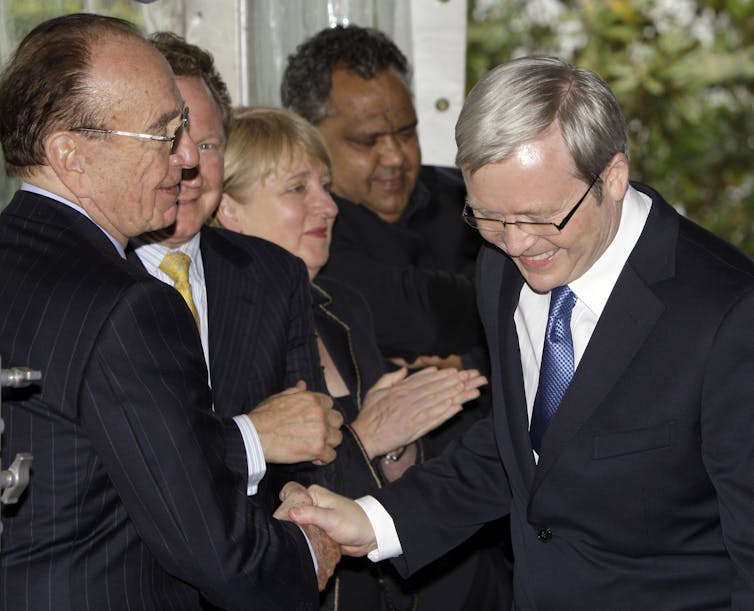 Successive leaders have paid court to Rupert Murdoch, including Kevin Rudd when he was prime minister.
Dean Lewins/AAP
Successive leaders have paid court to Rupert Murdoch, including Kevin Rudd when he was prime minister.
Dean Lewins/AAP
In the UK, Tony Blair travelled all the way to Hayman Island to obtain Murdoch’s blessing in the lead-up to the 1997 election. He obtained the blessing and won the election.
In episode three of the recent television documentary, The Murdoch Dynasty, Nigel Farage, who led UKIP in the Brexit referendum, said Murdoch’s support was crucial to the success of the “Leave” campaign.
In the same documentary, a Trump campaign insider from 2016 said Murdoch’s Fox News was indispensable to Trump’s success in that year’s US presidential election.
The benefit of a royal commission would be to lay bare the nature of the interactions between the elected politicians and the unelected Rupert Murdoch.
Details of the supplications, threats, deals, promises, attitudes and motives that are the stuff of these interactions would shed extraordinarily valuable light on a highly influential aspect of the way Australia’s democracy works.
It would enable the public to assess just how extensive Murdoch’s influence is, and what effect it has on public policy and electoral outcomes.
It’s highly improbable it would lead to greater diversity in media ownership. If it created a public clamour loud enough to make politicians think there were votes in it, then it might be possible one of the main parties would adopt media diversity as policy, and propose ways to achieve it.
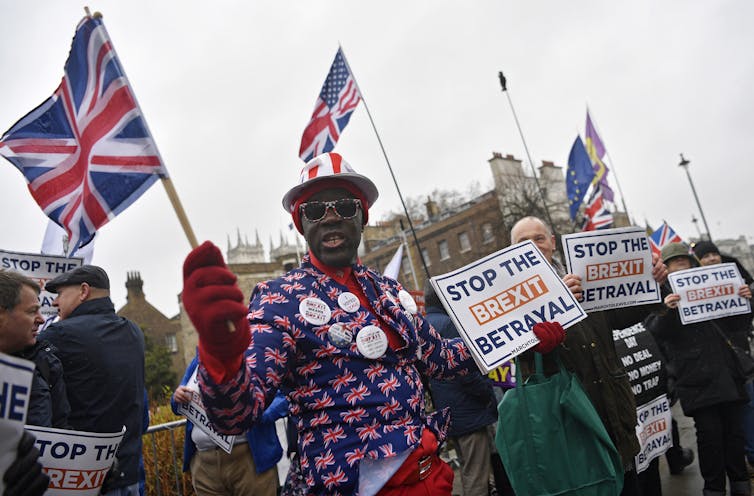 News Corporation’s support was vital to the ‘Leave’ campaign in the Brexit vote.
AAP/EPA/Neil Hall
News Corporation’s support was vital to the ‘Leave’ campaign in the Brexit vote.
AAP/EPA/Neil Hall
However, history tells us this is extremely unlikely.
A royal commission in England in 1947-49 dodged the issue; another in 1961-62 resulted in significant mergers being referred to the Monopolies and Mergers Commission. However, this was circumvented by Prime Minister Margaret Thatcher in 1981, when she pushed through Murdoch’s acquisition of The Times and The Sunday Times.
In Australia, both main parties have been complicit in creating the present state of affairs.
The Hawke-Keating government created the conditions that allowed Murdoch to take over the Herald and Weekly Times group, giving him Melbourne’s Herald Sun and daily newspaper monopolies in Brisbane, Adelaide and Hobart.
The Turnbull government made the situation worse in 2017 by abolishing rules about cross-ownership, market dominance and audience reach.
Read more: Why media reform in Australia has been so hard to achieve
For another thing, the Australian public has shown an astonishing complacency and lack of interest in the health of the media. This has remained the case even as media freedom has been directly assaulted by a succession of laws since 2001 that criminalise journalism in the name of national security.
Perhaps the rush to sign the Rudd petition, which is credited with causing the parliamentary website to crash, indicates a change of attitude, or it might just be clicktivism.
Finally, Australian parliaments have shown little interest in, and less appetite for, fixing the problem.
In 1980, the Victorian government of Rupert Hamer established a committee of inquiry under the chairmanship of Sir John Norris, a retired Supreme Court judge, into the ownership and control of newspapers in Victoria.
The Norris report was presented in September 1981. It recommended an independent statutory authority be established to scrutinise proposed newspaper acquisitions, to ensure undue concentration of ownership would not result.
It aroused indignant opposition from the newspaper companies and went nowhere.
In 1992, the federal House of Representatives established a Select Committee on the Print Media to examine many of the same issues. It produced a report called News and Fair Facts, a laboured pun on “Fairfax”. It too disappeared without trace.
Even if Rudd gets his royal commission, its report risks going the same way, unless it probes deeply enough to tell us something important about the way Australian democracy works.
Authors: Denis Muller, Senior Research Fellow, Centre for Advancing Journalism, University of Melbourne


















