

here’s what women should be getting screened regularly
- Written by: Jenny Doust, Clinical Professorial Research Fellow, The University of Queensland
Throughout the COVID-19 pandemic, many have felt anxious about going to the GP and other health facilities, believing these places have had a greater risk of transmission. A lot of us have also had to juggle work, childcare and home-based education.
So it’s not surprising the number of women attending for preventive health checks dropped alarmingly. For example, 145,000 fewer breast cancer screenings were done between January and June this year than in the same period in 2018. It’s important, however, not to let the pandemic lead to avoidable poor health.
Here are some of the main health checks the the Royal Australian College of General Practitioners (RACGP) recommends for women. These checks are advised for women at average risk, but women who have a strong family history of any of these conditions should ask with their GP if they should start screening earlier or seek different types of testing.
Cervical cancer screening
The National Cervical Screening Program recommends cervical cancer screening every five years for women aged between 25 and 74.
In December 2017, a new test was introduced for cervical cancer screening in Australia, and the testing interval changed from two years to five years. The change in testing interval was recommended because the new test is able to detect changes earlier. This means fewer women are tested each month, with the decline starting from December 2019.
Even accounting for this, the number of women tested in April and May 2020 fell sharply. There was some recovery in June, although rates in Victoria remain low. It used to be common practice to do a pelvic examination at the same time as a cervical screening test to look for problems in the uterus and ovaries, but this is no longer recommended due to its poor accuracy.
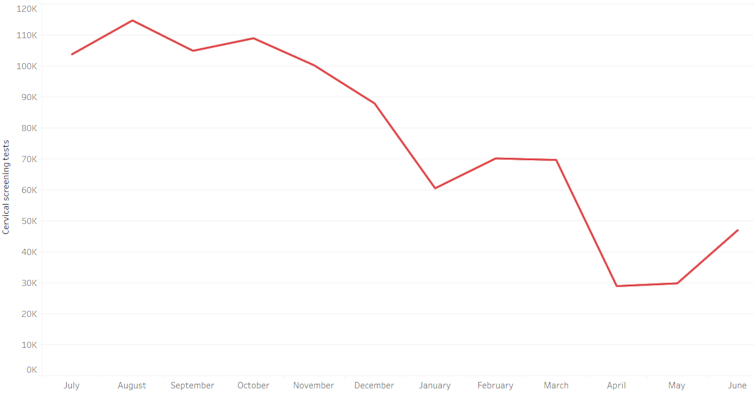 Number of Medicare claims for routine cervical screening tests in Australia 2019-20.
MBS Statistics Online
Number of Medicare claims for routine cervical screening tests in Australia 2019-20.
MBS Statistics Online
Breast cancer screening
Breast Screen Australia recommends an x-ray of the breasts, called a mammogram, every two years for women aged 50-74. Breast screening services were paused in April, but are now open again in all states, including Victoria.
Evidence for the benefits and harms of breast screening has been highly contested, so it’s important women make an informed choice. Cancer Australia states that for every 1,000 women screened for 25 years from the age of 50, around eight will avoid dying of breast cancer. On the other hand, eight women in every 1,000 diagnosed by screening will be treated unnecessarily (usually with surgery) for cancers that would never otherwise have been diagnosed.
Screening works by finding a cancer before a woman has any symptoms, but it also finds cancers that grow very slowly or even regress, and that would never have caused symptoms. More sensitive tests, such as MRI, find more of these “overdiagnosed cancers” than other tests.
Breast cancer survival has improved significantly in the past few decades, but most of this seems to be due to improvements in treatment rather than improvements in screening.
Ovarian cancer
Unfortunately, there is no method for early detection of ovarian cancer and the symptoms can be vague, often leading to late diagnosis.
The most common symptoms are abdominal bloating, abdominal or pelvic pain, appetite loss, feeling full quickly, indigestion, urinary frequency or urgency, constipation, unexplained weight loss or gain, and unexplained fatigue.
Women who have any of these symptoms for more than a few weeks should see their GP.
Sexually transmitted disease
About 1 in 20 women in their 20s will have a chlamydia infection and 1 in 200 will have gonorrhoea. These increase the risk of pelvic inflammatory disease and infertility. HIV, Hepatitis B and syphilis are less common, but important to detect early.
There is no formal screening program but the RACGP encourages sexually active women younger than 30 to have regular testing, especially if there has been a change in sexual partner.
Cardiovascular disease and diabetes
The leading causes of death in women in Australia are dementia, heart attacks, strokes, and lung cancer. The risks of these can be reduced with good preventive health.
 Women shouldn’t forget to get their blood pressure and cholesterol regularly checked.
Shutterstock
Women shouldn’t forget to get their blood pressure and cholesterol regularly checked.
Shutterstock
The RACGP recommends women have their blood pressure checked every two years from age 18, cholesterol every five years from age 45, and checks for diabetes and kidney disease when at risk (for example if you have a family history). GPs recommend a general health check for those aged 45 to 49, or a heart health check for those over 45, or Aboriginal or Torres Strait Islander people over 30.
Treating high blood pressure and cholesterol and reducing smoking rates has prompted a massive decline in Australian heart disease deaths since their peak in the 1960s. However, women are less likely to have all risk factors for heart disease checked, and younger women are less likely to be put on blood pressure or cholesterol-lowering medication than men with the same risk level.
Bowel cancer
Bowel cancer screening is recommended by the National Bowel Cancer Screening Program for all Australians every two years between ages 50 to 75. This is done by a stool sample test, using a kit mailed by the National Bowel Cancer Screening Program and returned by post. This screening reduces deaths from bowel cancer by 16%.
GPs have worked hard to ensure their patients’ safety during the COVID-19 pandemic. But it’s also important the recommended preventive health checks are not delayed unnecessarily.
Authors: Jenny Doust, Clinical Professorial Research Fellow, The University of Queensland


















