

Know My Name presents a new, female story of Australian art
- Written by: Joanna Mendelssohn, Principal Fellow (Hon), Victorian College of the Arts, University of Melbourne. Editor in Chief, Design and Art of Australia Online, University of Melbourne
Review: Know My Name: Australian Women Artists 1900 to now, National Gallery of Australia
Know My Name is more than an art exhibition, although the exhibition attached to its launch is large, complex and wonderful. Described as a “gender equity initiative”, it is part of a strategy by NGA Director Nick Mitzevich to move towards a culture of inclusion in both collecting and exhibiting.
The exhibition begins with a massed display of portraits, hung like a 19th century salon, almost like an honour guard. The subjects are all people with a purpose.
 Brenda L Croft, Gurindji/Malngin/Mudburra People; Anglo-Australian/Chinese/German/Irish Heritage, Matilda (Ngambri/Ngunnawal), 2019.
National Gallery of Australia, Canberra purchased 2020
Brenda L Croft, Gurindji/Malngin/Mudburra People; Anglo-Australian/Chinese/German/Irish Heritage, Matilda (Ngambri/Ngunnawal), 2019.
National Gallery of Australia, Canberra purchased 2020
Brenda L. Croft’s intense monochrome portrait of Auntie Matilda House, the Ngambri-Ngunnawal elder, provides a welcome to country. Nearby, Julie Dowling’s iconic, heartbreaking portraits of her family and community’s grief and loss are placed alongside Violet Teague’s Dian Dreams (1909), a painting with a subject who does not need to bask in anyone’s approval.
Some of the works are well known, others less so. Inevitably, the eye is drawn to Grace Cossington Smith’s The Sock Knitter (1915), the work that first placed women artists at the centre of Australia’s art history.
A century before the first Countess Report released its meticulously researched data on the inequitable treatment of women artists, The Sock Knitter was exhibited at the 1915 Royal Art Society of NSW’s annual exhibition. It was ignored, as was the artist, long regarded as a “lady amateur” flower painter.
Read more: Still counting: why the visual arts must do better on gender equality
The Sock Knitter remained in her studio until the late 1950s when it was discovered by Bernard Smith. Cossington Smith may now be recognised as perhaps Australia’s most important modernist artist, yet she spent most of her life in relative obscurity.
The exhibition is Mitzevich’s signal of a change in the NGA’s collections policy to one of affirmative action. Previously, the gallery only held 25% of works by women artists. What surprised him, he has said, is that despite the increased profile of female artists in the last four decades, the proportion of works by living women artists collected by the gallery over that time was less than in earlier years.
The gallery’s first director, James Mollison, may not have been prejudiced in favour of women, but he was not prejudiced against us. Key works by Rosalie Gascoigne, Joy Hester, Tracey Moffatt and Emily Kame Kngwarreye, were all bought on his watch. Many more recent works in the exhibition come from elsewhere.
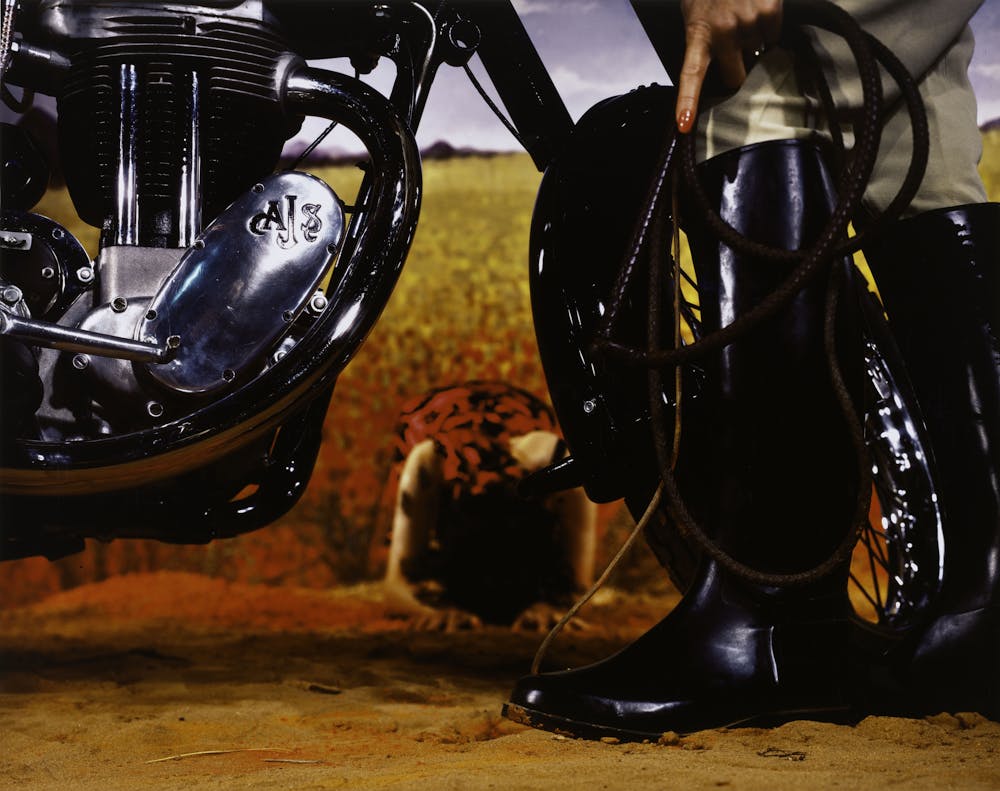 Tracey Moffatt, Something more #8, from Something more series 1989.
Naomi Milgrom AO Art Collection
Tracey Moffatt, Something more #8, from Something more series 1989.
Naomi Milgrom AO Art Collection
It could be argued that it is not possible to reconfigure Australian art using only the work of one gender. There is, of course, an easy answer to this. For many years, almost all the art on public display was by men.
Relationships, not history
The beauty and the audacity of this exhibition is that it ignores any attempt to slot artists into specific movements. Instead, curators Deborah Hart and Elspeth Pitt have created what they rightly call “a new story of Australian art”, one of relationships, not history.
It is a magnificent, encircling argument of solidarity and inclusion. Works are grouped by thematic concerns; crossing cultural and chronological barriers. Traditional hierarchies between high and low art are dissolved.
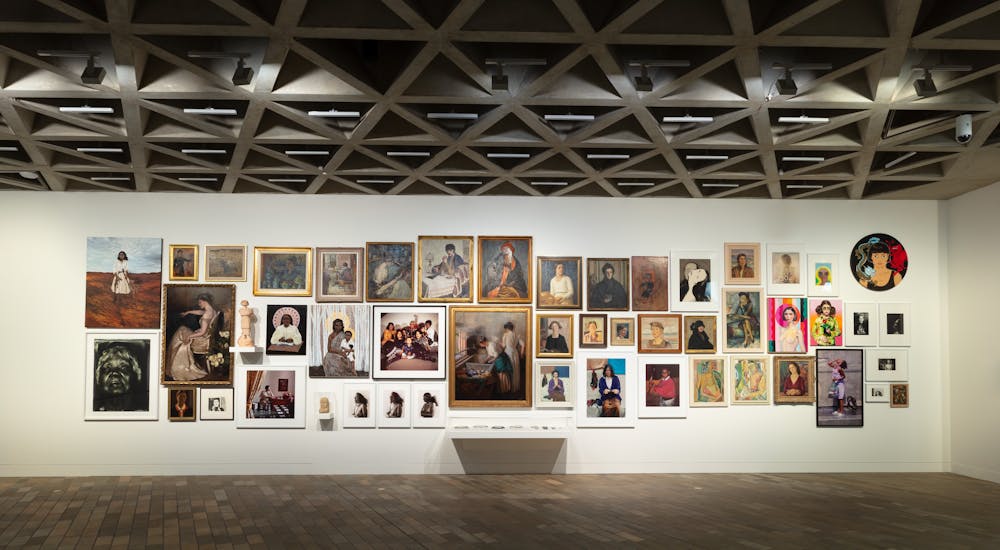 Know My Name doesn’t slot artists into specific movements. It is a new story of Australian art.
National Gallery Australia
Know My Name doesn’t slot artists into specific movements. It is a new story of Australian art.
National Gallery Australia
After the salon-style entrance, the visitor moves on to different interpretations of that great creation myth, the Seven Sisters. The space is dominated by the gallery’s recent commission, a large installation by the Tjanpi weavers. It is joined by paintings on the same subject, including works by the Ken sisters from the Anangu Pitjantjatjara Yankunytjatjara Lands. The message is of collaboration and generosity.
In the following room, Connection with Country, artists from different generations and cultures are linked to land and the environment. This includes a wall of Utopia batiks, a reminder that Jeanie Pwerle, Rosie Kngwarray and Emily Kame Kngwarreye first worked purely in textile.
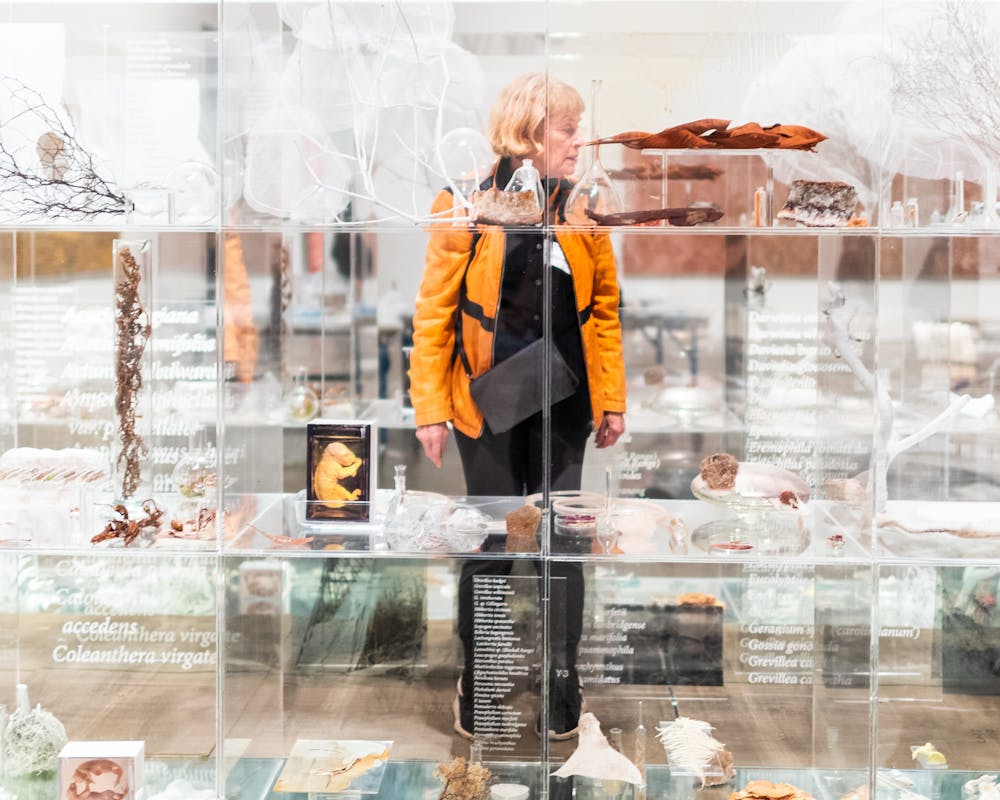 Installation view of Janet Laurence’s Requiem 2020, Know My Name: Australian Women Artists 1900 to Now.
National Gallery of Australia, Canberra
Installation view of Janet Laurence’s Requiem 2020, Know My Name: Australian Women Artists 1900 to Now.
National Gallery of Australia, Canberra
Emily Kame Kngwarreye’s great painting Untitled (Alhalker), (1992), from the collection of the Art Gallery of New South Wales, tells of her country.
Rosalie Gascoigne’s Feathered fence evokes the sparse beauty of the landscape around Canberra, while Janet Laurence’s installation, Requiem, mourns the loss of natural life. Fiona Hall’s Tender, with its bird nests woven from shredded American dollar bills, provides a stern reminder of the transience and folly of money.
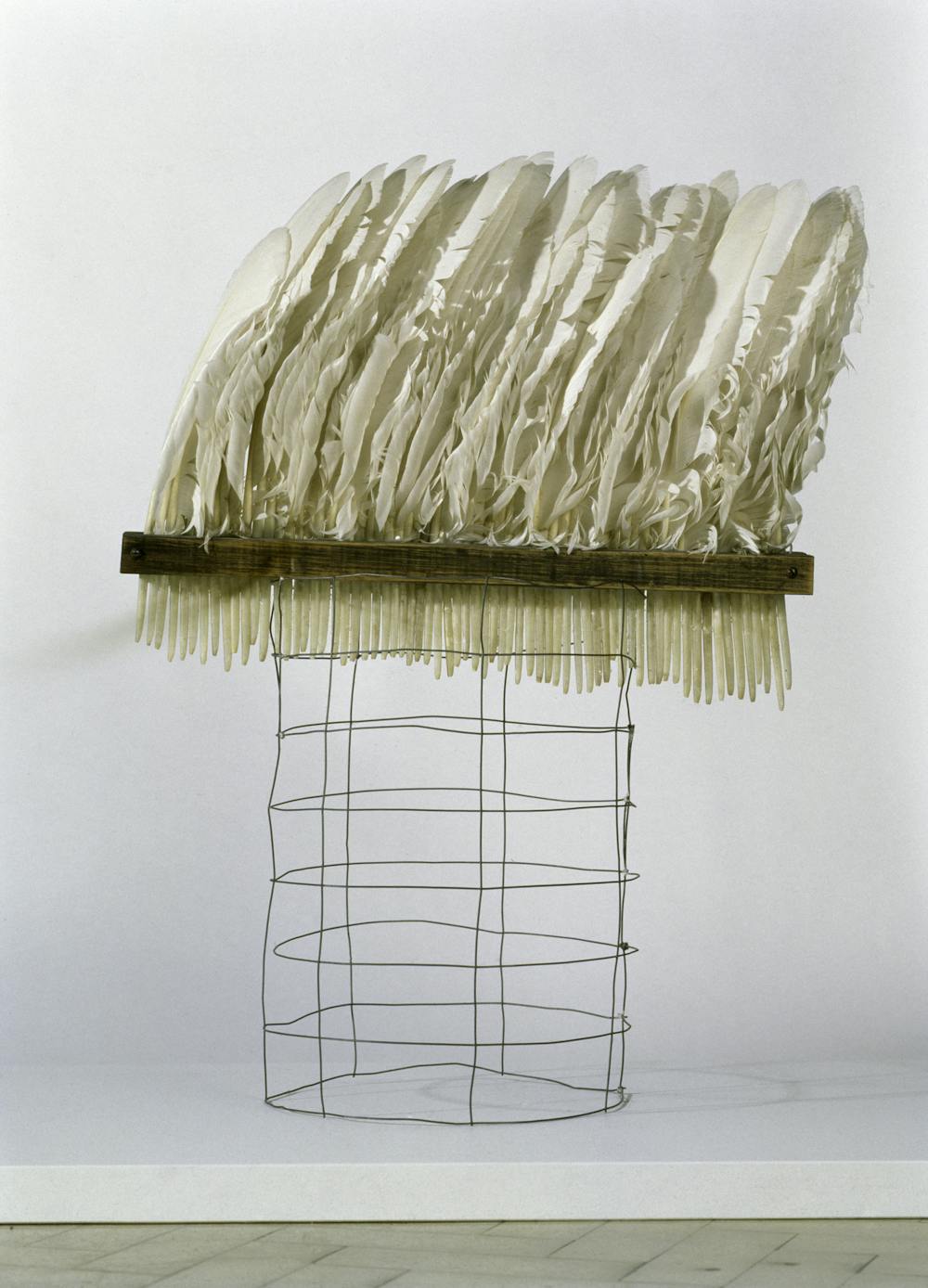 Rosalie Gascoigne, Feathered fence, 1979 National Gallery of Australia, Canberra, gift of the artist 1994.
© Rosalie Gascoigne/Copyright Agency
Rosalie Gascoigne, Feathered fence, 1979 National Gallery of Australia, Canberra, gift of the artist 1994.
© Rosalie Gascoigne/Copyright Agency
Despite the cavernous exhibition spaces it is possible to enjoy the intimate pleasure of getting up close and personal to Bea Maddock’s epic etched panorama, Terra Spiritus … with a darker shade of pale (1993-98), a painstakingly recorded circumnavigation of Tasmania, linking original names to those imposed on the land by the British invaders.
Then there are Narelle Jubelin’s exquisite reworking of colonial photographs, all in petit point.
A change of tempo
In the room titled Collaboration and care, the tempo changes. A large wall is covered with activist posters and more incendiary works, including Phoenix (Frances Budden)‘s Relic, a savage, embroidered critique of Catholicism and its regard for women.
The sense of outrage and protest that permeates this wall is matched by R.E.A.’s Resistance rework of the Aboriginal flag hanging opposite.
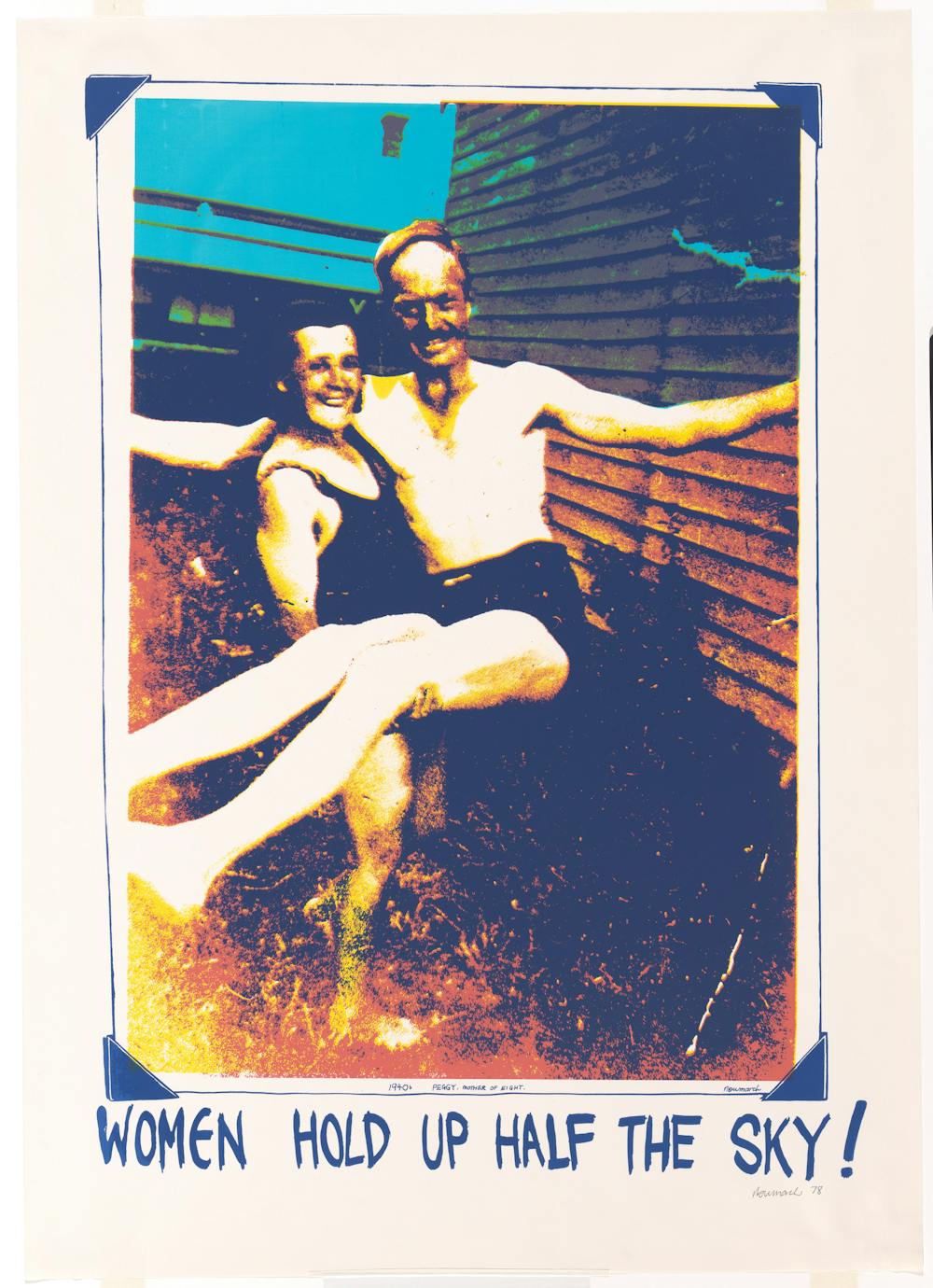 Ann Newmarch, Women hold up half the sky, 1978.
National Gallery of Australia, Canberra, gift of the artist 1988
Ann Newmarch, Women hold up half the sky, 1978.
National Gallery of Australia, Canberra, gift of the artist 1988
These polemicist works are countered by the tranqullity of the Westbury Quilt, made by the Misses Hampson in northern Tasmania in the early years of last century. The quilt’s small red and white squares, embroidered with details of daily life, are centred on an idealised vision of Queen Victoria.
Although they are exhibited in a different section, this quilt has perhaps more in common with Esme Timbery’s Shell worked slippers (from 2008) than other exhibits. They both speak of the domestic scale of traditional women’s work, and the way art can infiltrate into everyday spaces.
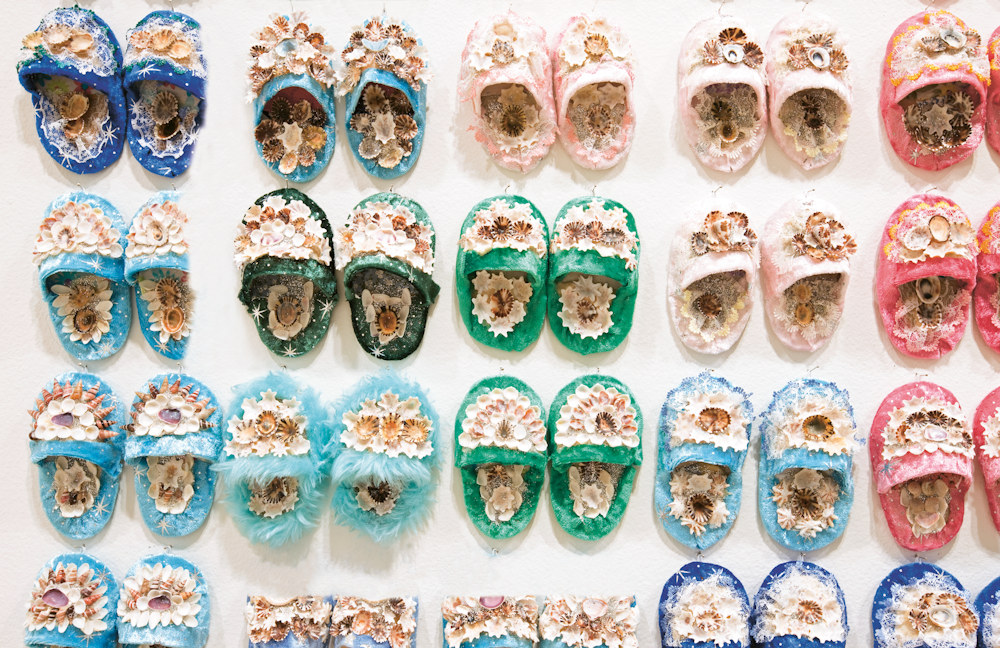 Esme Timbery (Bidjigal people), Shellworked slippers 2008.
Museum of Contemporary art, Purchased with funds provided by the Coe and Mordant families
Esme Timbery (Bidjigal people), Shellworked slippers 2008.
Museum of Contemporary art, Purchased with funds provided by the Coe and Mordant families
There is a sense of familiarity in the room, Colour, Light and Abstraction, as the contribution of women artists to Modernism has been well recorded. Here are old favourites by the pioneers – Dorrit Black, Cossington Smith, Grace Crowley, Klytie Pate – informing later generations including Margaret Worth, Janet Dawson, Virgina Cuppaidge and Melinda Harper.
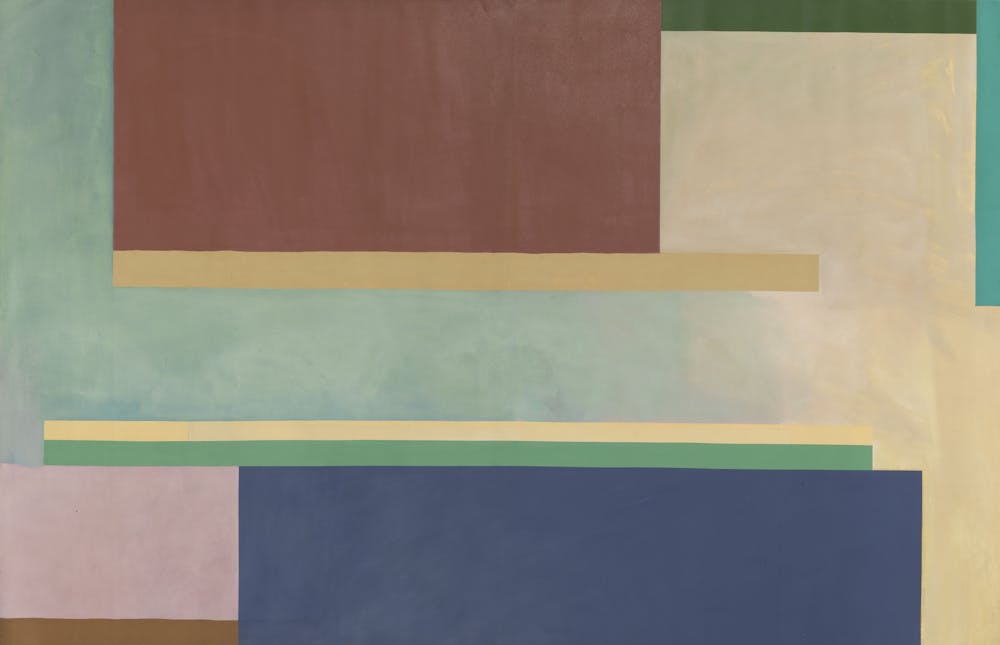 Virginia Cuppaidge, Lyon, 1972.
National Gallery of Australia, Canberra, gift of the artist 2012 © Virginia Cuppaidge
Virginia Cuppaidge, Lyon, 1972.
National Gallery of Australia, Canberra, gift of the artist 2012 © Virginia Cuppaidge
Read more: How our art museums finally opened their eyes to Australian women artists
The room titled Performing Gender presents the full suite of Julie Rrap’s Persona and Shadow, manipulated photographs based on both her body and the paintings of Edvard Munch.
These, along with Anne Ferran’s magnificent black and white Scenes on the Death of Nature, and Tracey Moffatt’s Something More, are probably the most familiar works for those who came of age in the 1980s.
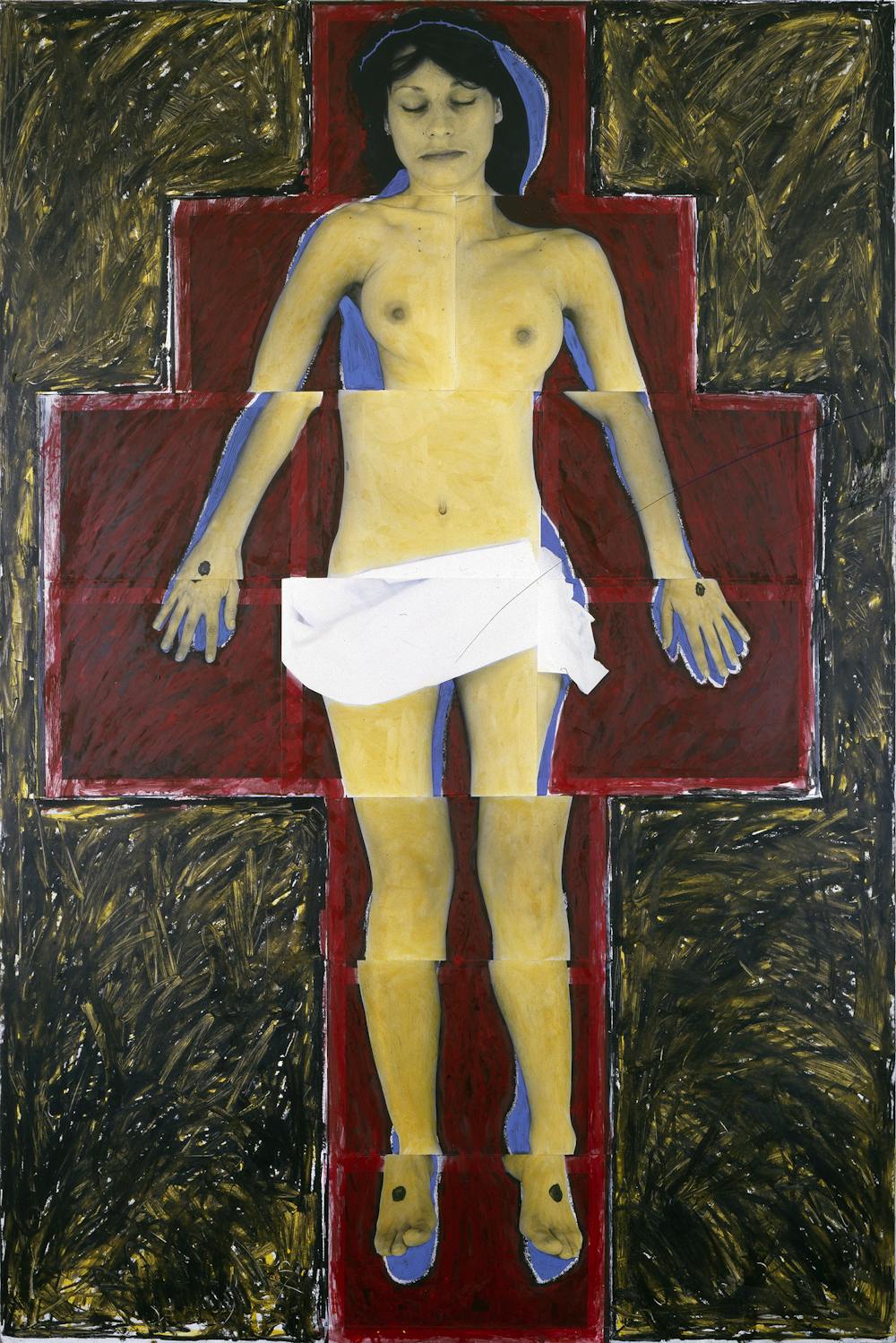 Julie Rrap, Persona and Shadow: Christ 1984, Purchased 2019.
National Gallery of Australia, Canberra
Julie Rrap, Persona and Shadow: Christ 1984, Purchased 2019.
National Gallery of Australia, Canberra
Remembering is the most sober of rooms. Kathy Temin’s memorial gardens installation honours loss of family with faux fur architecture. Lindy Lee’s bronze fragments remind us that we are but specks in the universe, while flight research, Rosemary Laing’s series of photographs, shows bridal figures floating in a clear, blue sky.
 Kathy Temin, Pavilion garden 2012, Purchased 2017.
National Gallery of Australia, Canberra
Kathy Temin, Pavilion garden 2012, Purchased 2017.
National Gallery of Australia, Canberra
The exhibition is so big only half of it is on display now. The second half is planned for July next year (it was preceded by an online conference). That one may be more confronting as it will include the in-your-face works of Pat Larter, for many years better known as the wife of Richard Larter.
Read more: Hidden women of history: Pat Larter, pioneering 'femail' artist who gave men the Playboy treatment
Twenty four years after her death she is finally being honoured with a small survey exhibition at the Art Gallery of NSW.
There is still a lot of catching up to do.
Authors: Joanna Mendelssohn, Principal Fellow (Hon), Victorian College of the Arts, University of Melbourne. Editor in Chief, Design and Art of Australia Online, University of Melbourne


















