

how COVID-19 affected Papua New Guinean fishing families
- Written by: Jacqueline Lau, Research fellow, James Cook University
In March 2020, Papua New Guinea went into a state of emergency to contain the spread of COVID-19. For Ahus Island — a small atoll community of around 600 people off the north coast of Manus Island — the state of emergency had far-reaching consequences.
In July and August, we interviewed Ahus islanders about their experience of COVID-19, and what they did to cope.
Their stories from the first six months of COVID-19 offer insight into the impacts of the pandemic on small-scale fishing communities and isolated islands.
As the new normal unfolds, the COVID-19 pandemic will continue to reverberate across fishing communities. The stories from Ahus island reflect the experiences of other fishing communities across the Pacific. Other Papua New Guinean coastal communities struggled with food shortages, and needed external support for basic foods and services. Getting cut-off from markets and food can affect people’s livelihoods and well being in unforeseen ways.
Globally, there is a need to coordinate short and long-term responses to support small-scale fisheries, especially across the Indo-Pacific, where food insecurity is already a concern.
Fishing pressure on island’s reefs decreased, but at the cost of people’s livelihoods
In Ahus, most people earn a livelihood selling fish — almost no food is grown on the island itself, and there are almost no other jobs.
During the state of emergency, fishers and fish sellers struggled to get to markets and to sell fish, which put stress on fishing families. Normally, fishers sell fish at the town market, a 40-minute boat ride from the island. During the state of emergency, the market was deserted and there was almost no demand for fish. With no customers, people stopped earning income and were unable to buy food:
We found it hard because you go to the market and there’s not one person who’ll buy fish from you.
If you have money, you get food, if you don’t have money you can’t get food. And the way we get money is from the sea alone.
Passenger restrictions meant fewer passengers could get to town. And trips took three times as long because boat owners switched to smaller motors to save petrol.
One man explained:
For us on this island, it is hard … We travel by sea. We go by boat. Now, if only limited people can get on a boat, then that affects us.
The island’s market also closed briefly at the beginning of the pandemic, and travel to the mainland was restricted, leaving some people with no way to access food. Some people secretly bartered fish with relatives on the mainland, but others had to wait for markets to reopen.
When they did reopen, there was limited cash in the community, and many returned to a traditional system of bartering fish for vegetables.
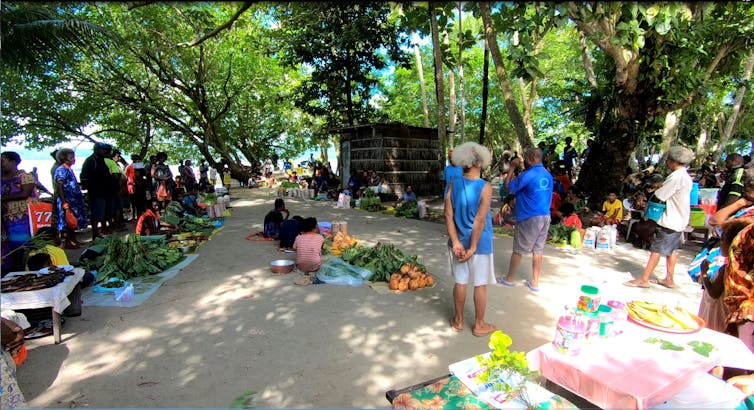 People gather at the local island market. Normally, fishers sell fish at the town market, a 40 minute boat ride from Ahus island.
Photo credit: Dean Miller
People gather at the local island market. Normally, fishers sell fish at the town market, a 40 minute boat ride from Ahus island.
Photo credit: Dean Miller
The combination of disruptions of markets and transport restrictions impacted fishing. People explained that it was hard to get fuel from town to troll for ocean fish. Others fished less because they were afraid to leave the house for too long.
The town hospital was only accepting emergency patients. One woman said:
So I told our family, you can’t go to the sea, because if you get sick then how can we go to the hospital? So during that time no one went fishing, and we didn’t have money or enough food.
Fishing pressure on island’s reefs decreased, but at the cost of people’s livelihoods.
‘Little, little for each child and each adult’
To cope with lack of income and difficulty getting food, most households started reducing what they ate. One woman said:
Before, we’d all eat rice often. Not now. I’ve cooked sago over and over, and everyone complains … but there’s nothing else.
Many families rationed food. As one person said:
There was limited food … we’d serve just a little, little for each child and each adult. It doesn’t matter if you’re full up or only just full, that was your share.
Restricting food comes with risk. Diets of fish, sago and rice alone don’t contain enough essential nutrients to maintain health. Children’s physical and mental development can be permanently impaired if they are undernourished.
As families struggled to support themselves, some stopped sharing and helping others in the community. Several people mentioned that they’d received government support during past emergencies in the form of food and basic services. Others had heard other provinces were receiving support and were frustrated that their community had been left out.
The road ahead
Since these interviews, we have spoken again with people in the community. Their situation has improved since the state of emergency lifted.
The sea cucumber season opened in September, bringing a quick cash injection to the community. Markets have returned to business as usual, food is accessible and people have started sharing again.
But the last year has shown many communities are ill-prepared for the economic disruption that comes with a pandemic. Pandemic responses that do not account for impacts on food and nutrition security may lead to non-compliance and foster distrust in the legitimacy of future directives.
Decision-makers, locally and globally, must balance management of pandemics with a recognition that fish and fishing communities are essential to local well being.
Our research report can be found here.
Wilda Hungito, a PNG-based private research consultant and co-author on the report, contributed to this article.
Authors: Jacqueline Lau, Research fellow, James Cook University


















