

The Dreamtime, science and narratives of Indigenous Australia
- Written by: David Lambert, Professor of Evolutionary Biology, Griffith University
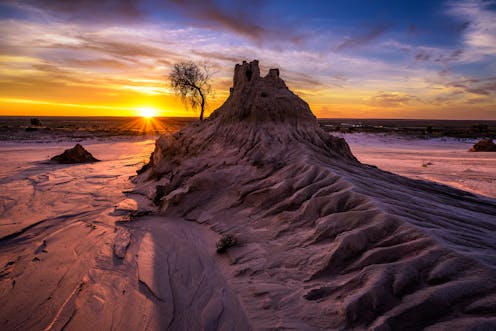
This article is an extract from an essay Owning the science: the power of partnerships in First Things First, the 60th edition of Griffith Review.
We’re publishing it as part of our occasional series Zoom Out, where authors explore key ideas in science and technology in the broader context of society and humanity.
Scientific and Indigenous knowledge systems have often been in conflict. In my view, too much is made of these conflicts; they have a lot in common.
For example, Indigenous knowledge typically takes the form of a narrative, usually a spoken story about how the world came to be. In a similar way, evolutionary theories, which aim to explain why particular characters are adapted to certain functions, also take the form of narratives. Both narratives are mostly focused on “origins”.
Read more: Friday essay: when did Australia’s human history begin?
From a strictly genetic perspective, progress on origins research in Australia has been particularly slow. Early ancient DNA studies were focused on remains from permafrost conditions in Antarctica and cool temperate environments such as northern Europe, including Greenland.
But Australia is very different. Here, human remains are very old, and many are recovered from very hot environments.
While ancient DNA studies have played an important role in informing understanding of the evolution of our species worldwide, little is known about the levels of ancient genomic variation in Australia’s First Peoples – although some progress has been made in recent years. This includes the landmark recovery of genomic sequences from both contemporary and ancient Aboriginal Australian remains.
Found, or revealed?
Mungo Man and Mungo Lady have been the subject of both Indigenous and scientific narratives.
From a scientific perspective, in 1968 the burnt remains of a woman were recovered at Lake Mungo by Jim Bowler, a young geologist. Six years later, after heavy rain, Bowler was riding his motorbike around the lake and again found human remains, this time of a man.
From an Indigenous perspective, it was not that Jim Bowler discovered these ancient people but that they found him. And of course, one is struck by the apparent coincidence that they both revealed themselves to the same person, albeit six years apart.
Professor Jim Bowler is a distinguished scientist who has close ties with, and an understanding of, Australia’s First Peoples, so Mungo Lady and Mungo Man chose well.
Since the Dreamtime
Perhaps the most well-known conflict between scientific and Indigenous perspectives relates to the origins of Aboriginal Australians.
From an Indigenous perspective, Aboriginal Australians have always been on this land – since the Dreamtime. From a scientific perspective, there is strong evidence that they have been here for more than 65,000 years – not quite “always”.
From my perspective, though, 65,000 years seems pretty close to “always”, and, moreover, it is likely that people became Aboriginal Australians when they first set foot on this land. So, in this sense, they have indeed always been here.
When a publication by Professor Alan Thorne, a prominent Australian anthropologist, and his colleagues from the Australian National University appeared in the journal PNAS in 2001, it drew worldwide attention. The authors reported the recovery of short mitochondrial DNA from Mungo Man, as well as the other ancient remains of a number of people from the Willandra Lakes region.
Read more: Explainer: what are mitochondria and how did we come to have them?
The results from their analysis, which included an evolutionary tree of recovered DNA sequences, suggested that Mungo Man was genetically different to the other ancient people they studied, who were closely related to the Aboriginal Australians of today.
This implied that contemporary Aboriginal Australians replaced another population of humans that lived here first.
This conclusion caused widespread offence among Aboriginal people, though it was difficult for them to reject the scientific claims. Some scientists argued that Thorne’s results were highly unlikely to be correct, given the age of the remains and the hot environment in which they had been interred. It was not, however, possible to refute these claims without a detailed understanding of the methods used and the opportunity to redo the experiment.
Some politicians and commentators seized on the result to argue against constitutional recognition of Aboriginal Australians, suggesting there was considerable doubt about their First Peoples status.
Read more: FactCheck: might there have been people in Australia prior to Aboriginal people?
Big personalities
Big personalities have dominated Australian archaeology and anthropology, and influenced its development – Alan Thorne prominent among them. He first became involved in the Lake Mungo excavations under the archaeologist Jim Bowler in 1969, reconstructing the remains of the skeleton of Mungo Lady.
Five years later he also reconstructed Mungo Man and led excavations at other important burial grounds in Victoria. Thorne was very well known for his work on the multiregional evolution hypothesis, a model of human evolution that disputed the more widely known recent African origin (or “out of Africa”) hypothesis.
For more than a decade after Thorne’s research was published, his work on Mungo Man and other ancient people from Willandra went largely unchallenged, despite the distress it caused to Aboriginal Australians.
Then, in 2010, with the permission of the Paakantji, Ngyiampaa and the Mutthi Mutthi peoples of the Willandra Lakes, my colleagues and I from the Australian Research Centre for Human Evolution were able to resample these important remains.
With the advantages of technology that had developed in the preceding decade, we repeated much of the original work. The new technology meant that we were able to recover much smaller amounts of DNA (if it was still present in the remains) and sequence it.
In 2016, we also published the results in PNAS journal. Our findings provided strong evidence to refute the claims made by Thorne and his colleagues, showing it was not possible to recover any DNA that unequivocally belonged to Mungo Man.
Read more: New DNA study confirms ancient Aborigines were the First Australians
We did, however, recover five distinct DNA sequences from his remains. But these sequences revealed no ancient DNA damage patterns, indicating that they were not ancient sequences – and genetic analysis showed that they were European in origin. Clearly these were sequences from people who left their DNA on the bone material after handling Mungo Man’s remains.
New techniques, new light
Our study set the record straight. We refuted the claim that Mungo Man was a member of an earlier group of people that previously inhabited Australia and not an Aboriginal Australian.
Perhaps of equal importance, we were able to recover substantial coverage of the mitochondrial genome from another ancient Willandra Lakes man, who was buried only a few hundred metres from Mungo Man.
The remains contained about 1% human DNA; from them, we were able to recover two complete mitochondrial genomes. One of these was a previously unidentified Aboriginal Australian mitochondrial genetic type, almost certainly from the remains themselves. The other was European in origin, and certainly a contaminant.
It appeared that this man was from within the Holocene period (that is, the period since the last Ice Age that ended around 11,700 years ago); we know this because the skeletal remains were not heavily mineralised. His teeth exhibited a pattern of wear typical of Aboriginal hunter-gatherer populations and included no evidence of cavities or tooth decay.
Read more: World's scientists turn to Asia and Australia to rewrite human history
Combined with the lack of mineralisation in the bone and its position in the soil layers at Lake Mungo, various authors have suggested that the remains were a few thousand years old. This is important, because it means that he represents the best “proxy” currently available for Mungo Man.
The fact that he was buried so close to the oldest-known Australian, albeit much later, suggests a common place and country. This is particularly significant given that the environmental conditions were very different at the times of the two burials, which were about 40,000 years apart.
Hence, nuclear gene studies of this man, currently underway, will be especially relevant to our understanding of Mungo Man himself. And because the nuclear genome is much larger than the mitochondrial, it will reveal much more information.
Such nuclear genome studies enable us to establish kinship relationships between people living now and ancient peoples. Such studies will take substantial time and effort, and will require the development of new innovative genomic tools.
Ethical considerations demand Aboriginal involvement in both the design and operation of such new techniques, as well as new research relationships with Indigenous communities.
Read more: Buried tools and pigments tell a new history of humans in Australia for 65,000 years
Authors: David Lambert, Professor of Evolutionary Biology, Griffith University
Read more http://theconversation.com/the-dreamtime-science-and-narratives-of-indigenous-australia-95919


















