

is it safe for kids to go back to school? And what about the new mutant strain?
- Written by: Asha Bowen, Head, Skin Health, Telethon Kids Institute
A year ago, in late January 2020, Australia reported its first cases of COVID-19. Since then, we have seen almost 29,000 confirmed cases and 909 deaths.
As cases climbed in Australian cities in 2020, many students did their schoolwork from home. Australia, including Victoria, came out of lockdowns at the end of last year. But due to outbreaks in New South Wales and Queensland over Christmas and New Year, that impacted on Victoria, restrictions remain in some places.
So what now, for the new school year? Is it safe for students to go back to school?
What we learnt in 2020
Australian health officials, paediatricians, and federal and state education departments worked together to understand how SARS-CoV-2 — the virus that causes COVID-19 — is transmitted in Australian schools.
They also kept updating, as more information came to light, what schools can do to provide a safe learning environment for children and staff.
Up to the end of term 3 in New South Wales, 49 student- and 24 staff- cases were linked to schools and early learning centres. Each of these cases, and their contacts, were followed since the pandemic began. Schools had low rates of transmission — with 51 transmission events (38 students, 13 staff) out of 5,793 contacts traced (<1%) — in terms 1, 2, and 3 when COVID-19 safe measures were in place.
Key measures were:
Most schools and early learning centres in NSW reopened after only a few days.
In Victoria, up until the end of August 2020, 1,635 cases were associated with early learning centres and schools. These consisted of 254 staff, 599 students and 753 household members, out of a total of 19,109 cases in Victoria during their second wave.
Two-thirds of infections in early learning centres and schools did not progress to outbreaks (two or more cases) and more than 90% were small outbreaks (fewer than ten cases).
While transmission has been connected with a Victorian school in the media, transmission events often have a more complex basis than just occurring in the classroom. Schools are often located in a multi-generational community and cases in this large school cluster were linked to high community transmission rates rather than infection in the school.
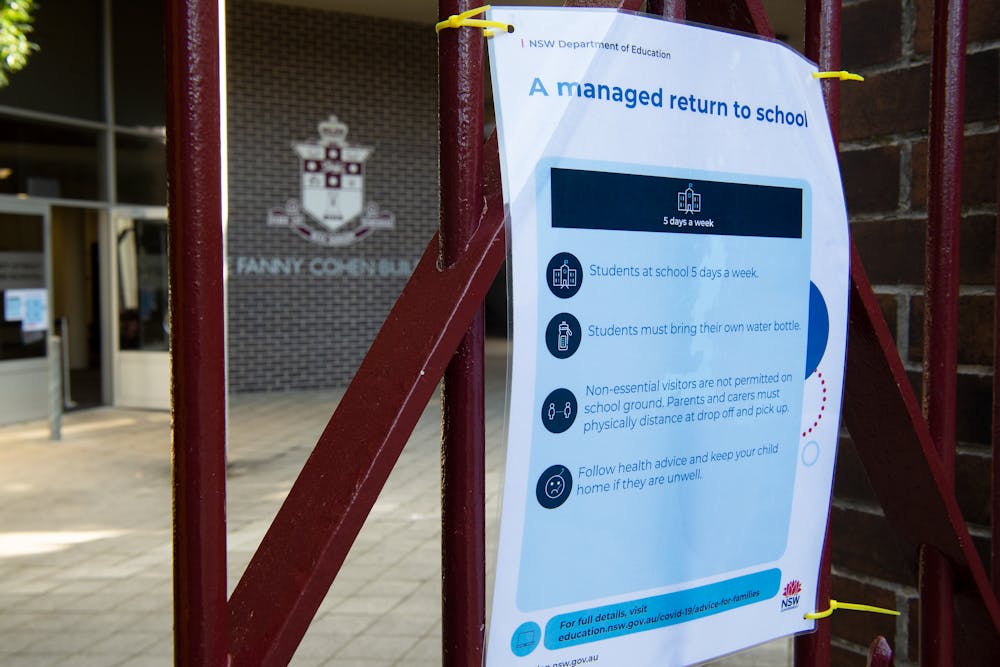 Schools closed swiftly and employed COVID-safe measures throughout 2020 in the event of a suspected or confirmed case. (Notice outside Fort Street High School in Sydney, Thursday, July 30, 2020)
Bianca de Marchi/AAP
Schools closed swiftly and employed COVID-safe measures throughout 2020 in the event of a suspected or confirmed case. (Notice outside Fort Street High School in Sydney, Thursday, July 30, 2020)
Bianca de Marchi/AAP
These studies confirm that when SARS-CoV-2 is detected in a student or staff member, it is very unlikely for other students or staff to be infected at school with the processes put in place in 2020 to provide a safe learning environment.
In Western Australia, almost 14,000 asymptomatic staff and students were swabbed at the school in terms 2 and 3. No cases of SARS-CoV-2 were detected, consistent with the absence of community transmission in that state.
But why are other countries closing schools?
Overseas, studies have shown schools can implement health strategies to safely keep schools open and minimise SARS-CoV-2 transmission risks.
In the US, the Centres for Disease Control and Prevention noted that: “trends among children and adolescents aged 0–17 years paralleled those among adults”. However, the organisation also reported:
as of the week beginning December 6, aggregate COVID-19 incidence among the general population in counties where K–12 schools offer in-person education (401.2 per 100,000) was similar to that in counties offering only virtual/online education (418.2 per 100,000).
In Norway, where testing is strong, schools were open with mitigation measures in place. There was minimal child-to-child (0.9%, 2 out of 234) and child-to-adult (1.7%, 1 out of 58) transmission.
Other countries have chosen to close schools as a last resort in national lockdowns in the face of extremely high rates of community transmission and daily case numbers, which meant only widespread reductions in population movements could be effective. This is not the case in Australia at the start of term 1, 2021.
It is common for viruses to evolve and there have now been several new variants of concern such as those identified in the UK, South Africa and Brazil which are more transmissible. The potential of such variants entering Australia is uncertain, and so is the risk of transmission in schools.
Reassuringly, if community transmission of such a variant occurs in Australia, we have established experience to monitor, and hopefully halt, its spread.
So, what should Australia do?
Remote learning provides considerable challenges to keep students engaged, reduces the close supervision and support in the classroom, and provides an added disadvantage for children with mental-health conditions, disabilities or special needs.
For parents, it is difficult to work effectively, provide for the family and maintain their well-being when their child is learning from home.
Read more: 'The workload was intense': what parents told us about remote learning
Based on the above evidence, schools are safe to open. But states should adopt mitigation measures — including when to add masks, reduce attendance or close schools — according to a traffic light system from green (standard measures) to red (close schools) based on the degree of community transmission. The Murdoch Children’s Research Institute has recommended this approach for Victoria. Education departments around Australia can consider a similar approach.
This is consistent with the recommendations of Australia’s National Cabinet and international advice.
It is important schools and early learning centres continue to adhere to their local COVID advice. Parents and guardians should check their contact details are up to date so they can be contacted easily, regularly check what restrictions are in place and, when unwell, get their child tested and stay at home.
In 2020, students and staff rapidly learned to regularly wash their hands, adapt to cleaners in the school throughout the day, socially distance and wear masks when required. These public health interventions, vaccination, and testing and tracing will remain the mainstay for the year ahead in Australia.
Monitoring well-being and building resilience will also be core educational activities in the months ahead.
Authors: Asha Bowen, Head, Skin Health, Telethon Kids Institute


















