

here's how the states can accelerate Australia's sputtering electric vehicle transition
- Written by Rupert Posner, Systems Lead - Sustainable Economies, ClimateWorks Australia
Last month, Volkswagen Australia chief Michael Bartsch revealed Australia’s clean technology laws were so weak, his German head office would not supply Australians with the company’s top selling mid-range electric vehicles.
Without a clear policy to signal the market for electric vehicles would grow, Bartsch said, Volkswagen would instead supply popular models, such as the ID.3 hatchback and the ID.4 SUV, to more welcoming markets such as North America and Europe.
Undoubtedly, the Morrison government remains in the slow lane on electric vehicle policy. Its Future Fuels Strategy discussion paper rules out subsidies for electric vehicles, and the government has failed to implement fuel efficiency standards to encourage the transition away from traditional cars.
But as history shows, in the absence of federal leadership, states and territories can work together and step into a policy breach. Now’s the time for them to band together on electric vehicles. Here’s how they can do it.
 The states can step into the federal policy breach to promote the uptake of electric vehicles.
PLUG ME IN
The states can step into the federal policy breach to promote the uptake of electric vehicles.
PLUG ME IN
A history of collaboration
Businesses largely want to act on climate change. But without strong, consistent, legally binding policy in place many businesses worry about damage to their investments, competitiveness and profits.
The situation right now is reminiscent of that in the early 2000s. Then, industry called on the Howard government to provide a clear signal on emissions reduction. The pressure culminated in 2006, when businesses – including BP, IAG and Origin Energy – declared climate change was a major business risk and “the longer we delay acting, the more expensive it becomes for business and for the wider Australian economy”.
In the years prior, Australian states and territories had already recognised the need to act. In a remarkable collaboration in 2004, they released a discussion paper on a possible National Emissions Trading Scheme (NETS). It aimed to “provide a framework for emissions reduction that gives business and the community certainty and predictability”.
This collaboration, together with industry pressure, forced the federal government to respond. In December 2006, then prime minister John Howard established a joint government-business group to advise on an emissions trading system.
As history shows, this policy didn’t eventuate. Howard lost the 2007 election and, following disappointing global climate talks in Copenhagen, the Rudd government abandoned emission trading.
But it demonstrates the opportunity for states to lead by acting collectively – and electric vehicle policy presents another such chance.
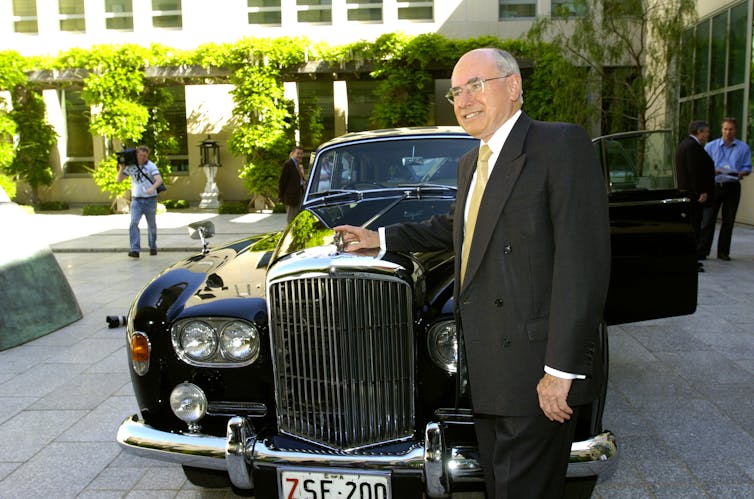 Industry concern prompted then prime minister John Howard to investigate an emissions trading scheme in 2006.
Alan Porritt/AAP
Industry concern prompted then prime minister John Howard to investigate an emissions trading scheme in 2006.
Alan Porritt/AAP
Power to the states
Australian states and territories are already leading on climate policy. All have targets or aspirations to reach net-zero emissions by 2050, and some have ambitious renewable energy targets.
Some jurisdictions are also starting to decarbonise their transport sector. For example, the ACT government offers financial incentives, stamp duty exemptions and a bold fleet purchasing commitment.
Norway provides a stunning example of policies that can support electric vehicle uptake. In under a decade, electric vehicle purchases have increased from virtually nothing to more than half of all new car sales in 2020. It has a national goal that all new cars sold by 2025 should be zero emissions.
In contrast, in Australia in 2020, electric vehicles comprised just 0.6% of new vehicle sales.
Electric vehicle incentives deployed in Norway include:
- exemption on 25% consumption tax normally applied to new vehicles
- road tax exemptions
- lower registration fees
- parking fee and tolls discounts
- no import tax
- permission to drive in bus lanes
- reduced company car tax.
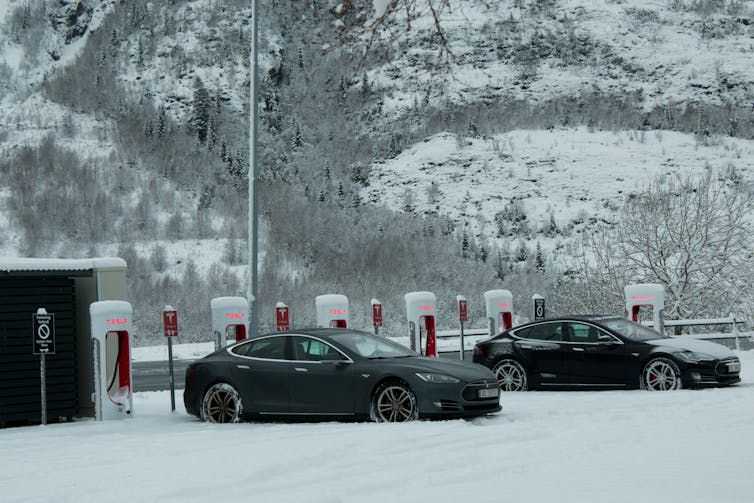 Norway’s electric vehicle policies offer a model for Australian states to follow.
Shutterstock
Norway’s electric vehicle policies offer a model for Australian states to follow.
Shutterstock
Many of these policies are within the remit of Australia’s states. But the efforts must be coordinated, or unintended consequences may result. For example, a large rebate offered in one state might mean consumers flock to purchase their electric vehicles outside their home state. That outcome would not be fair to taxpayers in the state offering the rebate.
Coordinated fleet purchasing is another way states could encourage electric vehicle uptake in Australia. At the moment, electric vehicle prices are out of reach for many consumers. Few low-cost options exist and the range of mid-range models – those priced about A$50,000 or $60,000 – is limited.
But our analysis shows some electric vehicles are already cost-competitive for government fleets. So if states banded together to buy a large number of a particular model of electric vehicles, this could be the incentive needed for manufacturers to offer the model for general purchase in Australia. Some manufacturers may even consider local assembly or manufacture if sales volumes were high enough.
And due to the relatively high turnover in government fleet cars, the second-hand market would soon see an influx of electric vehicles. This would quicken the transition across the economy.
It should be noted, the Morrison government plans to encourage business fleets to transition to electric vehicles. It is also trialling the Tesla Model 3 and Hyundai Ioniq EVas in its Comcar fleet.
States could also use their collective clout to have more electric vehicle charging infrastructure built. If all states act together to expand the charging network, it could be done more cheaply and efficiently.
Read more: The US jumps on board the electric vehicle revolution, leaving Australia in the dust
 Government fleet cars offer an opportunity to increase electric vehicle uptake.
Shutterstock
Government fleet cars offer an opportunity to increase electric vehicle uptake.
Shutterstock
On the road again
Working together, the states could send the signal manufacturers require before they commit to selling a wider range of electric vehicles in Australia.
Our research has shown 50-76% of new car sales in Australia must be electric by 2030 to ensure we reach net-zero emissions by 2050.
We don’t have much time. The states can jumpstart this transition – and with any luck, the Commonwealth might get on board.
Read more: Scott Morrison has embraced net-zero emissions – now it's time to walk the talk
Authors: Rupert Posner, Systems Lead - Sustainable Economies, ClimateWorks Australia

















