

German Modernism at the Staatsgalerie in Stuttgart — beauty, play and the horror of war
- Written by Emily Brayshaw, Honorary Research Fellow, University of Technology Sydney
In this series we pay tribute to the art we wish could visit — and hope to see once travel restrictions are lifted.
The city of Stuttgart doesn’t generally come to mind when planning a jaunt to Germany. Berlin’s edgy nightclubs and rich history make it a must-see destination and of course, thousands travel to Munich for its famous annual Oktoberfest. But poor old Stuttgart isn’t usually on tourists’ radar and perhaps that’s why I love it.
Stuttgart is Germany’s fourth largest metropolitan region and a major manufacturing hub. The Daimler Group, which owns Mercedes-Benz, is headquartered there, as are the Porsche HQ and factory.
But the city has put art at the centre of its cultural life for more than 250 years with countless famous artists, from the neo-classical scupltor Johann Heinrich von Dannecker, to leading Bauhaus practitioner Oskar Schlemmer and contemporary artist Karin Sander, all calling Stuttgart home.
A 2015 study ranked Stuttgart the number one city in Germany for arts and culture.
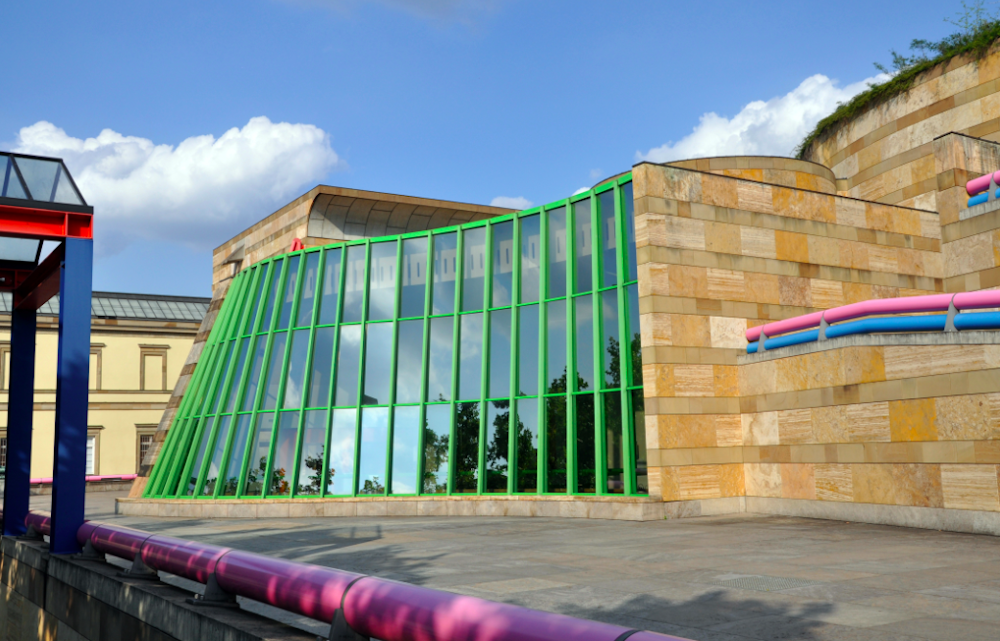 Stuttgart’s Neue Staatsgalerie has magnificent collections.
Wikimedia Commons
Stuttgart’s Neue Staatsgalerie has magnificent collections.
Wikimedia Commons
Stuttgart’s veneration of art is reflected in the magnificent collections held in the Neue Staatsgalerie, which include works spanning more than 1,000 years. Among my favourites are paintings and sculptures by leading German Modernists. These powerful works express the joys and beauty of the world as well as the horrors of World War I.
The Staatsgalerie holds Franz Marc’s works, The Little Blue Horses (1911) and The Little Yellow Horses (1912). Marc was one of the key figures of German Expressionism, an artistic movement that broadly emphasised representing the artists’ inner emotions or ideas over replicating reality.
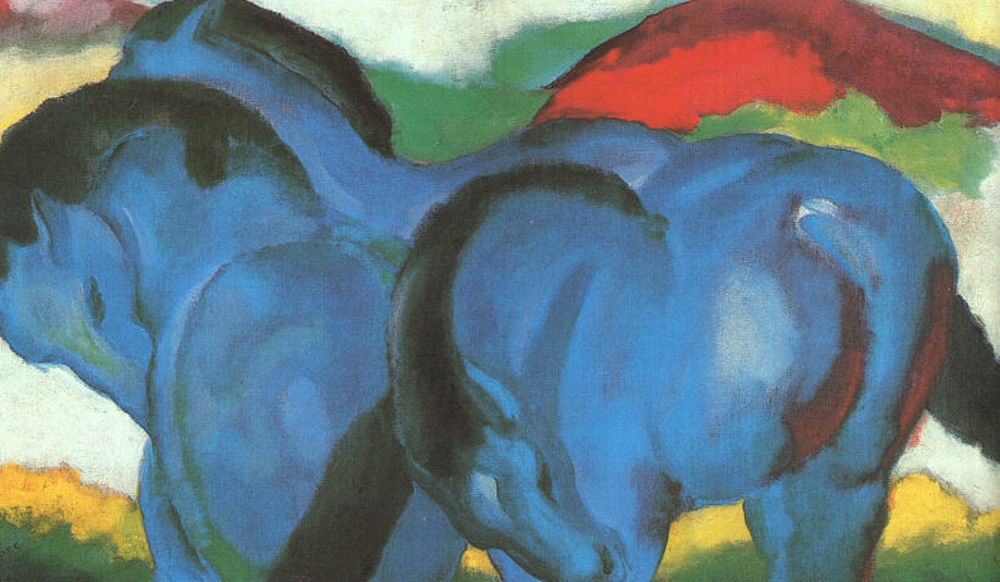 Franz Marc, The Little Blue Horses, 1911.
Wikimedia Commons
Franz Marc, The Little Blue Horses, 1911.
Wikimedia Commons
In 1909, Marc, along with Russian artist, Wassily Kandinsky, founded the Expressionist group, Der Blaue Reiter in Munich. The characteristics of Marc’s Expressionism included simplified shapes, bright colours and gestural marks or brushstrokes, which are seen in the beautiful, big, round rumps of Marc’s blue and yellow horses.
The pictures recall the geometry of Cubism, yet perfectly capture the spirit of relaxed horses standing in a field.
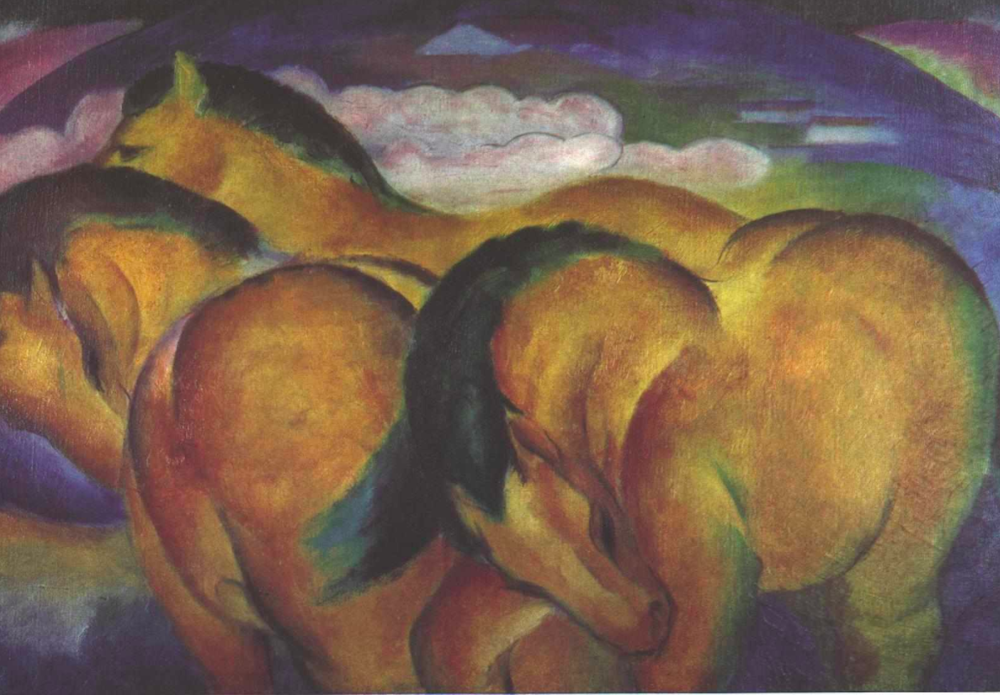 Franz Marc, The Little Yellow Horses, 1912.
Wikimedia Commons
Franz Marc, The Little Yellow Horses, 1912.
Wikimedia Commons
Another key work is Max Beckmann’s 1916 painting, Auferstehung (Resurrection). Beckmann had painted a neo-baroque vision of salvation in 1908-09, also entitled Auferstehung, which depicts the figures of redeemed souls reverently ascending to heaven in a column of light.
But after being discharged from the German army in 1915 following a nervous breakdown, Beckmann abandoned classical conventions in painting and turned to the distortion, angularity and exaggerated colour found in Expressionism for his 1916 Auferstehung to portray the terrible suffering of a people deceived by nationalistic promises of a glorious war.
In contrast to his earlier work of the same title, Beckmann’s 1916 Auferstehung shows dehumanised, broken people crawling from bombed out cellars onto piles of rubble and performing an apocalyptic danse macabre, or dance of death. The scale of the work, which is almost 3.5 metres high by 5 metres wide, adds to its shocking, tragic impact.
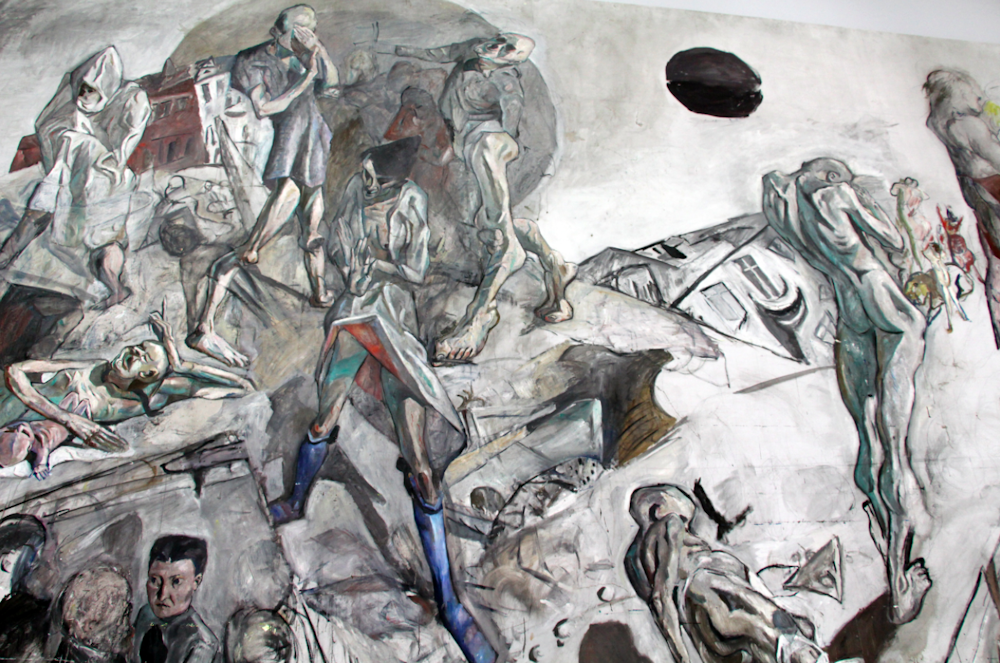 Auferstehung, Max Beckmann, 1916.
Wikimedia Commons
Auferstehung, Max Beckmann, 1916.
Wikimedia Commons
George Grosz’s 1917-1918 The Funeral Procession, Dedicated to Oskar Panizza painted the same year as his work, Explosion, also depicts the horrors of a society ruined by war.
 George Grosz, 1917-18, The Funeral (To Oskar Panizza), oil on canvas, 140 x 110 cm, 1918-18.
Wikimedia Commons
George Grosz, 1917-18, The Funeral (To Oskar Panizza), oil on canvas, 140 x 110 cm, 1918-18.
Wikimedia Commons
The painting shows grotesque figures moving in a macabre funeral procession through an infernal city led by three allegorical creatures representing Drunkenness, Syphilis, and Religious Fanaticism.
To me, this painting is a bitter reminder of how humans often self-medicate with alcohol, unsafe sex and religious zeal to try to cope with trauma.
The Staatsgalerie, however, also contains beautiful, strange and compelling works that exemplify Modernity in post-World War I Germany, including the original costumes for the Triadic Ballet (1922) by Oskar Schlemmer, and the Head in Brass (Portrait Toni Freedan) (1925) by the sculptor Rudolf Belling.
Schlemmer’s costumes point to the ideals of play and fun — so important to the ethos of the Bauhaus movement — particularly after the brutal war. The costumes are also a complex exploration of the relationships between the body and space.
Seeing them up close lets the viewer appreciate not just Schlemmer’s aims and work, but how important it must have been for artists to create something completely unrelated to war.
Belling’s brass head perfectly captures the Zeitgeist of mid-1920s Germany. Its lines point to styles Belling explored throughout his career, including Expressionism, Futurism and traditional sculpture, as well as to his 1921 work, Fashion Sculpture A, a mannequin made in collaboration with a Berlin workshop.
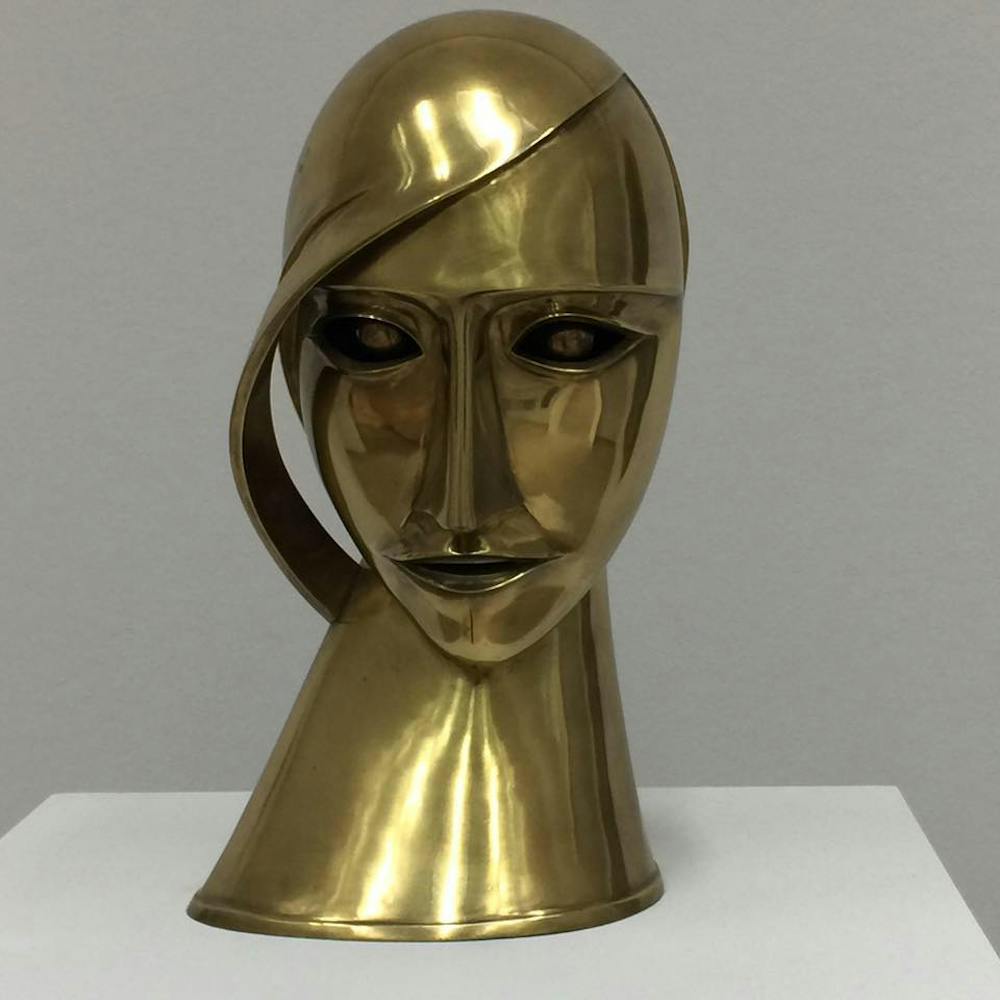 Rudolf Belling Head in brass (Portrait Toni Freedan) (1925).
Author provided
Rudolf Belling Head in brass (Portrait Toni Freedan) (1925).
Author provided
The head’s enigmatic expression echoes that of the ancient Bust of Nefertiti, which was first exhibited in Berlin in 1924, and foreshadows the beautiful “Maschinenmensch” robot of Fritz Lang’s 1927 film Metropolis.
These key works are just the beginning of any visit to the Staatsgalerie and to understanding how these great artists shaped how we see the world today.
Authors: Emily Brayshaw, Honorary Research Fellow, University of Technology Sydney

















