

new research shows bigger doesn't always mean smarter
- Written by Vera Weisbecker, Associate Professor, Flinders University
If a friend boasts of having a “big-brained” dog, your reaction is probably not to ask “relative to what?”. You would simply assume your friend thinks their dog is pretty smart. But are we always right to equate big brains with greater intelligence?
In a study published today in Science Advances, we and our colleagues describe how the relationship between large brains and “intelligence” in mammalian evolution isn’t as straightforward as you might assume.
A key problem is that, in evolutionary terms, a “large brain” doesn’t just refer to the absolute size of the brain. Rather, we refer to mammals as big-brained when their brain volume is large relative to their body mass.
There are many examples of intelligent animals that are also large-brained for their size. Humans are a particularly extreme case; our brains are roughly seven times larger than expected for an animal of our size. Dogs are also famously large-brained and smart, as are whales, dolphins and elephants.
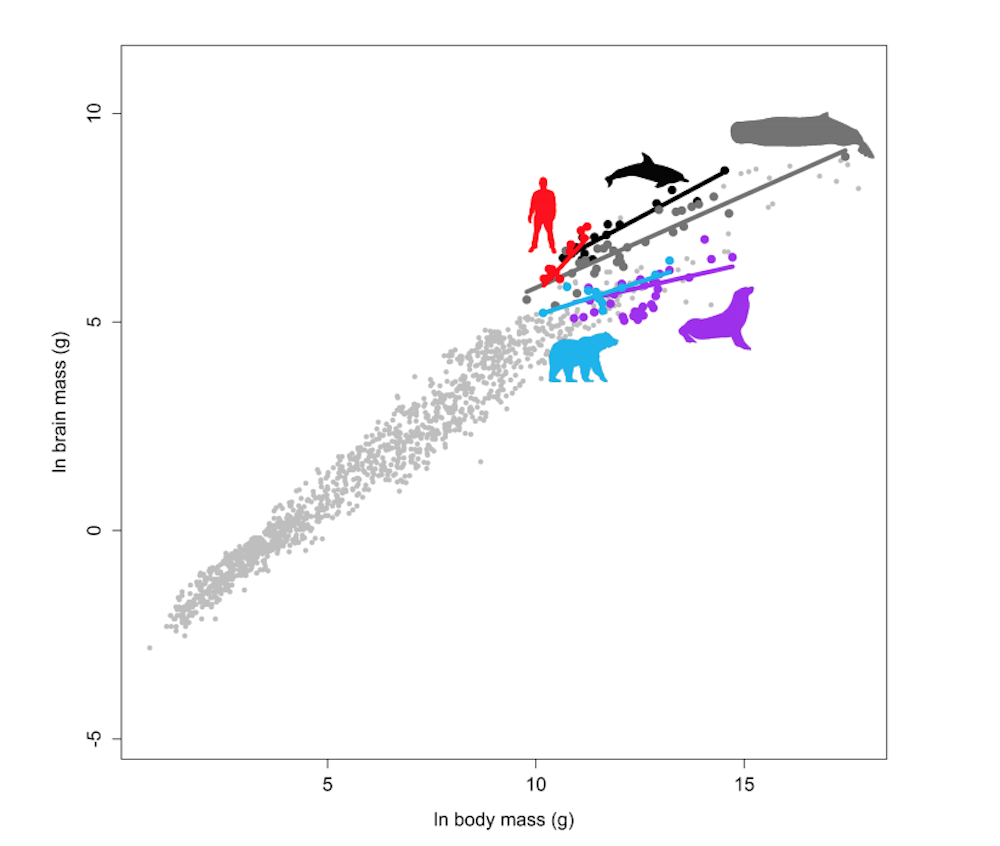 Brain to body size plot highlighting humans and hominins (species ancestral to humans) in red, dolphins in black, other toothed whales in grey, bears in blue, and seals and sea lions in purple.
Author provided
Brain to body size plot highlighting humans and hominins (species ancestral to humans) in red, dolphins in black, other toothed whales in grey, bears in blue, and seals and sea lions in purple.
Author provided
This big-equals-smart equivalence has also been applied in research on mammalian brain size evolution, under the assumption that relatively large mammalian brains evolve in situations where natural selection favours greater intelligence. But what if it’s not brain size that became larger, but body size that became smaller?
To investigate this question, we assembled the largest data set of brain and body masses of mammals from the existing literature. In total, we compiled size data for 1,400 mammal species, including 107 fossils.
We then assembled an evolutionary tree for these species. This allowed us to ask how brain and body size have related to each other throughout the evolution of mammals, starting from before the extinction of dinosaurs.
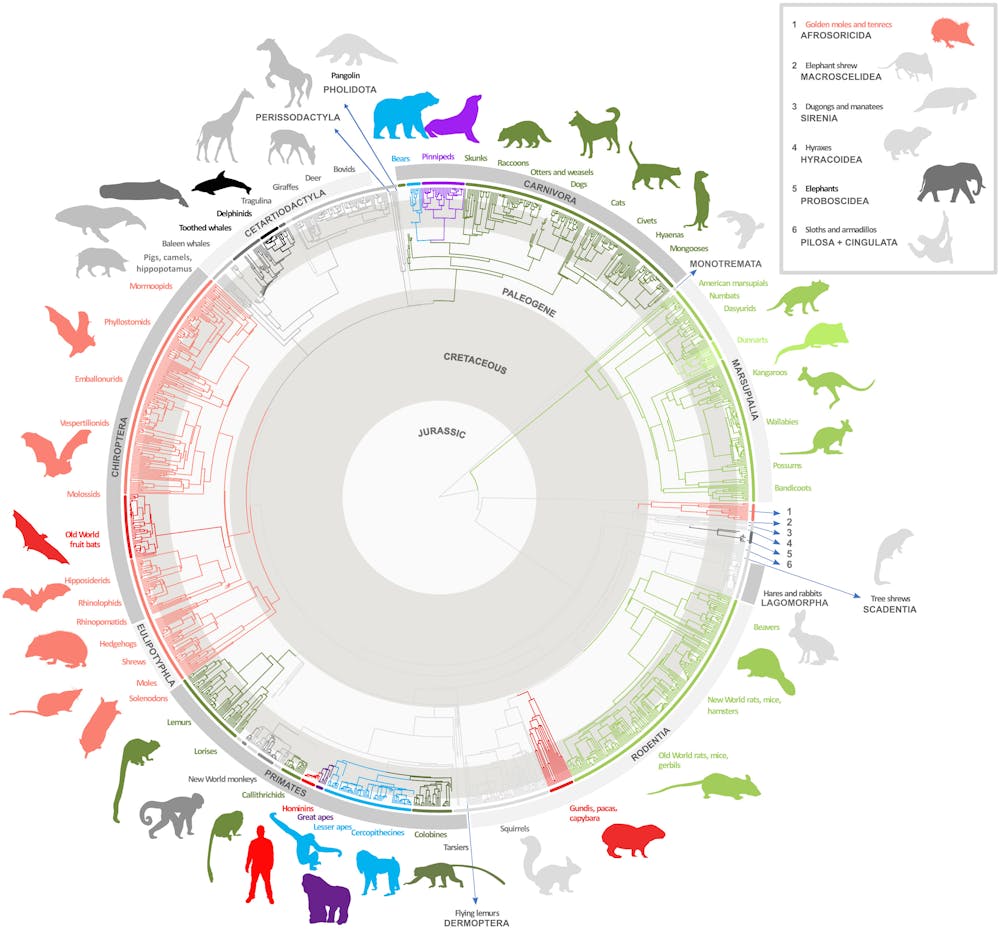 Evolutionary tree of mammals - different colours represent groups of species that share a similar brain-to-body size relationship.
Author provided
Evolutionary tree of mammals - different colours represent groups of species that share a similar brain-to-body size relationship.
Author provided
Our analysis revealed a mixed bag of evolutionary trajectories in brain and body sizes. For example, elephants are large, large-brained, and also known to be very intelligent. We saw that this combination arose through the elephants undergoing an even greater increase in brain size than expected for their large body size.
In contrast, the evolutionary lineages for humans and dolphins – both among the largest-brained mammals on Earth - were particularly unique in having larger brains but smaller bodies compared with their close relatives (chimps and gorillas for humans; other toothed whales for dolphins). This unusual combination makes their brains spectacularly large among mammals.
Read more: Curious Kids: which is smarter – a blue whale or an orca?
Strikingly, some mammals that are known to be very intelligent underwent stronger natural selection on body size than on brain size. The California sea lion, for example, famous for its circus-trick smarts, has an unusually small brain relative to its body mass. This is because when the evolutionary ancestors of seals and sea lions began living in water, evolution favoured massive increases in body size — perhaps to conserve body heat, to ward off predators such as sharks, or more generally because gravity is less of an impediment to large body size in water than in air.
This means California sea lions’ relative brain size is much smaller than expected, given their intelligence. So how are they so smart? One possible explanation is that, despite their relatively smaller brain size compared with their close relatives, California sea lions have up to four times more volume dedicated to brain areas that support intelligent behaviour, such as learning complicated tricks.
This seems to make them much smarter than other mammals with comparable brain sizes, such as bears, and shows why sea lions can learn skills that are not in their innate repertoire of behaviours, such as making vocalisations on command.
Our analysis also revealed that cataclysmic events in evolutionary history left their hallmarks in mammals’ brains. For example, there was an acceleration in increases in brain size relative to body mass after the extinction of the dinosaurs 66 million years ago. We think this may be due to the fact many mammals found new habitats to live in that were previously occupied by dinosaurs, often requiring new adaptations in either brain or body size.
Another intriguing pattern is a substantial rearrangement of the relationship between brain and body sizes between 30 million and 23 million years ago, when Earth cooled rapidly and some big evolutionary changes (such as the evolution of seals and sea lions) happened.
Some of these changes left legacies that still endure today. They have resulted in some of the biggest (elephants and whales) and smallest (bats and shrews) mammal brains on Earth.
Read more: Brain versus brawn: the evolution of humans and other animals
Given that the evolution of brain size and intelligence is even more complex than we realised, how do we go about trying to understand it more fully? We definitely need to consider the evolutionary background of present-day mammals. However, it is also important to understand how the various parts of the brain evolve relative to one another.
For example, humans and dolphins not only have large brains overall, but also an astoundingly large neocortex, which is the powerhouse of mammal intelligence.
In the meantime, next time your friend boasts about their big-brained dog, remind them size isn’t everything.
Authors: Vera Weisbecker, Associate Professor, Flinders University

















