

Flights have resumed between New Zealand and NSW, but the temporary travel pause may not be the last
- Written by Michael Plank, Professor in Applied Mathematics, University of Canterbury
New Zealand has resumed quarantine-free travel with New South Wales today, even though the Australian state’s government has extended restrictions in greater Sydney for another week.
From New Zealand’s perspective, the fact no further community cases have been discovered gives us confidence we’re not overlooking a large hidden outbreak after all.
While a few cases might trickle in over the days ahead, provided these are linked to the cluster, they shouldn’t lead to another pause in travel.
The ban on quarantine-free travel was put in place last week in response to two new cases of COVID-19 in Sydney. It was the third time travel has been paused from a specific state, which highlights the challenges in tracking the risk of an outbreak across jurisdictions with different systems in place.
The decision to pause travel with NSW was in line with the plan New Zealand’s government set out when it announced the trans-Tasman bubble.
When a case has no clear link to the border, travel may be paused until we are confident the outbreak has been contained.
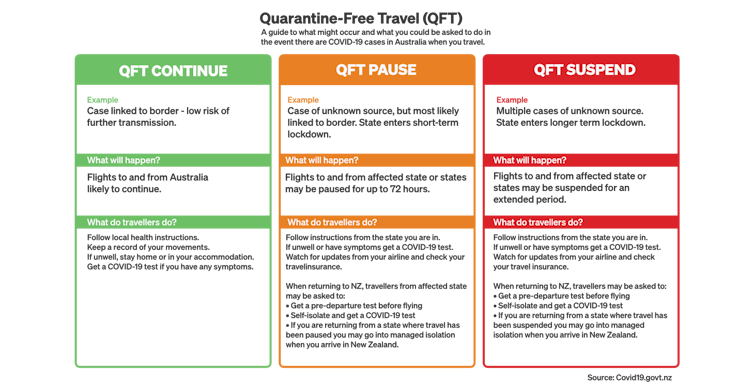 This guide explains what happens if COVID-19 cases are detected in Australia.
Author provided
This guide explains what happens if COVID-19 cases are detected in Australia.
Author provided
Red flags
The first Sydney case had some red flags. Although a genomic link was established with a case in a Sydney quarantine facility, there was no known contact between that person and the community case. This means there is almost certainly a missing link in the chain of transmission.
Additional risk factors include the person’s high viral load, the large number of locations they visited while infectious, and the positive result in sewage testing. Together these opened up the possibility the detected case could have been the tip of a much larger iceberg.
As New Zealand’s COVID-19 response minister Chris Hipkins said, the decision to hit pause was a line call. But, given the unknowns, it was a good decision to buy time for the results of contact-tracing and testing in Sydney to come in.
The Sydney case had higher risk factors than recent cases in Perth, which had also prompted a pause to quarantine-free travel.
Different states, different approaches
This highlights differences between Australian states’ responses. Western Australia has tended to be more risk-averse, and promptly announced a snap lockdown in response to a recent case with a clear link to the border.
NSW seems to have higher tolerance for risk, possibly because of higher confidence that its contact-tracing system can control outbreaks.
The principle of the trans-Tasman bubble is that New Zealand and each Australian state has to make their own decisions about when to close their borders. Once most of New Zealand’s population is vaccinated, the risk from this type of situation will be much smaller, but until then we need to maintain our strategy to keep COVID-19 out of the community.
One of the challenges of the trans-Tasman bubble is that people will move relatively quickly, which means COVID-19 can spread quickly. This makes contact-tracing all the more important, but doing this across borders is not as easy as it might seem.
Differences in contact tracing
Health authorities on each side have to share information about active cases, their movements and their contacts, all while respecting privacy regulations on both sides. A “data exchange” was trialled in three Australian states last year, but doesn’t appear to have been rolled out more broadly yet.
For Australia and New Zealand, this sharing is a manual exercise because our contact-tracing apps are not compatible with each other due to fundamental design differences. The Bluetooth protocols are different: Australia uses Herald; New Zealand uses the Apple/Google exposure notifications system. And they store data in different places.
Australia’s apps are centralised, with data going to servers controlled by health officials, protected by legislation. New Zealand’s app is decentralised, with data staying on the device until the user tests positive for COVID-19 and voluntarily provides it to contact tracers.
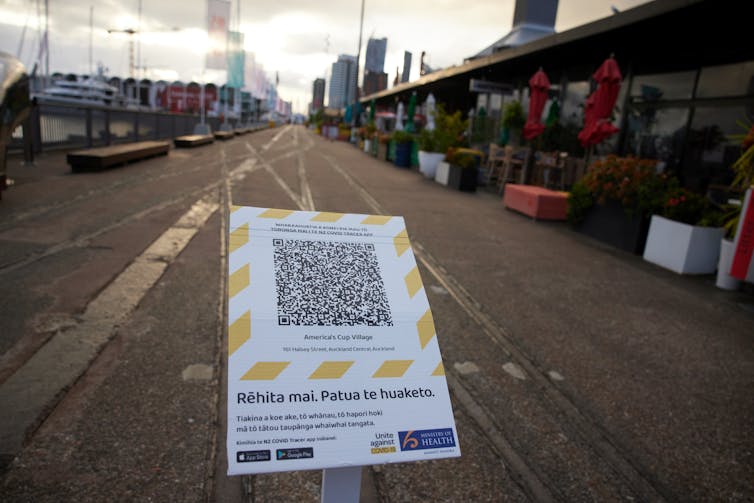 New Zealand and Australia use different apps for contact tracing, and they are not compatible.
Brendon O'Hagan/Bloomberg via Getty Images
New Zealand and Australia use different apps for contact tracing, and they are not compatible.
Brendon O'Hagan/Bloomberg via Getty Images
These differences mean we can’t easily automate the sharing of data between Australia and New Zealand, and people can’t get automatic alerts across multiple jurisdictions. But this isn’t necessarily a bad thing, because it means human contact-tracers can verify information and decide what is important enough to share. And they can provide context with the data so appropriate actions can be taken.
This manual approach wouldn’t work as well in countries with high rates of COVID-19 because the sheer number of cases would be impossible to keep up with. But it is effective in countries like New Zealand and Australia, which are committed to stamping out COVID-19.
As we gradually open the borders and more people start to travel internationally, we will need good contact-tracing processes to give us confidence that health officials can quickly contain any outbreaks. While the vaccines are coming, we will all need to remain vigilant for a while longer.
Authors: Michael Plank, Professor in Applied Mathematics, University of Canterbury

















