

Why the NSW government is reviewing its Confucius Classrooms program
- Written by: Jeffrey Gil, Senior Lecturer in College of Humanities, Arts and Social Sciences, Flinders University
Since the early 2000s, China has been focusing on soft power as one means of achieving its goals in world politics. The promotion of Chinese language learning has been a major aspect of this. Language is seen as a means for people to gain knowledge and understanding of China. Confucius Institutes and Confucius Classrooms are the primary vehicles for promoting Chinese language learning around the world.
Confucius Institutes are set up through partnerships between a Chinese university, a foreign university and the Office of Chinese Language Council International (Hanban), a language and culture promotion organisation operating directly under China’s Ministry of Education. Confucius Classrooms are offshoots of Confucius Institutes, and are located in primary and secondary schools. Both receive funding from Hanban.
The NSW government is currently reviewing its Confucius Classrooms program, amid claims it could expose children to propaganda.
Benefit or threat?
The first Confucius Institute in the world opened in Seoul, South Korea, in November 2004. Since then, the number of Confucius Institutes and Classrooms, and their coverage of the world, has expanded considerably. By the end of 2017, there were 525 Confucius Institutes and 1,113 Confucius Classrooms across 146 countries and regions. Australia has the third highest number of Confucius Institutes and Confucius Classrooms after the US and UK.
This development has been accompanied by considerable debate about their nature and impact.
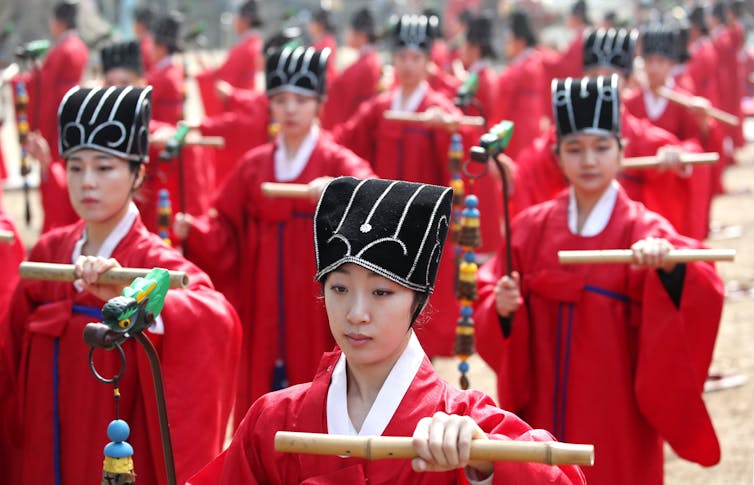 A group of students perform a traditional dance during the Spring ‘Seokjeon’ ceremony in Seoul, South Korea, in homage to Confucius and other renowned Confucian figures.
YONHAP/AAP
A group of students perform a traditional dance during the Spring ‘Seokjeon’ ceremony in Seoul, South Korea, in homage to Confucius and other renowned Confucian figures.
YONHAP/AAP
One view sees Confucius Institutes and Classrooms as beneficial for Chinese language and culture education. This view asserts they provide valuable resources (such as teaching materials, teaching staff and language classes) for a variety of people, and support for existing courses in schools and universities.
Another view sees Confucius Institutes and Classrooms as a threat to the institutions and countries which host them. They are seen to have the potential to compromise academic freedom, spread propaganda, encourage self-censorship on sensitive issues and exert undue influence on schools, universities and governments.
Read more: How should Australia respond to China's influence in our universities?
The NSW Department of Education has said their relationship with the Confucius Institute is currently under review to make sure there are no inappropriate influences from foreign powers.
The state’s 13 Confucius Classrooms opened in two groups in 2013 and 2015. They are coordinated by the Confucius Institute in the NSW Department of Education. According to those involved, Confucius Classrooms have been facilitating students’ learning of and interest in Chinese language and culture.
So why is the NSW government undertaking a review now?
Building Concerns in NSW
According to the Department’s website, Hanban provided establishment funds of A$150,000 for the Confucius Institute, as well as A$10,000 for every Confucius Classroom. For its part, the Department funds the positions of Confucius Institute Manager and Confucius Institute Officer and an annual operating budget. The housing of a Confucius Institute in a government department is a unique arrangement.
 A clay sculpture of Confucius reading with students.
Shutterstock
A clay sculpture of Confucius reading with students.
Shutterstock
It’s not surprising, then, that Confucius Classrooms have attracted controversy before. In December 2015, then Greens party member John Kaye put questions to the minister for education about their establishment operation during parliament.
Acting Greens education spokesman David Shoebridge said:
These classes might be free to Treasury, but they are paid for by exposing children to a foreign government’s propaganda machine.
Members of the public also raised similar concerns. Most recently, Ross Babbage, the former head of strategic analysis in the Office of National Assessments, described the location of a Confucius Institute in a state government department as “unacceptable” and urged a review of this arrangement.
Read more: Book review – Clive Hamilton's Silent Invasion: China's Influence in Australia
The Department’s decision to undertake a review suggests these concerns have been given greater weight in the context of broader concerns over Chinese political influence in Australia.
Overseas precedents
A public protest against Confucius Classrooms took place in Toronto, Canada, in 2014. The Toronto District School Board (TDSB) planned to establish a network of Confucius Classrooms to provide Chinese classes to schools. Parents and community members carried signs with messages such as “Don’t Poison Your Kids and Mine With Communism!”, “No Communist CI in TDSB” and “I Don’t Want Communist Chinese Textbook”.
The plan was cancelled and the Confucius Classrooms never eventuated.
A growing list of universities have also closed their Confucius Institutes, including Texas A&M University, the University of Chicago, Pennsylvania State University, University of McMaster and Stockholm University. Other universities have refused to establish Confucius Institutes at all, including the University of Manitoba, Cornell University and India’s Jawaharlal Nehru University, although there remains scant evidence such concerns are justified.
So far, Australia’s reaction to Confucius Institutes and Confucius Classrooms has not reached this level. But these precedents add to the feeling of unease about them, and are likely one reason for the review.
Do the Institutes and Classrooms actually have any influence?
Major opinion polls (such as the Pew Global Attitudes Survey and BBC World Service Poll) show limited, if any improvements in positive attitudes towards China since the establishment of Confucius Institutes and Confucius Classrooms.
The 2017 Lowy Institute Poll showed only 54% of Australians trusted China to act responsibly in the world. This is compared with 90% for the UK, 86% for Japan and Germany and 64% for the US and India. Only 8% considered China Australia’s best friend in the world.
Read more: When it comes to China's influence on Australia, beware of sweeping statements and conflated ideas
There’s also no evidence of a shift towards a more pro-China foreign policy. The Foreign Policy White Paper makes clear Australia’s preference for the US to maintain its presence and leadership in the region. It’s also critical of China’s actions in the South China Sea. Australia has proposed foreign interference laws and is reviving the quadrilateral security dialogue with the US, Japan and India.
The NSW case demonstrates the tension between the desire to access the resources for Chinese language and culture education available through Confucius Institutes and Classrooms and concerns about their presence in universities and schools. It remains to be seen if the review can resolve this tension.
Authors: Jeffrey Gil, Senior Lecturer in College of Humanities, Arts and Social Sciences, Flinders University


















