

Here's an approach to mentoring that can help close the leadership gender gap
- Written by: Teresa Wozniak, Senior Research Fellow and co-founder Catalyse Mentorship Program, Menzies School of Health Research
Mentoring is known to be a critical component of job satisfaction and career development. It is also widely recognised that career advancement in medicine, research and health more broadly remains in favour of men.
Traditional academic mentoring programs rely on a unidirectional mentor-mentee relationship: a senior academic mentors a junior (female) academic. This model has been shown to increase mentees’ personal achievement, career progress and satisfaction with work environment.
While these are important achievements, Simone Dennis and Alison Behie argue that “by replicating action of the mentors, junior women are merely trained how to navigate a system that favours men”. Traditional mentoring programs teach women how to work within, rather than change, a system biased against them. This perpetuates patriarchal structures.
Read more: Why mentoring for women risks propping up patriarchal structures instead of changing them
We have established a mentoring program for women scientists that focuses on diversifying and changing the education sector. This program helps equip them to challenge systemic values and culture.
What’s different about this model?
The Catalyse Mentorship Program in regional and rural Australia follows a dual-mentorship model. This means each female mentee is matched with an academic mentor and a corporate-sector mentor.
Our research found the Catalyse academic mentors provided technical university/ research pathways advice. They advised on explicit and implicit academic growth, such as formal university progression, the types of journals to publish in and how to distinguish one’s specific work.
The corporate mentors, on the other hand, provided advice on strategy, leadership and interpersonal skills. Advice included “how to generate consensus within a team and with external stakeholders”, “how to have difficult conversations”, and “how to build and express your personal brand”.
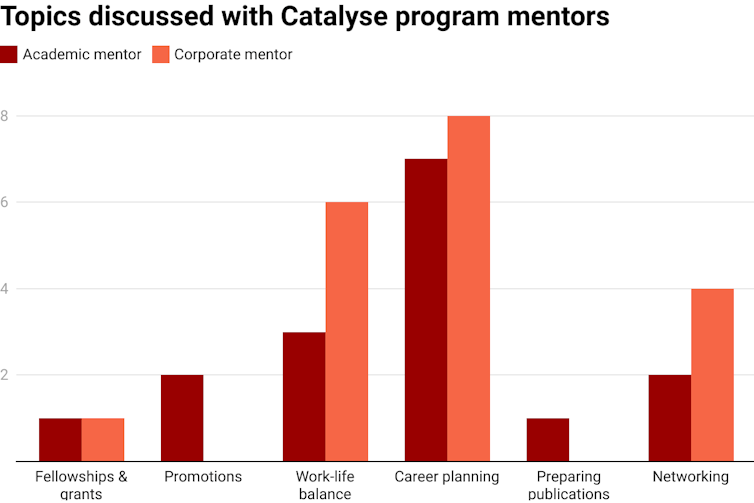 Chart: The Conversation. Data: Championing women working in health across regional and rural Australia – a new dual-mentorship model, Author provided
Read more:
How mentoring improves the leadership skills of those doing the mentoring
The Catalyse mentees reported positive “discomfort” at being pushed out of their “comfort zones”. This allowed them to reflect on leadership and impact outside their academic institution. The mentees set the agenda and explored first-time activities such as developing business cases, establishing peer-to-peer networking groups and applying for awards and accolades.
Group approach has additional benefits
Group mentoring is a way to go beyond supporting women and enhancing their capacity to manage a patriarchal culture. Bringing women together with a senior (retired) researcher has delivered several additional benefits compared to traditional unidirectional mentoring.
As the group members share their stories and worries, the sense of injustice and the care for each other increase. The women also bring a range of solutions and support to each other. This process strengthens ties within the cohort.
Such solutions are far more likely to be effective than those a single older mentor might suggest. That’s because they come from a contemporary context and a broader set of experiences.
Chart: The Conversation. Data: Championing women working in health across regional and rural Australia – a new dual-mentorship model, Author provided
Read more:
How mentoring improves the leadership skills of those doing the mentoring
The Catalyse mentees reported positive “discomfort” at being pushed out of their “comfort zones”. This allowed them to reflect on leadership and impact outside their academic institution. The mentees set the agenda and explored first-time activities such as developing business cases, establishing peer-to-peer networking groups and applying for awards and accolades.
Group approach has additional benefits
Group mentoring is a way to go beyond supporting women and enhancing their capacity to manage a patriarchal culture. Bringing women together with a senior (retired) researcher has delivered several additional benefits compared to traditional unidirectional mentoring.
As the group members share their stories and worries, the sense of injustice and the care for each other increase. The women also bring a range of solutions and support to each other. This process strengthens ties within the cohort.
Such solutions are far more likely to be effective than those a single older mentor might suggest. That’s because they come from a contemporary context and a broader set of experiences.
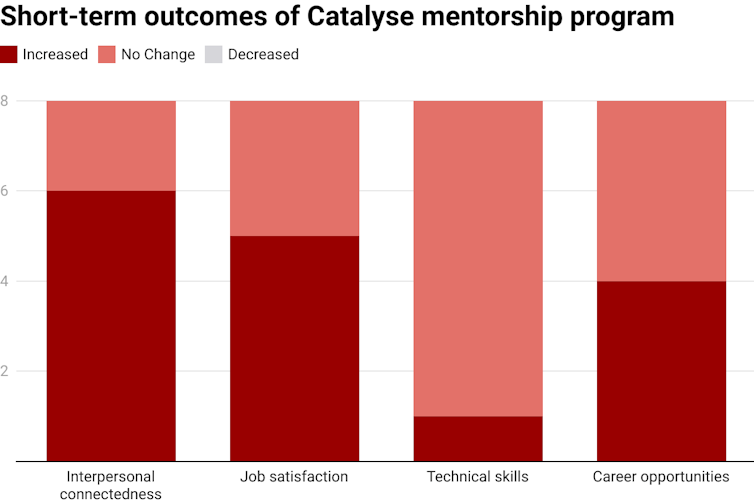 Chart: The Conversation. Data: Championing women working in health across regional and rural Australia – a new dual-mentorship model, Author provided
Read more:
How to support junior staff in a time of turmoil for universities
In addition, all the groups we have mentored have debated carefully developed strategies aimed at changing the status quo. This would not have happened in one-on-one mentoring. Examples of these strategies are:
request data on fund-raising within the organisation – and relate that data to gender as well as research area
demand administrative support for women who are asked to take on additional leadership or other roles – which made organisations look as if they were supporting more women but didn’t give them the capacity to manage those roles without significant impacts on their research time
present collective suggestions for the organisation to consider
push for the women to be the leading chief investigator on grant applications and first or senior author on papers, to be considered for national committees and to give keynote presentations at major conferences.
Read more:
Forget the ideal worker myth. Unis need to become more inclusive for all women (men will benefit too)
One of us (Fiona Stanley) has experience in group mentoring of First Nations health research scholars. The benefits of sharing experiences within these cohorts is that the scholars are able to provide much more solid collective solutions than if in a one-on-one session with a non-Indigenous older researcher.
It was clear from these sessions that racism pervades the health academic sector. However, empowering the group of mentees has resulted in major activities to address racism in their organisations. These include: mentees offering to give major presentations to the executive teams, often bringing in external speakers who have more power; suggesting and running NAIDOC activities; and reviewing reconciliation action plans to make them real rather than a token or box-ticking exercise.
3 key elements to bring about change
A strong mentoring model should consider three key elements to close the leadership gap:
mentees set the agenda and are empowered to initiate change within the organisation
diversify mentors, include mentors from corporate/business sectors, and do group mentoring to enhance networks
hold mentor networking events throughout the program, leading to cross-fertilisation between networks and (funding) opportunities.
Mentoring programs like these provide a more rounded approach to closing the leadership gap. These programs offer participants both discipline-based technical advice and external guidance on personal attributes and the strategic thinking needed to lead.
As Mary Wollstonecraft wrote in laying out the first steps toward bringing down the patriarchy for the betterment of all humanity, “I do not wish them [women] to have power over men; but over themselves.”
Read more:
It's not lack of confidence that's holding back women in STEM
Chart: The Conversation. Data: Championing women working in health across regional and rural Australia – a new dual-mentorship model, Author provided
Read more:
How to support junior staff in a time of turmoil for universities
In addition, all the groups we have mentored have debated carefully developed strategies aimed at changing the status quo. This would not have happened in one-on-one mentoring. Examples of these strategies are:
request data on fund-raising within the organisation – and relate that data to gender as well as research area
demand administrative support for women who are asked to take on additional leadership or other roles – which made organisations look as if they were supporting more women but didn’t give them the capacity to manage those roles without significant impacts on their research time
present collective suggestions for the organisation to consider
push for the women to be the leading chief investigator on grant applications and first or senior author on papers, to be considered for national committees and to give keynote presentations at major conferences.
Read more:
Forget the ideal worker myth. Unis need to become more inclusive for all women (men will benefit too)
One of us (Fiona Stanley) has experience in group mentoring of First Nations health research scholars. The benefits of sharing experiences within these cohorts is that the scholars are able to provide much more solid collective solutions than if in a one-on-one session with a non-Indigenous older researcher.
It was clear from these sessions that racism pervades the health academic sector. However, empowering the group of mentees has resulted in major activities to address racism in their organisations. These include: mentees offering to give major presentations to the executive teams, often bringing in external speakers who have more power; suggesting and running NAIDOC activities; and reviewing reconciliation action plans to make them real rather than a token or box-ticking exercise.
3 key elements to bring about change
A strong mentoring model should consider three key elements to close the leadership gap:
mentees set the agenda and are empowered to initiate change within the organisation
diversify mentors, include mentors from corporate/business sectors, and do group mentoring to enhance networks
hold mentor networking events throughout the program, leading to cross-fertilisation between networks and (funding) opportunities.
Mentoring programs like these provide a more rounded approach to closing the leadership gap. These programs offer participants both discipline-based technical advice and external guidance on personal attributes and the strategic thinking needed to lead.
As Mary Wollstonecraft wrote in laying out the first steps toward bringing down the patriarchy for the betterment of all humanity, “I do not wish them [women] to have power over men; but over themselves.”
Read more:
It's not lack of confidence that's holding back women in STEM
Authors: Teresa Wozniak, Senior Research Fellow and co-founder Catalyse Mentorship Program, Menzies School of Health Research


















