

sediment DNA reveals a 300,000-year timeline of ancient and modern humans living in Siberia
- Written by: Elena Zavala, PhD Student, Max Planck Institute for Evolutionary Anthropology
In the foothills of the Altai Mountains in southern Siberia lies Denisova Cave. It is the only site in the world known to have been inhabited by the eponymous Denisovans and their close relatives the Neanderthals (Homo neanderthalensis) — which overlapped at times — as well as by some of the earliest modern humans (Homo sapiens) to have dispersed into northern Asia.
Our new study pieces together the history of this site over the past 300,000 years from fragments of ancient DNA that survived in the cave sediments. Our findings reveal multiple turnovers of archaic and modern humans during this period, as well as major changes in the diversity of other animals.
We discovered Denisovans were the earliest toolmakers at the site, while Neanderthals were the sole human occupants between about 130,000 and 80,000 years ago. The first modern humans arrived much later, just as the last Denisovans and Neanderthals were leaving the scene.
We also detected marked changes in the types of human and animal DNA around 200,000 and 100,000 years ago, coincident with major shifts in climate and environmental conditions.
Genetic ghosts
Excavations in the cave by our Russian colleagues have unearthed about a dozen fossils of Denisovans and Neanderthals over the past 40 years, but none of modern humans.
Rather, the presence of modern humans at the cave has been surmised based on the recovery of artefacts made from stone, animal bones and teeth, mammoth ivory, ostrich eggshells, marble and gemstones.
The rarity of fossils at the site has also meant that questions persist about when different groups of humans occupied the cave, and which of them was responsible for making specific artefacts.
We managed to put flesh on the missing bones by using genetic traces of ancient humans and various other mammals preserved in the cave sediments. And we did so without having to find more fossils.
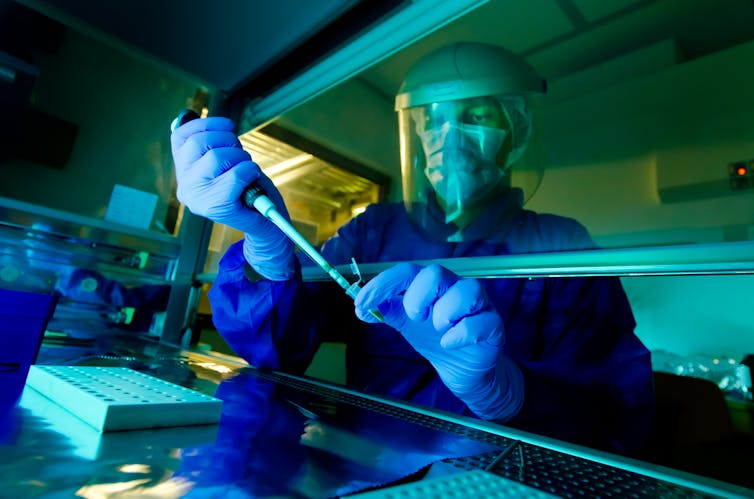 Project leader, Matthias Meyer, in the ancient DNA clean lab at the Max Planck Institute for Evolutionary Anthropology.
Max Planck Institute for Evolutionary Anthropology
Project leader, Matthias Meyer, in the ancient DNA clean lab at the Max Planck Institute for Evolutionary Anthropology.
Max Planck Institute for Evolutionary Anthropology
Our latest work is the most comprehensive study yet of ancient DNA extracted from sediment at any single site in the world. It builds on our trailblazing research published in 2017.
We extracted mitochondrial DNA from more than 700 samples and anchored them to a timeline for Denisova Cave, generating a detailed picture of which humans and animals were present at this famous site at various times in the past.
Read more: Fresh clues to the life and times of the Denisovans, a little-known ancient group of humans
Turbulent times
We retrieved ancient human DNA from 175 sediment samples — more than ten times the number of human fossils found at the site. Several interesting findings emerged from our genetic analyses.
We found Denisovans were present at the cave, on and off, from 250,000 years ago until 60,000 years ago. And they were the only humans at the site between 250,000 and 200,000 years ago, so we can now say with more confidence they likely produced the stone tools recovered from these layers.
Denisovan fossils and ancient DNA have been found at only one other site, on the edge of the Tibetan Plateau.
Meanwhile, Neanderthals first appeared at Denisova Cave about 200,000 years ago, with a variety of DNA that was previously unknown. They vanished from the site about 40,000 years ago, around the same time Neanderthals disappeared in other parts of Eurasia.
Importantly, we could only find traces of Neanderthal DNA in sediments dated to between 130,000 and 80,000 years ago at Denisova Cave — and none of Denisovans.
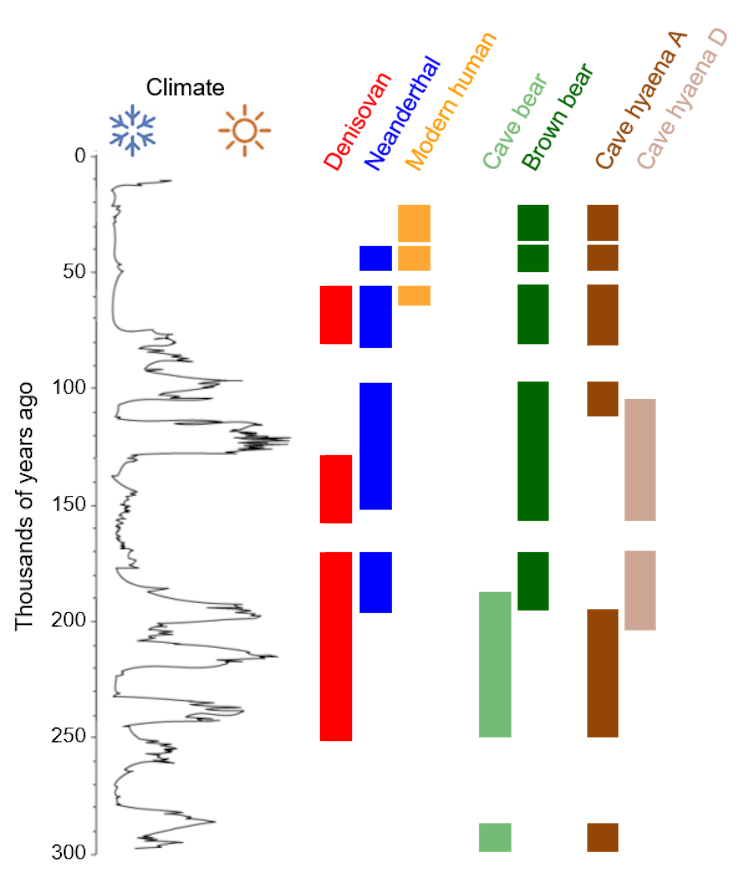 Summary timeline of the different types of human, bear and hyaena DNA in sediments at Denisova Cave. White gaps indicate missing parts of the sedimentary sequence. The graph on the left shows the changes in climate between relatively cold and warm conditions recorded in drill cores from Lake Baikal, also in southern Siberia.
Bert Roberts
Summary timeline of the different types of human, bear and hyaena DNA in sediments at Denisova Cave. White gaps indicate missing parts of the sedimentary sequence. The graph on the left shows the changes in climate between relatively cold and warm conditions recorded in drill cores from Lake Baikal, also in southern Siberia.
Bert Roberts
This time interval coincides with a major change in Earth’s climate: the start of the last interglacial. This was a relatively warm period similar to the present. It marked a switch from one type of Denisovan DNA before 130,000 years ago to another after 80,000 years ago.
This matches previous findings from genetic analysis of Denisovan fossils, which indicated a possible turnover in Denisovan populations. It also coincides with a population replacement of Neanderthals in Spain about 100,000 years ago — again identified from ancient DNA in cave sediments.
We also recovered the ancient DNA of modern humans from sediments deposited at Denisova Cave within the last 60,000 years. No modern human fossils have been found at the site, so these traces of DNA — from the same layers as the jewellery and pendants made from stone, bone, tooth and ivory — are the first direct evidence of Homo sapiens’ presence at the cave.
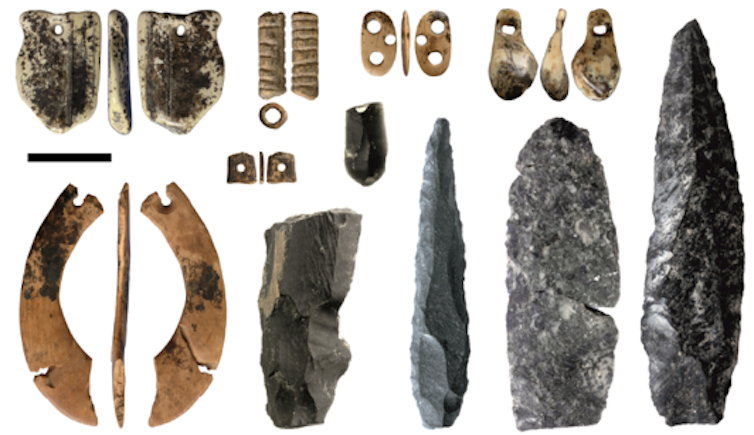 Selection of stone tools and personal ornaments made from bone, tooth and ivory recovered from the same sediment layers as modern human ancient DNA.
Institute of Archaeology and Ethnography of the Siberian Branch of the Russian Academy of Sciences.
Selection of stone tools and personal ornaments made from bone, tooth and ivory recovered from the same sediment layers as modern human ancient DNA.
Institute of Archaeology and Ethnography of the Siberian Branch of the Russian Academy of Sciences.
Denisova zoo
We recovered other ancient animal DNA from 94% of the sediment samples. This is providing new vistas into cave use by more than 12 taxonomic families of mammals, including species such as bear, hyena, wolf and woolly mammoth.
Previous studies have shown the cave was occupied at times by hyenas and bears. Our findings take this further, revealing cave bears dominated between 300,000 and 200,000 years ago, after which brown bears became more abundant.
Read more: Dishing the dirt: sediments reveal a famous early human cave site was also home to hyenas and wolves
We also identified two major shifts in the types of hyena present at different times, with turnovers occurring when climatic conditions changed from relatively warm to cold 200,000 years ago, and from relatively cold to warm 100,000 years ago.
The timing of these turnovers, coupled with the patterns we discovered for Denisovans and Neanderthals, suggests these events were likely connected to environmental changes.
A guided tour of our key findings, presented by the lead author of the study, Elena Zavala from the Max Planck Institute for Evolutionary Anthropology.Sediment diaries
The power of sediment DNA lies in the fact that sediments are ubiquitous at archaeological and palaeontological sites. Even tiny samples can contain genetic traces of a variety of animals — including humans — in the absence of fossils.
Sediments also often contain plant remains and other materials that can be used to reconstruct ancient environments, with timelines obtained by directly dating sediment grains.
By sampling sites with high densities of sediment DNA, the ebb and flow of humans and other animals can be compared to records of past environmental change. Making these crucial connections can help illuminate the dark corners of our planet’s history.
Authors: Elena Zavala, PhD Student, Max Planck Institute for Evolutionary Anthropology


















