

As the Taliban surges across Afghanistan, al-Qaeda is poised for a swift return
- Written by: Greg Barton, Chair in Global Islamic Politics, Alfred Deakin Institute for Citizenship and Globalisation, Deakin University
The imminent fall of Afghanistan is more than a national disaster. It is not just that the gains made in the past two decades, at the cost of tens of thousands of lives and trillions of dollars, look certain to be reversed as the Taliban advances.
The Taliban’s victory is also al-Qaeda’s victory, and it has global implications.
Even before the US military completes the final steps of its troop withdrawal, the Taliban is surging. It is now reported to control 212 districts — more than half of Afghanistan’s 407 districts. This is triple the territory it controlled on May 1. The Taliban has seized 51 districts since the start of July alone.
The Taliban is currently contesting a further 119 districts, leaving the government with control over just 76, or little more than 20%.
And the government-held territory is surrounded. Almost the entire circular national highway is in the hands of the Taliban, meaning the cities under government control can only safely be reached by air.
Afghanistan has fallen
US President Joe Biden and political leaders in Kabul talk optimistically of a fightback to reverse the surge. But Afghan moral has collapsed along with the fabric of national security.
When the US military quietly snuck out of Bagram Airbase in the early hours of July 2, they did not just turn off the lights, they extinguished what hope that remained.
Read more: For the Afghan peace talks to succeed, a ceasefire is the next — and perhaps toughest — step forward
The Afghan military is stuck in a Catch-22 situation. Without air support, it cannot maintain logistic supply lines and medivac support for its troops across Afghanistan’s mountainous expanses.
The Afghan air force has just 136 airplanes and helicopters ready for combat missions from a fleet of 167, a drop of 24 aircraft in the previous quarter. It relies on international contractors to keep its aircraft flying. And almost all of the 18,000 US-funded contractors left with the last of the troop flights out of Bagram, leaving most of the Afghan helicopters and C130 transports soon to be grounded.
At the same time, Afghanistan’s scarce reserves of US-trained pilots are at risk of assassination from Taliban death squads, with at least seven gunned down while off base in recent months.
Whether the Taliban swiftly moves to take Kabul now, or remains content with encircling the capital and other cities, it is clear: Afghanistan has fallen.
‘War against the US will be continuing on all fronts’
Biden was dealt a very weak hand by his predecessor. The “peace agreement” between the Taliban and the Trump administration (but not the government of Afghanistan) committed the US to draw down all remaining 13,000 troops by May 2021, along with NATO troops.
It also involved a prisoner swap, with more than 5,000 captured Taliban fighters guaranteed release.
In return, the Taliban “pledged” to prevent its longtime ally, al-Qaeda, from operating out of Afghanistan, and to refrain from attacking international forces before their withdrawal.
The Taliban did refrain from targeting foreign troops, but at the same time stepped up its attacks on Afghan forces and leading civil society figures, with a particular focus on assassinating women and girls, and members of the largely Shia Hazara community.
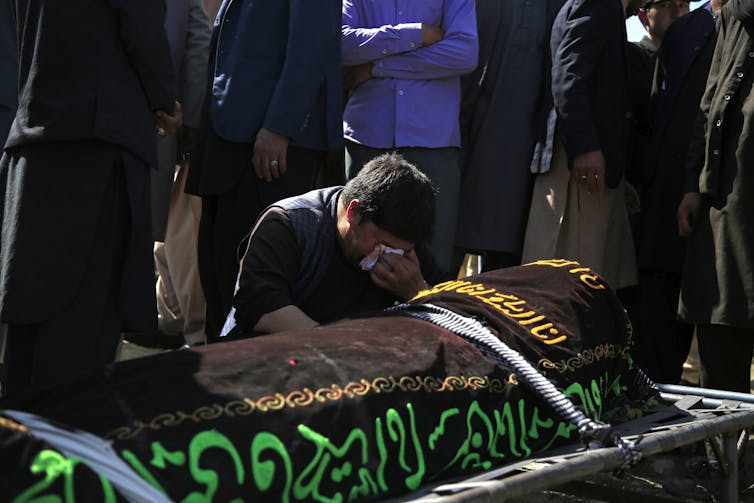 A man cries over the body of a victim of deadly bombing at the entrance to a girls’ school in the Afghan capital in May.
Mariam Zuhaib/AP
A man cries over the body of a victim of deadly bombing at the entrance to a girls’ school in the Afghan capital in May.
Mariam Zuhaib/AP
Critics of the “peace process” with the Taliban, including former US generals and security officials, have argued that, with no real checks and balances on the Taliban breaking off its lifelong relationship with al-Qaeda, the deal represented mere window dressing to dignify a US exit.
On February 21 2020, The New York Times published an eloquent opinion piece attributed to Sirajuddin Haqqani as the “deputy leader of the Taliban”. What the Times did not disclose is he is the son of Jalaluddin Haqqani, the founder of the infamous al-Qaeda-allied Haqqani Network. And that the US has designated Sirajuddin a terrorist and offered US$10 million for information on his whereabouts.
In the piece, Sirajuddin opined:
I am confident that, liberated from foreign domination and interference, we together will find a way to build an Islamic system in which all Afghans have equal rights, where the rights of women that are granted by Islam — from the right to education to the right to work — are protected, and where merit is the basis for equal opportunity.
We are also aware of concerns about the potential of Afghanistan being used by disruptive groups to threaten regional and world security. But these concerns are inflated […]
But as attacks have continued unabated in Afghanistan, few believe the sincerity of Sirajuddin’s words. In fact, the piece was harshly criticised by numerous US officials, one of whom called it “blatant propaganda”.
Then in April of this year, Saleem Mehsud, a CNN reporter in Pakistan, conducted an interview through intermediaries with two al-Qaeda figures. It underscores the close relationship between al-Qaeda and the Taliban — both the Afghan Taliban and Pakistani Taliban (TTP):
The Americans are now defeated […] Now the organisation of Pakistani Taliban and their leadership not only moving forward in the light of Sharia but also making better decisions based on past experiences and recent successes have been made possible by the same unity and adherence to Sharia and Wisdom […]
Thanks to Afghans for the protection of comrades-in-arms, many such jihadi fronts have been successfully operating in different parts of the Islamic world for a long time […]
Ominously, the al-Qaeda spokesmen warned:
war against the US will be continuing on all other fronts unless they are expelled from the rest of the Islamic world.
A safe haven for terrorists again
Biden has justified withdrawing from Afghanistan by asserting the US military had accomplished its goal of ousting al-Qaeda from its safe haven in Afghanistan.
But Robert Gates, who served as secretary of defence from 2006–11, confessed in a recent New York Times op-ed:
There is little doubt the United States made strategic mistakes in Afghanistan. We vastly underestimated the challenge of changing an ancient culture and of nation building in a historically highly decentralised country. We never figured out what to do about the Taliban safe haven in Pakistan.
Despite ongoing negotiations, I do not believe the Taliban will settle for a partial victory or for participation in a coalition government. They want total control, and they still maintain ties to al Qaeda […]
Read more: As the US plans its Afghan troop withdrawal, what was it all for?
Gates’s comments echo a UN monitoring team report released in June that claimed al-Qaeda is already present across Afghanistan, especially along the border with Pakistan, and is led by Osama Mahmood under al-Qaeda’s Jabhat-al-Nasr wing:
19 members of the group have been relocated to more remote areas by the Taliban to avoid potential exposure and targeting
al-Qaeda maintains contact with the Taliban but has minimised overt communications with Taliban leadership in an effort to ‘lay low’ and not jeopardise the Taliban’s diplomatic position vis-a-vis the Doha agreement [with the US].
Both al-Qaeda, which is estimated to have 400-600 fighters in Afghanistan and Pakistan, and the Taliban are playing the long game. Their patience will have tragic implications for the Afghan people. But that is just the beginning of the problem.
Afghanistan was the birthplace of al-Qaeda in 1988. The group gave rise to terrorist networks around the world, including Southeast Asia’s Jemaah Islamiyah, formed in Afghanistan in 1993, and Al Qaeda in Iraq, which morphed into the Islamic State in Iraq in 2006.
A Taliban-controlled Afghanistan — a return of the Islamic Emirate of Afghanistan — will be much larger and prove much more durable than the IS caliphate in Syria and Iraq could ever have been. This will be a powerful inspiration for jihadi terrorists everywhere.
And there will be little to prevent it becoming a safe haven for training and equipping terrorists from around the world.
Authors: Greg Barton, Chair in Global Islamic Politics, Alfred Deakin Institute for Citizenship and Globalisation, Deakin University


















