

Why we need engineers who study ethics as much as maths
- Written by: S. Travis Waller, Professor and Head of the School of Civil and Environmental Engineering, UNSW
The recent apartment building collapse in Miami, Florida, is a tragic reminder of the huge impacts engineering can have on our lives. Disasters such as this force engineers to reflect on their practice and perhaps fundamentally change their approach. Specifically, we should give much greater weight to ethics when training engineers.
Engineers work in a vast range of fields that pose ethical concerns. These include artificial intelligence, data privacy, building construction, public health, and activity on shared environments (including Indigenous communities). The decisions engineers make, if not fully thought through, can have unintended consequences – including building failures and climate change.
Read more: Why did the Miami apartment building collapse? And are others in danger?
Engineers have ethical obligations (such as Engineers Australia’s code of ethics) that they must follow. However, as identified at UNSW, the complexity of emerging social concerns creates a need for engineers’ education to equip them with much deeper ethical skill sets.
Engineering is seen as a trusted and ethical profession. In a 2019 Gallup poll, 66% rated the honesty and ethical standards of engineers as high/very high, on a par with medical doctors (65%).
However, ethics as a body of knowledge is massive. There are nearly as many academic papers on ethics as mathematics, and clearly more than on artificial intelligence.
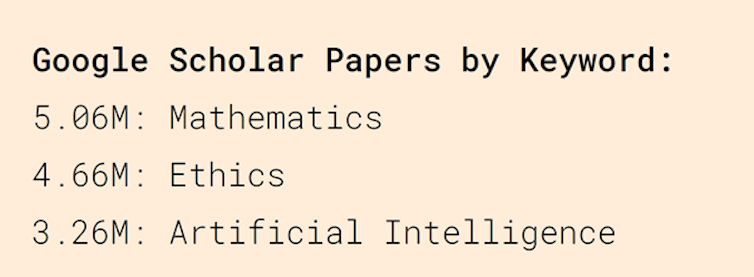 Comparison of numbers of research papers by keyword (mathematics, ethics and AI).
With such a rich backdrop of knowledge, engineers must embrace ethics in a way that previous generations embraced mathematics. Complex societal problems make much greater demands on engineering thinking than in the past. We need to consider whole and complex systems, not just issues as individual challenges.
Ethics and the construction industry
The construction industry provides a topical example of such complexity. Opal Tower in Sydney, Lacrosse building in Melbourne, Grenfell Tower in London and Torch Tower in Dubai became household names for all the wrong reasons.
Importantly, these issues of poor quality and performance don’t arise from new technology or know-how. They involve well-established technical domains of engineering: combustible cladding, fire safety, structural adequacy and so on. A fragmented design and delivery process with unclear responsibility and/or accountability has led to poor outcomes.
These issues prompted the Australian Building Ministers’ Forum to commission the Shergold Weir Report, followed by a task force to implement its recommendations across Australia.
There are real shortcomings in the legal and contractual processes for allocating and “commoditising” risk in the industry. However, ethics should do the heavy lifting when legal frameworks are lacking. One key question is whether erosion of professional ethics has played a part in this state of affairs. The answer is a likely “yes”.
Engineers face ethical dilemmas such as:
“Should I accept a narrow or inadequately framed design commission within a design and build delivery model when there is no certainty my design will be appropriately integrated with other parts of the project?”
“How can I accept a commission when my client provides no budget for my oversight of the construction to ensure the technical integrity of my design is maintained when built?”
“How do I play in a commercially competitive landscape with pressures to produce "leaner” designs to save cost without compromising safety and long-term performance of my design?“
"Do I hide behind the contractual clauses (or minimum requirements of codes of practice) when I know the overall process is flawed and does not deliver quality and/or value for money for the end user?”
Or worse: “Do I resort to phoenixing to avoid any accountability?”
Read more: Lacrosse fire ruling sends shudders through building industry consultants and governments
 The ethics of engineering involve much more than ensuring buildings don’t collapse.
Chad Davis/Flickr, CC BY-SA
The ethics of engineering involve much more than ensuring buildings don’t collapse.
Chad Davis/Flickr, CC BY-SA
Engineering on Country
The enduring connection of Aboriginal Australians to Country requires engineers to navigate ethical considerations in Indigenous communities. Engineers must reconcile the legal, technical and regulatory requirements of their projects with Indigenous cultural values and needs. They might not be properly equipped to navigate ethical scenarios when they encounter unfamiliar cultural connections, or regulations are insufficient.
Consider, for example, the sacred sites of the McArthur River Mine. Traditional owners have raised concerns that current mining activities do not adequately protect sacred and cultural heritage sites. Evidence given by community leaders provides insight into the intimate and diverse relationship that traditional owners have with the land.
In considering such evidence, engineers must be able to evaluate both physical site risks (such as acidification of mine tailings and contamination of water bodies) and cultural risks (such as failing to identify all locations of cultural value).
How might we tackle such complicated projects? By properly engaging with traditional communities and by having diverse teams with multiple worldviews and experiences, along with strong technical skills. The broad field of ethical knowledge provides the skill sets to attempt to reconcile the diverse considerations.
Read more: Juukan Gorge inquiry puts Rio Tinto on notice, but without drastic reforms, it could happen again
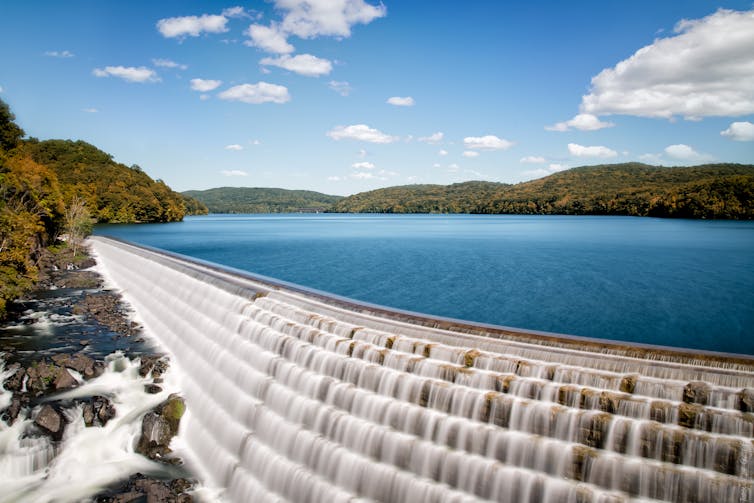 Cornell Dam on the Croton River near Croton-on-Hudson, New York, was the tallest dam in the world when completed in 1906. The dam was built with beauty and the environment in mind, but protests and disputes still impacted its construction.
Malinda Rathnayake/Flickr, CC BY
Cornell Dam on the Croton River near Croton-on-Hudson, New York, was the tallest dam in the world when completed in 1906. The dam was built with beauty and the environment in mind, but protests and disputes still impacted its construction.
Malinda Rathnayake/Flickr, CC BY
What should the curriculum look like?
Engineering students’ ethical development requires a holistic approach. One assessment suggested:
“[…] that institutions integrate ethics instruction throughout the formal curriculum, support use of varied approaches that foster high‐quality experiences, and leverage both influences of co‐curricular experiences and students’ desires to engage in positive ethical behaviours.”
The curriculum should include:
skills/expertise – the underlying intellectual basis for discerning what is ethical and what is not, which is much more than codes of conduct or a prescriptive, formulaic approach
practice – practical know-how in terms of ethical solutions that engineers can apply
mindset – having an individual and group culture of acting ethically. The engineers’ problem-solving mindset must be supplemented by constant reflection on the decisions made and their ethical consequences.
Ethics is not an “add-on” subject. It must permeate all aspects of tertiary education – teaching, research and professional behaviour.
While the arguments for acting now are strong, market realities will also drive the process. The upcoming generation will likely displace those who are slow or reluctant to adapt.
For instance, engineering firms are under pressure from their own staff on the issue of climate change. More than 1,900 Australian engineers and nearly 180 engineering organisations have signed a declaration committing them to evaluate all new projects against the need to mitigate climate change.
Future engineers must transcend any remaining single-solution mindsets from the past. They’ll need to embrace a much more complex and socially minded ethics. And that begins with their university education.
Authors: S. Travis Waller, Professor and Head of the School of Civil and Environmental Engineering, UNSW
Read more https://theconversation.com/why-we-need-engineers-who-study-ethics-as-much-as-maths-161356


















