

it’s time Pākehā New Zealanders faced their personal connections to the past
- Written by: Richard Shaw, Professor of Politics, Massey University
Whenever I visit my mother in New Plymouth we drive out around the Taranaki coast to visit the old family farms, chugging along the South Road that was built to carry the armed constabulary (AC) and sundry volunteer forces that invaded Parihaka on November 5 1881.
My great-grandfather, who joined the AC in 1877 and served in it for nine years, worked on that road. He was standing alongside 1,588 other men as the sun rose on the morning of te Pāhua (the sacking).
By the time he left the pā three years later he had participated in the assault on Parihaka, the weeks and months of despoliation that followed, and the years of occupation as the colonial government and its forces knelt on the throats of the people led by Te Whiti-o-Rongomai and Tohu Kākahi.
Having contributed to the military campaign, several years later he returned as part of the agricultural campaign to complete the alienation of Taranaki iwi from their land.
In time, he and his wife would own two farms on the coast. One of these had previously been returned to Māori via a Crown grant said to be “absolutely inalienable”, which turned out to be anything but.
They also leased a third property under the baleful West Coast lease system which, among other things, excluded Māori landowners from the process of negotiating rent, gave them peppercorn rentals and locked them out of their land in perpetuity. All three farms were part of the 1,199,622 acres of land confiscated from Māori – “rebel” and loyalist alike – by executive decree in 1865.
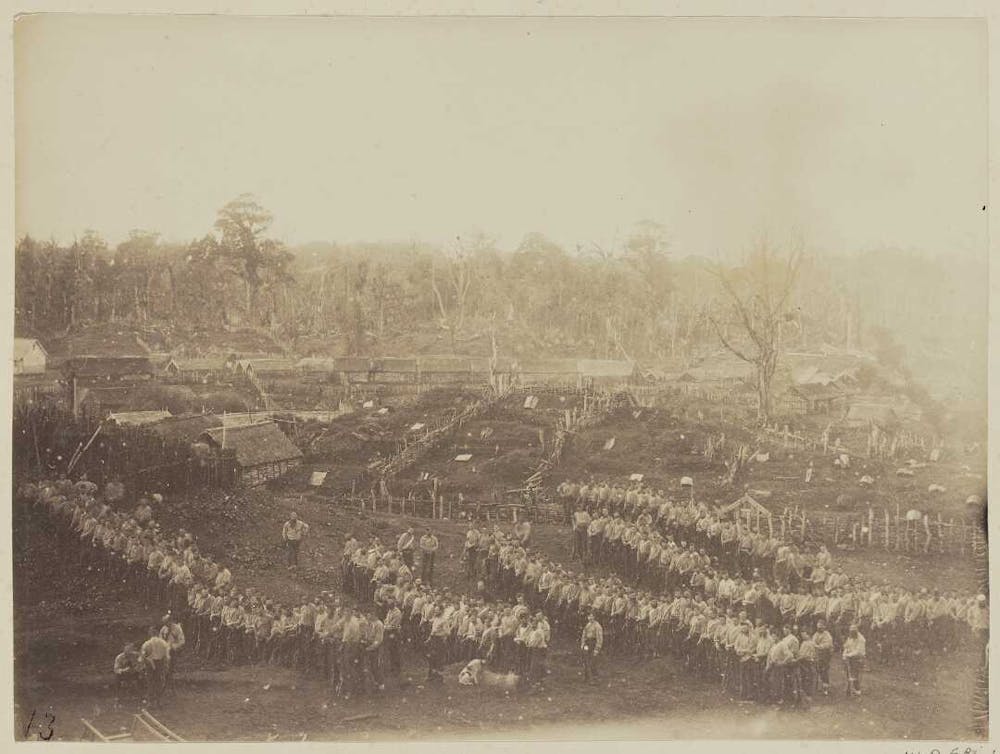 Armed constabulary awaiting orders to advance on Parihaka pā, 1881.
Alexander Turnbull Library, CC BY-NC
Armed constabulary awaiting orders to advance on Parihaka pā, 1881.
Alexander Turnbull Library, CC BY-NC
An unsettled history
I can already feel the defensively minded scrabbling together the usual case for avoiding this uncomfortable history — eulogising hard-working settlers as the backbone of the nation, bemoaning the creeping “separatism” of He Puapua, “woke” Pākehā, and being made to feel guilty for being a European New Zealander.
There’s a lot of this about at the moment, but it needs to stop. It only enables the evasion of hard truths about the history and contemporary impacts of colonisation in this country — one of which is that for many Pākehā, me included, our time here began on land that had been stolen (sorry, “confiscated”) from the people to whom it belonged.
 An 1880 map of the Taranaki coast showing the area of ‘confiscated’ territory.
Puke Ariki, Author provided
An 1880 map of the Taranaki coast showing the area of ‘confiscated’ territory.
Puke Ariki, Author provided
My great-grandfather and his wife eventually controlled 412 acres of Taranaki land, on which a small economic and social revolution took place. For a start, the three farms allowed my great-grandparents to transform themselves from poor Irish migrants into settler landowners.
The scale of the economic transformation was breathtaking. My great-grandfather was one of ten children, the son of tenant farmers who paid £26 and ten shillings a year to the local (English) squire for the lease on a 29-acre tenement in Kilteely parish in the east of County Limerick.
When he died, the combined property he and his wife held sway over on the Taranaki coast was 16 times the size of the farm he was born on, and nearly 17% larger than the total amount of land the absentee English landlord owned in Kilteely.
Read more: How NZ's colonial government misused laws to crush non-violent dissent at Parihaka
From tenants to landed gentry
The land also enabled my great-grandparents to reinvent themselves as respected members of the local farming community. My great-grandfather played the violin at the annual district bachelors’ ball in 1895, where the “refreshments were all that one could wish for” and the dancing “commenced punctually at 8pm and did not break up until nearly 4am”.
He won first place in the rhubarb section of the farm and garden produce division of the Cape Egmont Horticultural Society’s third annual show in 1901 (and took out top place in the ham section a year later). And he became a stalwart of the Rahotu Athletics Club and the Pungarehu School Board.
He was born the son of an Irish tenant farmer and died a landowning British settler. It is an extraordinary economic and social transformation in a single generation.
And it is built upon land that the colonial state had taken from other people.
Read more: My ancestors met Cook in Aotearoa 250 years ago. For us, it's time to reinterpret a painful history
Not only did the original inhabitants lose their land, they and their descendants have also been denied the material wealth that has subsequently been generated from that land. I can’t yet accurately quantify the full value of the economic returns that accrued to my great-grandparents and their six children, but I do have a couple of snapshots that illustrate the general point I’m trying to make.
First, at the time they were purchased by my great-grandparents, the combined value of the two farms owned outright was roughly NZ$400,000 in today’s terms. Not one dollar went directly to the original owners of the land.
Second, in his will, one of my great-grandfather’s sons, who was a Roman Catholic priest and who died young, left nearly $30,000 to the church and just under $200,000 to his two sisters. We’re up to $630,000 in transactions already (and haven’t even looked at the revenues earned through the farms) — but none of this activity benefited those from whom the land was taken.
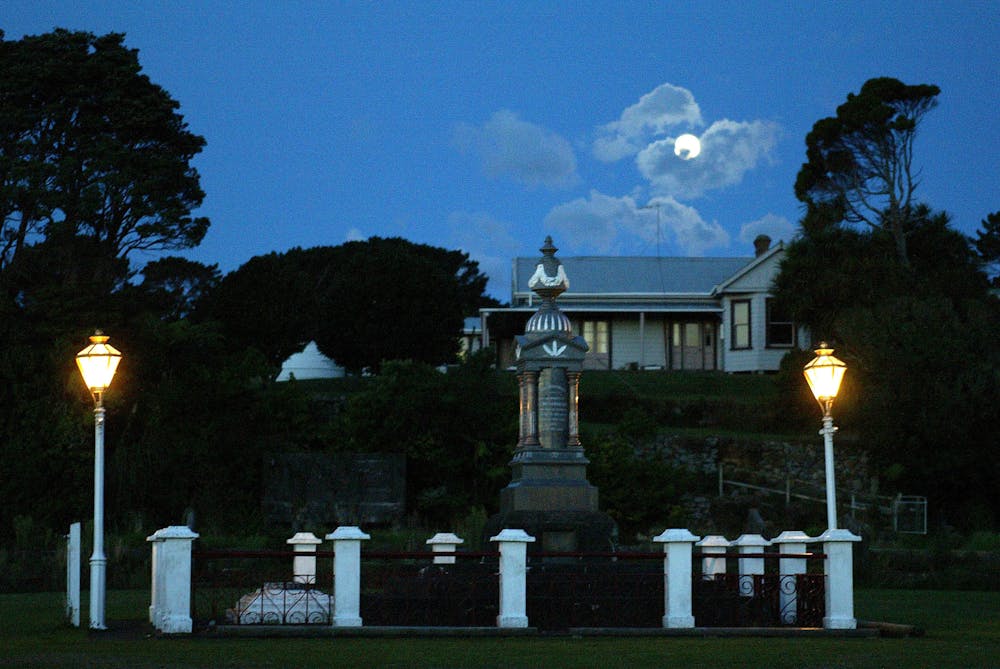 The burial place of Parihaka founder Te Whiti-o-Rongomai at the marae near Opunake, West Taranaki.
GettyImages
The burial place of Parihaka founder Te Whiti-o-Rongomai at the marae near Opunake, West Taranaki.
GettyImages
Wealth and dispossession
That wealth has echoed down through time, supporting the endeavours of later generations. It lies behind the purchase of other properties and houses, bequests to daughters and sons, support with the costs of education — all the things Professor Christine Sleeter, an education activist, calls the “financial footholds and cushions” families try to provide to subsequent generations.
And each of these has its own multiplier effect, which is why the inter-generational transfer of wealth is such a critical factor in people’s socioeconomic well-being (or lack thereof). Merit and hard work play a part in this, but there is no avoiding – in my case – that it all began with the dispossession of Māori.
That land gifted us something else, too. My people have long since moved away from the coast but our origin story will forever be there. That is where it began for us in Aotearoa. Where my great-uncle, who completed a doctorate of divinity in Rome at the age of 21, was born. Where my grandfather established himself as a powerful figure in Taranaki rugby. Where my mother grew up and escaped from, meeting my father in the process.
Read more: Why it's time for New Zealanders to learn more about their own country's history
That land gave my ancestors a place of their own on which to stand. It is where we began the process of becoming Pākehā.
This is what privilege looks like. Not historical at all, as it happens, but something that is very much alive and well. Not to do with events that I have no association with, but concerning processes that continue to spool out and from which I benefit. Not disconnected from the colonisation of this country, but utterly rooted in it. Bluntly, my historical privilege is grounded in the historical trauma experienced by Māori.
Curiously, however, not one of the stories of the coast I grew up with spoke of my great-grandfather’s presence at Parihaka or carried the history of the family farms.
Ending the forgetting
I doubt I am alone in having these partial family stories. I’m not the only Pākehā who has much preferred the standard settler account of thrusting progress and economic productivity, one which dances lightly over the confiscation, theft and violence that lie beneath the surface.
For the better part of my life I have happily lived in what historian and author Rachel Buchanan calls the “dementia wing” of our country’s history, choosing to forget (or never to learn, which amounts to much the same thing) what happened at Parihaka, comfortable in the knowledge my history here began with the purchase of the family farms.
Read more: Friday essay: the 'great Australian silence' 50 years on
And although forgetting is usually associated with loss, in my experience there was much to be gained from forgetting (or avoiding) my connection with the AC, the sacking of Parihaka and the purchase of land taken from others: ease of mind, and that tacit sense of relief that comes from steering clear of something you know is going to be difficult to confront.
There’s a reason we need a new national histories curriculum, a reason the government must get to grips with its obligations to tangata whenua. The reason is people like me. I still recognise myself in the bleating of those who ignore the colonial violation of Māori, and in the words of people who are all too happy to extol the benefits of colonisation but whose eyes glaze over when the talk turns to the theft of land.
But it is long since time we Pākehā confronted the unsettled history of the place in which the “team of five million” lives. Time we were honest with ourselves. Time we ended the forgetting.
Authors: Richard Shaw, Professor of Politics, Massey University


















