

wild pigs release the same emissions as 1 million cars each year
- Written by: Christopher J. O'Bryan, Postdoctoral Research Fellow, School of Earth and Environmental Sciences, The University of Queensland
Whether you call them feral pigs, boar, swine, hogs, or even razorbacks, wild pigs are one of the most damaging invasive species on Earth, and they’re notorious for damaging agriculture and native wildlife.
A big reason they’re so harmful is because they uproot soil at vast scales, like tractors ploughing a field. Our new research, published today, is the first to calculate the global extent of this and its implications for carbon emissions.
Our findings were staggering. We discovered the cumulative area of soil uprooted by wild pigs is likely the same area as Taiwan. This releases 4.9 million tonnes of carbon dioxide each year — the same as one million cars. The majority of these emissions occur in Oceania.
A huge portion of Earth’s carbon is stored in soil, so releasing even a small fraction of this into the atmosphere can have a huge impact on climate change.
The problem with pigs
Wild pigs (Sus scrofa) are native throughout much of Europe and Asia, but today they live on every continent except Antarctica, making them one of the most widespread invasive mammals on the planet. An estimated three million wild pigs live in Australia alone.
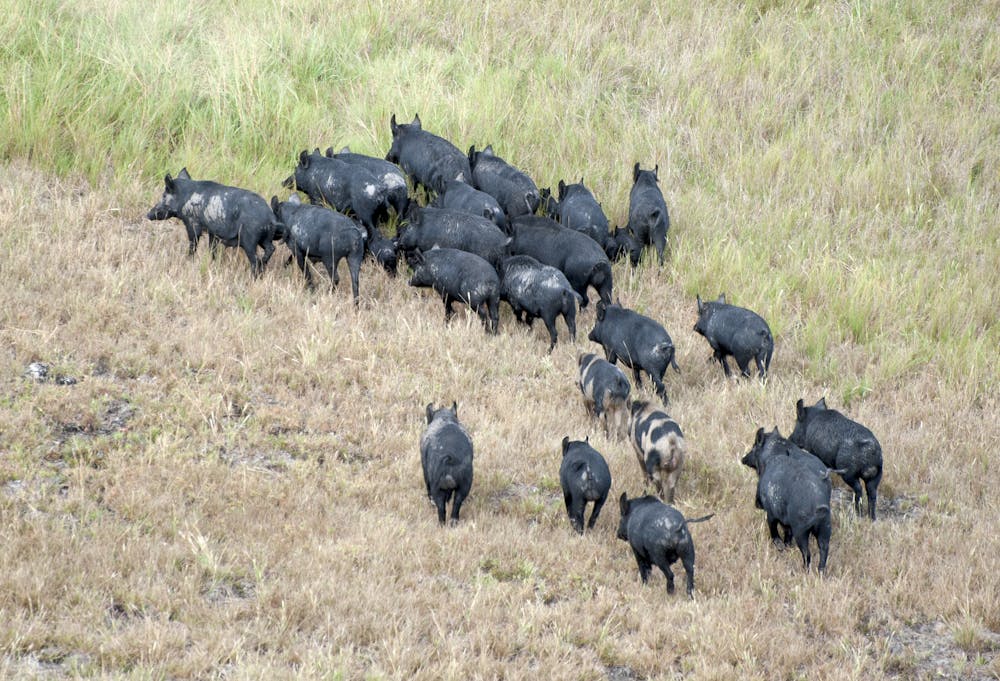 Wild pigs are one of the most widespread invasive animals on Earth.
Shutterstock
Wild pigs are one of the most widespread invasive animals on Earth.
Shutterstock
It’s estimated that wild pigs destroy more than A$100 million (US$74 million) worth of crops and pasture each year in Australia, and more than US$270 million (A$366 million) in just 12 states in the USA.
Wild pigs have also been found to directly threaten 672 vertebrate and plant species across 54 different countries. This includes imperilled Australian ground frogs, tree frogs and multiple orchid species, as pigs destroy their habitats and prey on them.
Their geographic range is expected to expand in the coming decades, suggesting their threats to food security and biodiversity will likely worsen. But here, let’s focus on their contribution to global emissions.
Their carbon hoofprint
Previous research has highlighted the potential contribution of wild pigs to greenhouse gas emissions, but only at local scales.
One such study was conducted for three years in hardwood forests of Switzerland. The researchers found wild pigs caused soil carbon emissions to increase by around 23% per year.
Similarly, a study in the Jigong Mountains National Nature Reserve in China found soil emissions increased by more than 70% per year in places disturbed by wild pigs.
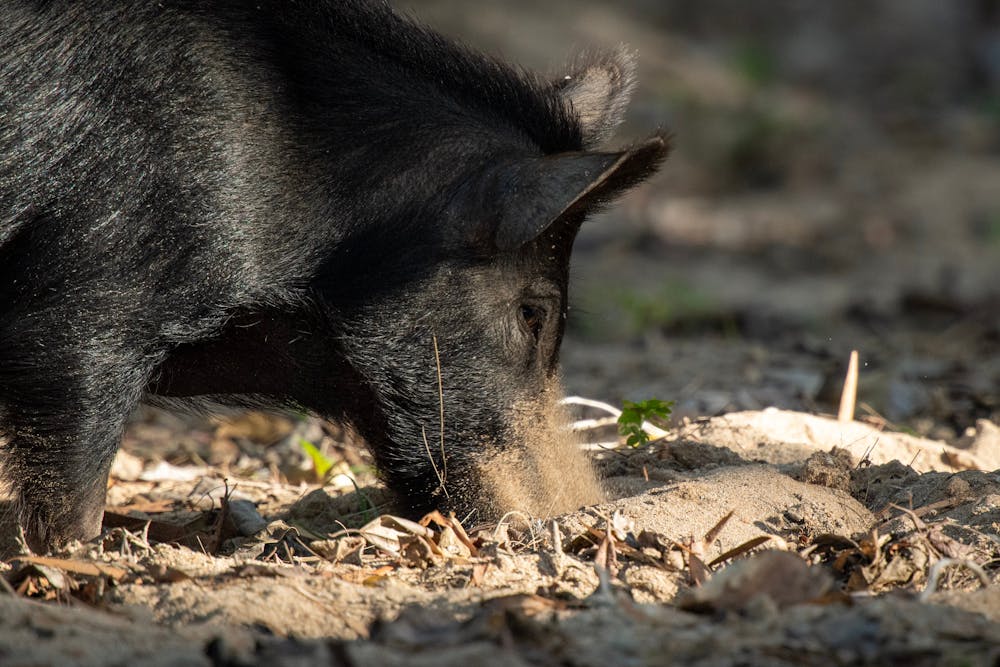 Wild pigs turn over 36,214 to 123,517 square kilometres of soil each year.
Shutterstock
Wild pigs turn over 36,214 to 123,517 square kilometres of soil each year.
Shutterstock
To find out what the impact was on a global scale, we ran 10,000 simulations of wild pig population sizes in their non-native distribution, including in the Americas, Oceania, Africa and parts of Southeast Asia.
For each simulation, we determined the amount of soil they would disturb using another model from a different study. Lastly, we used local case studies to calculate the minimum and maximum amount of wild pig-driven carbon emissions.
And we estimate the soil wild pigs uproot worldwide each year is likely between 36,214 and 123,517 square kilometres — or between the sizes of Taiwan and England.
Most of this soil damage and associated emissions occur in Oceania due to the large distribution of wild pigs there, and the amount of carbon stored in the soil in this region.
Read more: Feral pigs harm wildlife and biodiversity as well as crops
So how exactly does disturbing soil release emissions?
Wild pigs use their tough snouts to excavate soil in search of plant parts such as roots, fungi and invertebrates. This “ploughing” behaviour commonly disturbs soil at a depth of about five to 15 centimetres, which is roughly the same depth as crop tilling by farmers.
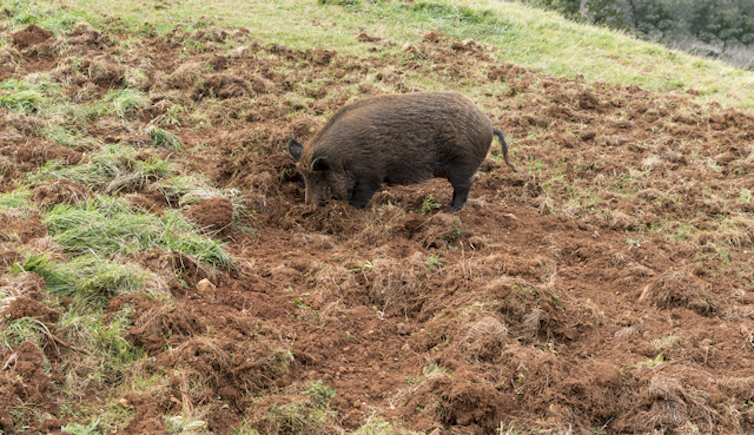 Wild pigs uproot soil in search of food, such as invertebrates and plant roots.
University of Kentucky, Department of Forestry and Natural Resources, Forestry Extension.
Wild pigs uproot soil in search of food, such as invertebrates and plant roots.
University of Kentucky, Department of Forestry and Natural Resources, Forestry Extension.
Because wild pigs are highly social and often feed in large groups, they can completely destroy a small paddock in a short period. This makes them a formidable foe to the organic carbon stored in soil.
In general, soil organic carbon is the balance between organic matter input into the soil (such as fungi, animal waste, root growth and leaf litter) versus outputs (such as decomposition, respiration and erosion). This balance is an indicator of soil health.
When soils are disturbed, whether from ploughing a field or from an animal burrowing or uprooting, carbon is released into the atmosphere as a greenhouse gas.
This is because digging up soil exposes it to oxygen, and oxygen promotes the rapid growth of microbes. These newly invigorated microbes, in turn, break down the organic matter containing carbon.
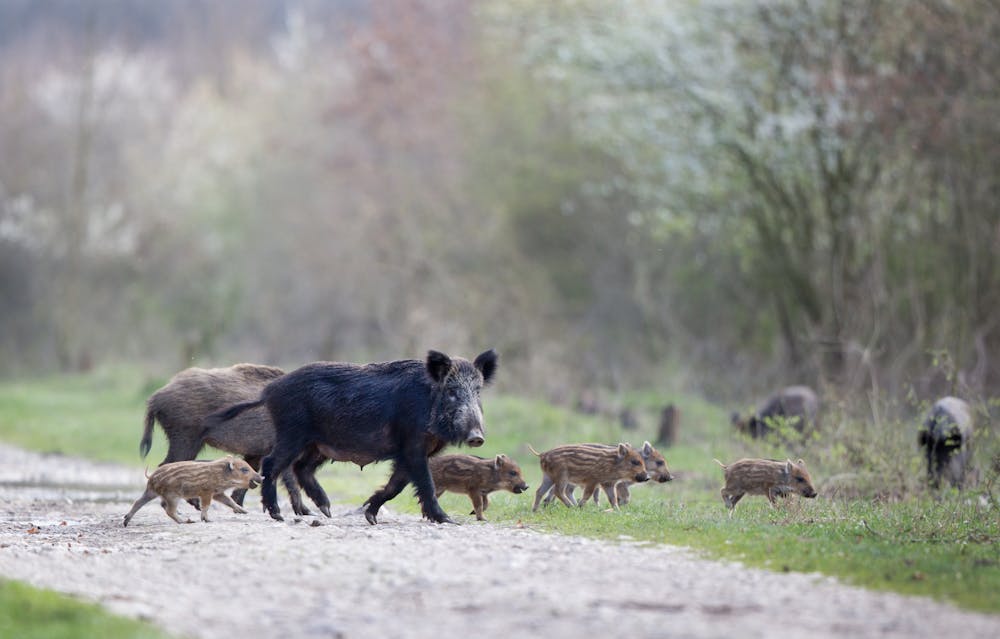 Wild pigs have a rapid breeding rate, which makes controlling populations difficult.
Shutterstock
Wild pigs have a rapid breeding rate, which makes controlling populations difficult.
Shutterstock
Tough and cunning
Wild pig control is incredibly difficult and costly due to their cunning behaviour, rapid breeding rate, and overall tough nature.
For example, wild pigs have been known to avoid traps if they had been previously caught, and they are skilled at changing their behaviour to avoid hunters.
Read more: Dig this: a tiny echidna moves 8 trailer-loads of soil a year, helping tackle climate change
In Australia, management efforts include coordinated hunting events to slow the spread of wild pig populations. Other techniques include setting traps and installing fences to prevent wild pig expansion, or aerial control programs.
Some of these control methods can also cause substantial carbon emissions, such as using helicopters for aerial control and other vehicles for hunting. Still, the long-term benefits of wild pig reduction may far outweigh these costs.
Working towards reduced global emissions is no simple feat, and our study is another tool in the toolbox for assessing the threats of this widespread invasive species.
Authors: Christopher J. O'Bryan, Postdoctoral Research Fellow, School of Earth and Environmental Sciences, The University of Queensland


















