

How did I catch a cold in lockdown?
- Written by: Natasha Yates, Assistant Professor, General Practice, Bond University
More than half of Australia is in lockdown in an effort to stem the current Delta strain COVID outbreak, with vast numbers of us steering clear of workplaces, school, retail shops, public transport and other busy places.
If, despite all that, you or your children have developed a sniffle, tested negative for COVID and been forced to conclude it’s just a common cold, don’t worry — you’re not alone.
It’s still reasonably easy to catch a cold even during lockdown. The good news is there’s plenty you can do to greatly reduce the risk.
We cannot avoid germs altogether
The air is much more contaminated than many of us would like to believe. So even if we are isolating from humans, we are still breathing in germs all the time.
Most of them don’t make us sick, thanks to our incredible immune system, but sometimes viruses do sneak past our defences. There have even been outbreaks of the common cold on Antarctic bases after 17 weeks of complete isolation.
Pathogens are part of life, and indeed part of us. We carry around pathogens all the time, including on our skin and up our noses. Most of the time we live in harmony with them.
However, even though our skin and noses are well designed to stop serious pathogens from entering our body, if there’s a breakdown in a barrier — for example, from picking our nose — that can give them a way to get in. In fact, the commonest ways viruses enter our bodies are through our mouth, nose and eyes, which is why we are always being reminded not to touch our faces.
You are still out and about
It’s worth remembering that even during lockdown, many of us still have to go out — for exercise, essential shopping, to seek medical care or for work or compassionate care reasons. So even if you feel locked away and like you’ve not seen friends or family in eons, you have still been out and about.
You can pick up one of the 200 or more viruses that cause what we call the common cold by simply touching a shop counter when you pick up essential groceries, then rubbing the germ into your eye.
Perhaps you pushed a child on the swings and then touched your nose or mouth. A child might have picked up a cold at the playground and brought it home.
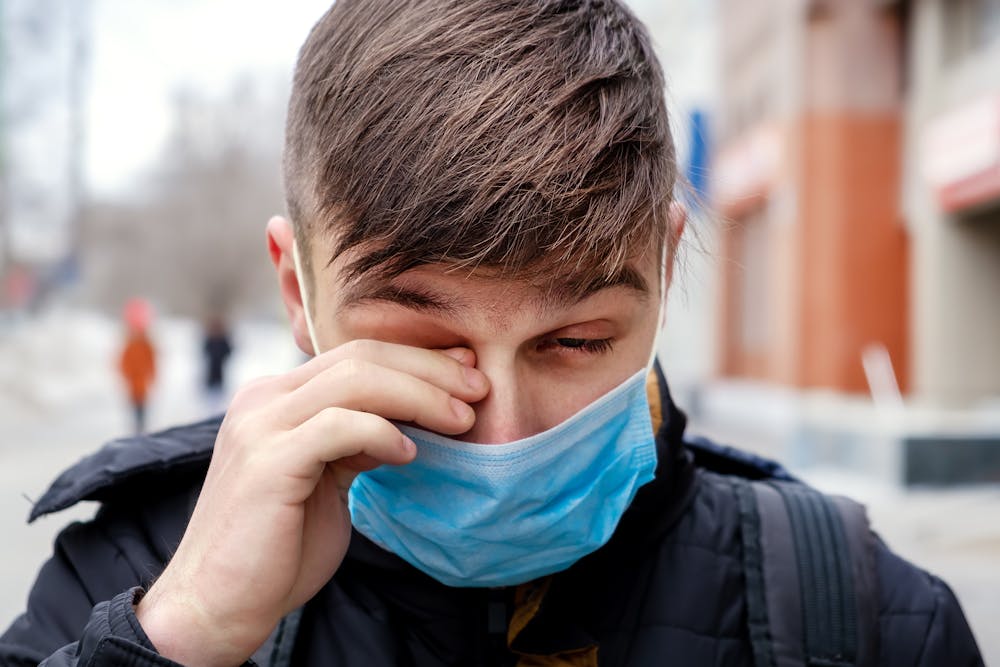 Rubbing your eye is a one way to transfer a germ from your hand to your body.
Shutterstock
Rubbing your eye is a one way to transfer a germ from your hand to your body.
Shutterstock
Viruses that cause the common cold include rhinovirus (which can be airborne and can survive for hours on surfaces under certain conditions). Another virus that causes colds is adenovirus, which can be airborne and has been detected on surfaces.
Once you have actually picked up a cold virus, it may take days before you actually get sick — this is what we call the incubation period, meaning the time between infection with the pathogen, and the onset of symptoms.
Cold viruses can incubate for many days, so it’s possible that even though you or your household members are getting a sniffle now, it was a germ picked up some time ago that has just been biding its time.
And remember: not all “coughs and colds” are actually caused by a virus. For example, whooping cough seems very much like “just a cold” when you first get sick with it. Whooping cough is actually caused by a bacterium, and can survive up to 42 days before it declares itself. For example, my son managed to “catch” whooping cough more than two weeks into lockdown last year. It’s highly likely he picked it up from another child at school before lockdown began, but only developed the cough a fortnight later. Incidentally, he was fully vaccinated as a baby.
Washing hands and wearing masks
What all this shows is that many of us are not as great at washing our hands as we would like to think. Even surgeons, who know how to scrub exceptionally well, still sometimes pass on infections to patients. Viruses are just excellent at surviving and getting past our defences.
So if you’d like to reduce your chances of getting a cold during lockdown — and goodness knows it’s the last thing you need when you’ve got so much else on your plate — remember the basics.
Wash hands often, don’t share utensils, avoid touching your nose, mouth and eyes, wear a mask when you leave the house, and try not to get too close to any other household members who may be coughing and sneezing.
Authors: Natasha Yates, Assistant Professor, General Practice, Bond University
Read more https://theconversation.com/how-did-i-catch-a-cold-in-lockdown-164861


















