

Parents, studies show most kids have done just fine in remote schooling. Here's how to survive the home stretch
- Written by: Rebecca English, Senior Lecturer in Education, Queensland University of Technology
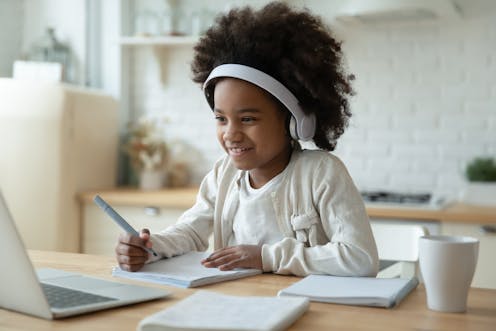
With nearly half of Australia’s population in lockdown, a lot of children and young people are still not attending face-to-face school.
In Melbourne students in year 12 go back to the classroom this week, and there are staggered return plans for the rest of the year levels. Preps and grades 1 and 2 will return part time in the following weeks. All students will return to the classroom full-time by November 5.
Regional Victorian students have a different schedule with all students back in the classroom full-time by October 26.
In New South Wales, students are set to return to class earlier than expected. Kindergarten, year 1 and year 12 students will return on October 18; years 2, 6 and 11 will return on October 25 and all other grades will resume on November 1.
But even with staggered return plans, many kids will still be learning from home if only part of the time.
Parents can be understandably worried about their children’s learning when at home. After a year and a half of COVID and lockdowns, many students and parents are feeling tired, burnt out and sick of online school. Some have disengaged from what the school is providing.
If you’re overwhelmed, and your child is disengaged, have no fear. Your child likely still continued to learn, and will continue to do so, just in a different way.
What we know from last year
During the lockdowns last year, many experts and parents were concerned children’s education would suffer.
But the majority of Australian students have done just fine. For instance, there has been little change in the NAPLAN average results in 2021 compared to 2019 in all states and territories, including Victoria, which had the longest period of remote schooling in 2020. This doesn’t mean every group succeeded, and there is evidence the learning of disadvantaged students suffered but perhaps less than would have been expected.
Some children’s mental health and well-being may have suffered due to extended uncertainty and lack of face-to-face contact with friends. This is especially so for senior students who have missed out on important events like school formals.
But we also know some children, including children with autism, reported being happier because they experienced less bullying and their learning needs were better met at home. And a report on children with disability found learning improved for many, to the extent some parents were thinking of doing it long term.
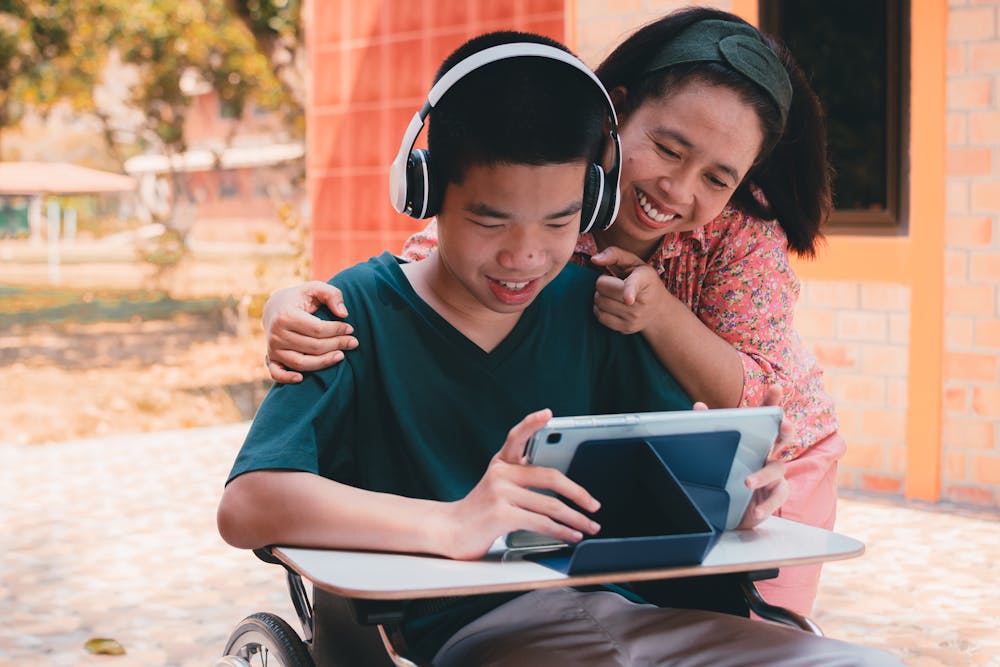
There are several explanations for remote learning being more successful than expected. Some schools have changed, perhaps permanently to accommodate different teaching and learning approaches.
Learning at home also meant many parents knew more about how their children were doing so were better able to support them. Parents being more involved in their children’s education is a marker of success in schools.
Home learning during lockdowns improved students’ autonomy in many cases. Some students said they valued the flexibility of being able to work at their own pace.
This may have implications for how schools continue. It may also reflect how learning can happen, even when children are not actively being taught.
How children learn
In 1985, psychologists Edward Deci and Richard Ryan introduced what is now known as self-determination theory in their book Self-Determination and Intrinsic Motivation in Human Behavior.
The theory holds that learning happens when children find meaning in what they are learning about, learn collaboratively with others and have some relationships with the content and the people they are learning with. Deci and Ryan called these motivations to learn
competence, which is the feeling you can do something and be successful
autonomy, which is the feeling you have some control over your experiences
relatedness, which means experiencing positive relationships as part of the learning process.
You don’t need to do anything special to your home to make these three things happen for your children.
The natural flows of family life can provide an environment where children and young people are motivated to learn. Incidental conversation (while doing the washing up or cooking), interactions with siblings (reading to the baby), trying to solve problems (fixing a bike), writing to communicate (to a friend in Minecraft) all provide opportunities to learn new skills and take on new information.
Children are naturally curious. In fact, you have to work very hard to stop them learning.
So, what can you do to foster your child’s learning?
Unlike the classroom, it can be easier to facilitate individual children’s autonomous learning and interests at home. This is because children can have more freedom and flexibility in what they do and learning can be incidental.
By encouraging students to learn what they’re interested in, do research and find their own answers, Deci and Ryan’s work would suggest parents can support motivation and success.
Outside of the formal schooling program, this may involve a child researching a particular topic online or doing something practical like fixing something broken.
Where students are unwilling to do activities provided by the school, it may be possible to cover the same learning in a different way. For example, a student might be unwilling to do fractions on the computer or a worksheet but love cooking and be perfectly happy making a cake ¾ the size of the recipe.
Read more: Don't want to send the kids back to school? Why not try unschooling at home?
If you had a conversation over the dishes about something they’re interested in, they’re still learning. The conversation could be about anything at all, the critical factor is that it interests your child.
If your child has learned how to crochet on YouTube, they’ve learned not only how to crochet but also how to learn – that’s competence.
If your child rang their grandfather to ask about the Vietnam War, they’ve collected first hand data on the war experience – that’s autonomy.
If you’re feeling burnt out and tired, you’re not alone. It shouldn’t be long now, keep doing what you’ve been doing and the kids will likely be all right.
Authors: Rebecca English, Senior Lecturer in Education, Queensland University of Technology


















