

the rise and fall of COVID convalescent plasma therapy
- Written by: Andrew McLachlan, Head of School and Dean of Pharmacy, University of Sydney
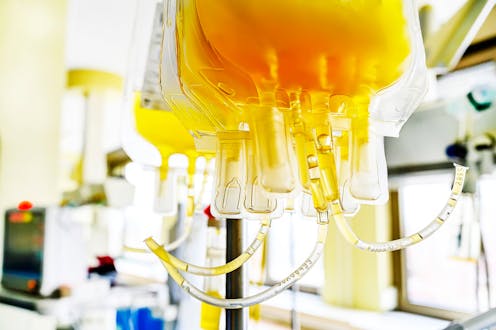
Early in the pandemic, scientists thought “convalescent plasma” might be a way to treat COVID-19.
By giving patients the plasma of people who had recovered (or convalesced) from COVID-19, the idea was this antibody-rich infusion would help their immune systems fight infection. It’s a strategy tried, with various degrees of success, for other infectious diseases, including Ebola.
But growing evidence, including an international study published this week, shows convalescent plasma does not save lives of people critically ill with COVID-19. The researchers concluded the therapy was “futile”.
Read more: Coronavirus: what is plasma therapy?
What is convalescent plasma?
Convalescent plasma is a blood product containing antibodies against an infectious pathogen (such as SARS-CoV-2, the coronavirus that causes COVID-19). It comes from blood collected from people who have recovered from the infectious disease.
Scientists use a process called apheresis to separate the different blood components. Red and white cells, and platelets are removed leaving plasma, which is rich in antibodies.
The story of convalescent plasma therapy (or serum therapy) originates in the 1890s. This is when physician Emil von Behring infected horses with the bacteria that causes diphtheria.
Once the horses recovered, Behring collected their antibody-rich blood to treat humans with the disease. This led to him being awarded the first Nobel prize in physiology or medicine, in 1901.
Why has convalescent plasma been used to treat COVID?
Convalescent plasma has been used to treat infectious diseases for over a century. These include: scarlet fever, pneumonia, tetanus, diphtheria, mumps and chickenpox.
More recently, convalescent plasma has been investigated as a treatment for SARS (severe acute respiratory syndrome), MERS (Middle East respiratory syndrome) and Ebola.
So early in the pandemic, researchers hoped convalescent plasma could be used to treat COVID-19 too.
Initial studies and some clinical trials were promising. This led to the widespread use of convalescent plasma for patients with COVID-19 in the United States, a decision supported by the Food and Drug Administration.
By May this year more than 100 clinical trials had been conducted with convalescent plasma in people with COVID-19; about one-third of these studies had finished or were stopped early.
Earlier this year, the results of the United Kingdom’s landmark RECOVERY trial were reported. This investigated convalescent plasma therapy (compared to usual supportive care) in more than 10,000 people hospitalised with COVID-19.
Treatment did not reduce the risk of death (24% in both groups), with no difference in the number of patients who recovered (66% discharged from hospital in both groups) or who got worse (29% needed mechanical ventilation to support breathing in both groups).
So for people admitted to hospital with COVID-19, the researchers concluded convalescent plasma offered no benefit.
A Cochrane review, which was updated in May this year and evaluated all available trials, confirmed these results. These trials involved more than 40,000 people with moderate-to-severe COVID-19 who received convalescent plasma.
The review found the treatment had no effect on the risk of dying from COVID-19, did not reduce the risk of requiring hospitalisation nor the need for a ventilator to assist breathing when compared to placebo or standard care.
In Australia, the National COVID-19 Clinical Evidence Taskforce does not recommend using convalescent plasma in people with COVID-19, unless it is in a clinical trial.
Read more: Here's what happens when you’re hospitalised with COVID
What’s the latest news?
The results of the trial reported this week come from a major clinical trial involving about 2,000 hospitalised patients with moderate-to-severe COVID-19.
Patients were randomised to received convalescent plasma or usual care. All patients had access to other supportive medicines used in critically ill hospitalised people with COVID, such as dexamethasone and remdesivir.
The international team of investigators included those from Australia, Canada, UK and US.
Although the results and detailed analysis were published this week, the trial was halted in January. This is when the trial committee reviewed the interim results and reported “convalescent plasma was unlikely to be of benefit for patients with COVID-19 who require organ support in an intensive care unit”. So continuing the trial was considered futile.
Convalescent plasma treatment did not reduce the risk of death in hospital over the month after treatment (37.3% convalescent plasma treated, 38.4% usual care, not treated with convalescent plasma). The median number of days without the need for organ support (such as a mechanical ventilator or cardiac support) was 14 days in both groups. Serious adverse events were reported in 3.0% of people treated with convalescent plasma and only 1.3% in the usual care group.
Taken together, the weight of evidence now clearly demonstrates convalescent plasma is not a treatment option for people with mild, moderate or even severe COVID-19.
Where next for COVID-19 treatments?
While vaccinations remain the major strategy to prevent COVID-19, attention is now turning to some emerging and promising treatments to prevent COVID-19 worsening.
These include emerging antiviral treatments that may be used early in the disease, including monoclonal antibodies such as sotrovimab and AZD7442. Then there are potential oral antiviral medicines, such as molnupiravir and PF-07321332.
Authors: Andrew McLachlan, Head of School and Dean of Pharmacy, University of Sydney


















