

Back to school blues: how to help your child with shyness
- Written by Ron Rapee, Director of the Centre for Emotional Health and Distinguished Professor in the Department of Psychology, Macquarie University
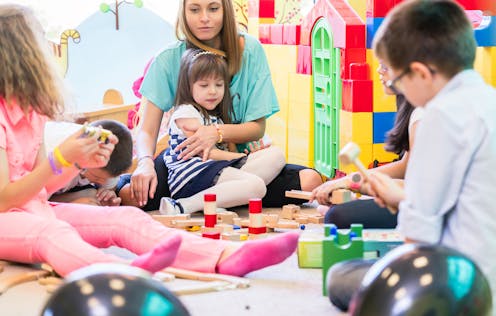 Excessively protecting your child and taking over, doesn’t allow them to learn through experience. Shutterstock
This series draws on the latest research on back to school transitions. In it, the experts explain how best to prepare children for school, and counter difficulties such as stress or bad behaviour.
Around the end of January, more than 3.5 million young people will start or return to schools across Australia.
For most young people this is a time of high excitement and energy. The long holidays are coming to an end and they are looking forward to seeing old friends, making new ones, and being a grade higher. But the excitement is often tinged with a hint of trepidation – “who will be in my class”, “will they still like me”, “what teachers will I get”? For some young people, these worries can dominate their life.
The good news is parents can help their kids through it.
What is shyness and social anxiety?
Shyness is a personality characteristic that exists on a continuum across the community from very low to the highest levels. When we use the term shyness, we are usually referring to the upper levels – up to 40% of people describe themselves as shy. When shyness becomes very severe and starts to affect a person’s life, it can be diagnosed using the clinical term, “social anxiety disorder”. When diagnosed correctly, around 2.5% of young people in Australia meet criteria for social anxiety disorder in a given 12-month period.
Read more: Childhood shyness: when is it normal and when is it cause for concern?
So, around one child in every typical Australian classroom will have this clinical disorder, and up to a dozen will be shy.
Socially anxious young people worry excessively about what others think of them and how they come across. They are very self-conscious and often freeze or become confused when they are the focus of attention.
Going back to school is the stuff of nightmares for these children. Some of the hardest experiences for a socially anxious young person will be found at school: meeting new kids, talking to authority figures, standing in front of a group, getting into trouble, and negotiating the hierarchies of the playground.
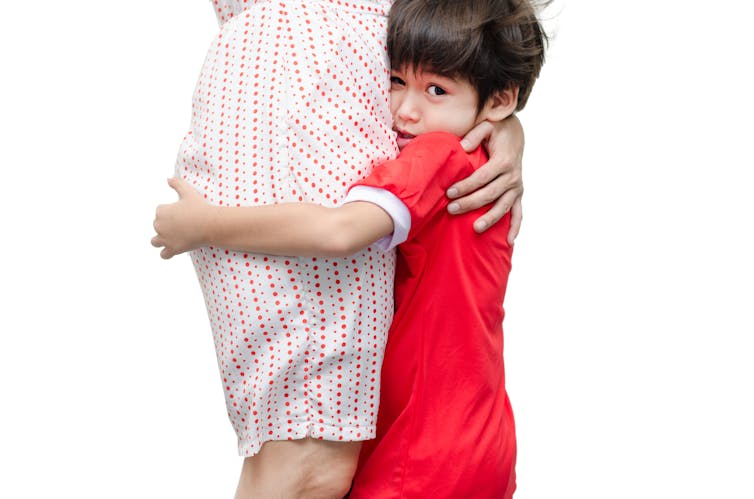 Going back to school can be a difficult time for shy kids.Shutterstock
Shy youth can make good friendships, but usually have fewer friends than other kids. They are also more likely to be the targets of bullying. Many of these young people will be terrified at the prospect of going to school and the first few weeks will be especially hard.
Social anxiety can occur at any age – from kindergarten to the end of high school (and into adulthood). But it generally increases in the early teenage years, which is when most young people start to become more self-conscious.
Social anxiety is slightly more common in girls than boys. There is clearly a genetic aspect and parents of shy young people are often themselves slightly more shy than average. Aside from that, social anxiety cuts across society: it makes no difference whether families are rich or poor, from any particular cultural group, or married or divorced.
How parents can affect social anxiety
In our work at the Centre for Emotional Health at Sydney’s Macquarie University, we have found that parents can make a difference to their child’s social anxiety. This does not mean parents cause the problem, but they can help change it.
When their child is scared, a loving parent can think of nothing more important than protecting them. But excessively protecting your child and taking over, doesn’t allow them to learn through experience.
Read more: How facing challenging situations can prepare your child for school
In one study we asked children aged seven to 13 to prepare a two minute speech. For half of these children, we asked their mothers to help them extensively with speech preparation and more or less take over the task. The other half were told to only gently guide their child. We then asked the children to prepare a second speech by themselves and then deliver it to a small audience. Children whose mothers had taken over the speech-writing the first time showed more anxiety and tension when they delivered their second speech.
On the other hand, parents can help their child overcome social anxiety. We recently finished a large treatment study. The overall study was about treating all forms of anxiety (including social anxiety) and it looked at how we can step up the intensity of treatment when needed.
In the first step, parents of anxious children received a book explaining how to help their child and also spoke with a therapist on four brief occasions. After three months, 40% of these children were completely free from their presenting anxiety.
How can you help your child?
A lot of it is common-sense and practical skills. Shy young people can be taught to think more realistically about the things that worry them. “They will think I’m an idiot if I wear that” can be challenged by asking “what would you think of someone wearing it?”. “Everyone is staring at me” can be challenged by getting the child to look around and count how many people are actually looking.
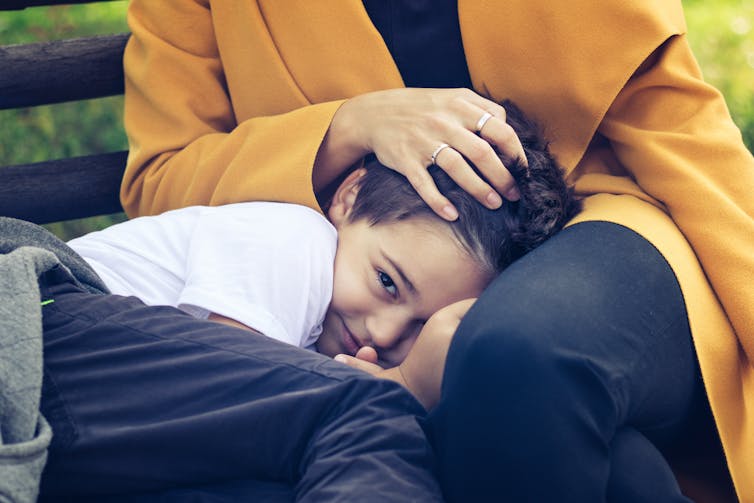 Shy children should be challenged and gently encouraged to face their fears.Shutterstock
Shy young people should also be challenged to gently and gradually face their fears. For example, for a young person who is scared to speak to others, they could be challenged to speak to one or two “safer” kids every day for the next week. Then they could be asked to speak to a couple of slightly “harder” kids every day the following week, and so on.
Finally, if you find that you, as a parent, have a tendency to jump in and regularly help your child, try to get into the habit of asking yourself, “what would happen if I held back for a few minutes?”.
Extreme shyness and social anxiety can severely impact a young person’s life and can set them up for a future of missed opportunities. But we now have some good treatments and we are continuing to research new ways of helping these young people.
If you have any concerns about your child, seek the opinion of a qualified mental health practitioner.
Ron Rapee works for the Centre for Emotional Health at Macquarie University. He receives funding from the Australian Research Council and the National Health and Medical Research Council. He is an author of Helping Your Anxious Child: A step-by-step guide for parents, from which he receives royalties and is an author of the Cool Kids program from which he receives no royalties.
Authors: Ron Rapee, Director of the Centre for Emotional Health and Distinguished Professor in the Department of Psychology, Macquarie University
Read more http://theconversation.com/back-to-school-blues-how-to-help-your-child-with-shyness-90228

















