

Barnaby Joyce has refused to support doubling Australia's 2030 emissions reduction targets – but we could get there so cheaply and easily
- Written by: Andrew Blakers, Professor of Engineering, Australian National University
As Prime Minister Scott Morrison tries to land a Coalition climate policy deal ahead of the international COP26 summit in Glasgow, Nationals leader Barnaby Joyce on Sunday ruled out supporting more ambitious 2030 targets.
The current 2030 target aims to cut emissions by 26-28% below 2005 levels, and has been criticised by scientists and the international community as far too weak.
But ahead of a Nationals party room meeting on Sunday to discuss changes to national climate policy, Joyce declared it “highly unlikely” he would support a doubling of the 2030 target, according to ABC reports.
If Australia was to adopt the bolder target, it would bring us in line with our key ally and trading partner, the United States, and would be broadly in line with the targets of other allies, the European Union and the United Kingdom. It would see Australia become a valued and relevant party to the negotiations at Glasgow, rather than a resented freeloader.
As a professor of engineering and an author of many research papers considering what’s needed to reach 100% renewable energy, I believe Australia could halve its 2030 emissions with minimal cost and inconvenience. Here’s how it could be done.
By the megatonnes
The top three sources of Australia’s emissions are electricity (34%), heating from burning fossil fuels in homes and factories (20%), and transport (18%).
Australia’s emissions baseline year is 2005, when the total emissions were 612 million tonnes (megatonnes) of carbon dioxide equivalent.
By 2020, emissions had fallen to 498 megatonnes, mostly because the rates of land clearing, another big source of emissions, are much lower now than in 2005.
This puts us well on track to meet and beat Australia’s current 2030 target, which equates to about 453 megatonnes. We will easily reach this soft target by continuing to displace coal generation of electricity with solar and wind at the current rate of 7 gigawatts per year, provided we avoid new sources of emissions.
Earlier this year, United States President Joe Biden announced his commitment to reduce US emissions 50-52% by 2030.
Australia should offer to match this at the Glasgow summit. Cutting, say, 51% of Australia’s 2005 levels would bring Australia’s emissions down to just 300 megatonnes in 2030.
OK, so how do we do it?
The task of reaching 300 megatonnes in 2030 is straightforward, and with around zero net cost. It would see:
90% of electricity generation coming from solar, wind and hydro in 2030 (three-quarters of the task)
90% of new sales of vehicles and heating equipment be electric from 2027 (one-quarter of the task)
no new emissions sources. For example, encouraging fossil gas companies to frack large new areas makes the task more onerous because of methane leakage.
Let’s look at transport first. Curtailing sales of petrol vehicles with a combination of incentives and regulation would see nearly all vehicles become electric by the mid-2030s, as old cars retire.
While the federal government has been famously unenthusiastic about electric vehicles, states and territories are already offering modest incentives.
Read more: Up to 90% of electricity from solar and wind the cheapest option by 2030: CSIRO analysis
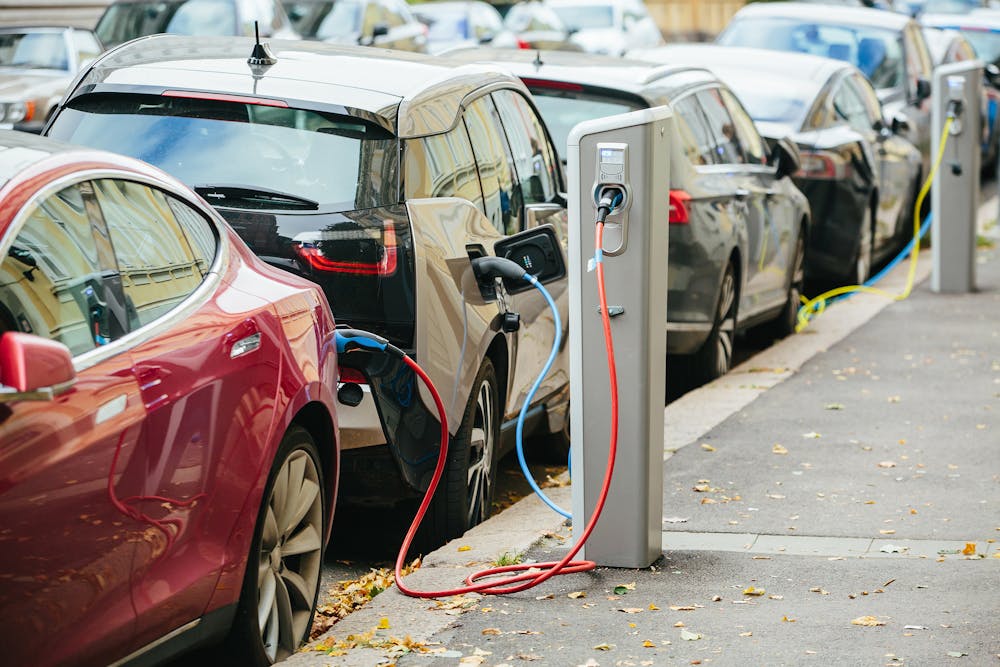 All vehicles could become electric when older cars retire.
Shutterstock
All vehicles could become electric when older cars retire.
Shutterstock
The bulk of emissions cuts will come from the electricity sector, because the cost of solar and wind technology has fallen below coal and gas.
As of this month, Australia’s National Electricity Market derives 36% of its electricity demand from renewables (mostly solar and wind), and is tracking towards 50% in 2025. Coal burning makes up 60%, but is falling quickly because of growing competition from solar and wind. Gas generation has fallen to just 4%.
The wholesale market price has also fallen sharply from 2020, as a flood of new solar and wind farms entered the market. This means the faster we deploy solar and wind, the lower electricity prices will be and the faster we reduce emissions.
The biggest impediment to rapid deployment of solar and wind is a lack of new transmission cables to bring new solar and wind power from the regions to the cities. The government needs to facilitate a national transmission network to get rid of congestion when transmitting renewable electricity — then stand back as solar and wind farm companies rush to utilise it.
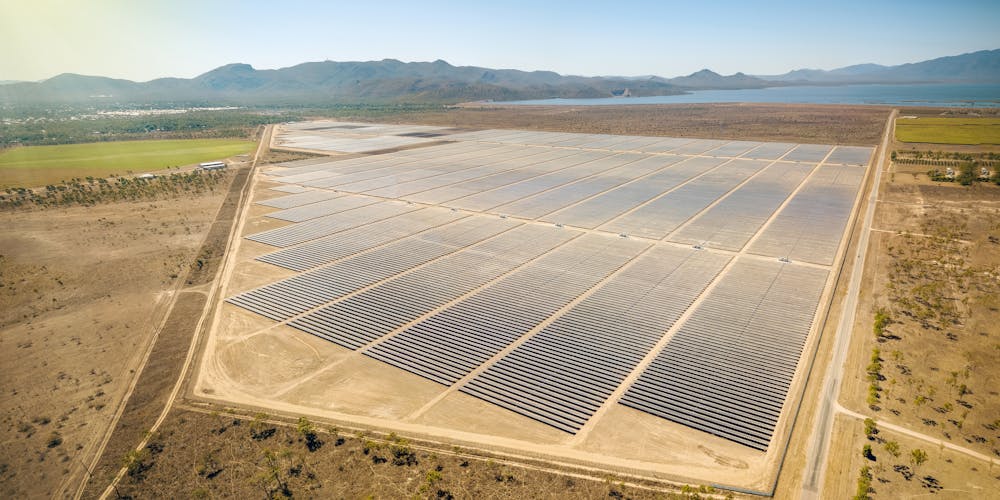 Australia has a wealth of sunlight, giving us huge potential for deploying solar power.
Shutterstock
Australia has a wealth of sunlight, giving us huge potential for deploying solar power.
Shutterstock
Australia’s natural advantage
Not only is the market for renewable energy dramatically improving, Australia also has a natural advantage. Compared with most other developed nations, Australia has excellent solar and wind resources where most people actually live, near the sea.
Australia also has a big head start on installing rooftop solar, solar farms and windfarms, helped along by strong Australian-developed solar technology and political support between 2007 and 2013.
In fact, in 2020 Australia was among the top three global leaders in deploying new renewable energy capacity, alongside the Netherlands and Norway, as the chart below shows. These three nations deployed new renewables per capita at 10 times the global rate, and between three and five times faster than China, Japan, Europe and the USA.
The fastest change in global energy systems in history is underway. Due to their their compelling economic advantage, solar and wind provided three-quarters of new electricity generating capacity worldwide, and 99% of new capacity in Australia, in 2020.
 Data for this chart is from the International Renewable Energy Agency.
Andrew Blakers, Author provided
Data for this chart is from the International Renewable Energy Agency.
Andrew Blakers, Author provided
Cutting further to 100 megatonnes
Reducing emissions to 300 megatonnes in 2030 would place Australia on track to just 100 megatonnes sometime in the 2030s, at low cost. We’d eventually see emissions fully removed from electricity, land transport and heating as, for example, electric vehicles replace retiring older cars and retiring gas heaters are replaced.
It’s also important to note that every year, coal and gas mining releases around 50 megatonnes of “fugitive” methane emissions — leaks from coal mining and gas fracking. But this, too, will vanish in Australia when other countries stop buying Australian coal and gas. Presumably, this will be before 2050 as other countries make good on their promises to decarbonise.
The technology we need to reach 100 megatonnes of emissions is already available at low cost from vast production runs: solar, wind, energy storage (via pumped hydro and batteries), transmission cables, electric vehicles, heat pumps and electric furnaces. Continued research and development will make these costs even lower.
So what’s left over to get to net-zero?
Remaining emissions come from aviation, shipping, industry (cement, chemicals, metals), land clearing and agriculture. These sectors need plenty of research and industrial development to decarbonise, but we have time to do this over the next decade if we halve emissions by 2030.
Given Australia has plenty of land, good wind and much better solar than its rivals, it would be unconscionable for Australia to have a softer emissions target than the US, UK and EU at the Glasgow.
We don’t need new taxes, nor hydrogen, nor carbon capture and storage, nor a “gas-led recovery”. But we do need the federal government to either get involved or get out of the way.
Authors: Andrew Blakers, Professor of Engineering, Australian National University


















